Will My Baby Have Blue Eyes If Both Parents Have Blue Eyes?
Is it a guarantee that two blue-eyed parents will have a blue-eyed baby? Uncover the rare genetic exceptions, modifier genes, and how AI maps baby features.
Will two blue-eyed parents always have a blue-eyed baby?
Almost always — but not with 100% certainty. When both parents have blue eyes, the overwhelming majority of children (about 95–99%) also have blue eyes. In roughly 1 in 100 cases, however, a brown or green-eyed baby appears. Modern genetics explains why the old "two blue-eyed parents can only have a blue-eyed baby" rule is wrong.
The rare exception explained
The one-gene Punnett square (BB, Bb, bb) predicts that two blue-eyed parents (bb × bb) can only produce blue-eyed children. But eye color is polygenic — it depends on at least a dozen genes, not one. OCA2 and HERC2 on chromosome 15 are the primary drivers, but modifier genes like SLC24A4, TYR, IRF4, and SLC45A2 all influence how much melanin actually reaches the iris.
Even when both parents look blue-eyed, one of them may carry a hidden variant that boosts melanin production. If both parents happen to pass a rare melanin-increasing allele, the baby's iris can end up green, hazel, or brown. This is unusual, but well-documented in genetic studies.
What's the actual probability?
- Blue eyes: ~95%
- Green or hazel: ~4%
- Brown: ~1%
Our Baby Eye Color Calculator uses the same distribution based on population-level inheritance studies. Run your own parent combination for an instant estimate.
Why do many blue-eyed babies eventually turn brown?
Almost every newborn is born with eyes that look blue or grey because melanin hasn't yet accumulated in the iris. Over the first year of life, melanocytes in the iris ramp up pigment production. If both parents are truly blue-eyed and carry no hidden melanin-boosting variants, the baby's eyes will stay blue. If a hidden variant is passed on, you might watch the color slowly darken through the first year — sometimes even up to age 3.
Read more in Why a Baby's Permanent Eye Color Takes Months to Settle.
What about grandparents?
Grandparents matter indirectly. Every genetic variant a parent carries came from a grandparent, so a brown-eyed grandparent can pass a hidden melanin-boosting allele through a blue-eyed parent and into the grandchild. This is why blue-eyed families with a mixed heritage still see the occasional brown-eyed baby.
Related reads
- Will my baby have blue eyes if both parents have brown eyes?
- Will my baby have green eyes if one parent has blue and one has brown?
- Baby eye color genetics explained
- Green eye inheritance in multi-ethnic families
Try the calculator or preview your baby visually
For a probability estimate across all parent combinations, use the Baby Eye Color Calculator. For a visual AI preview of your future baby's face — eye color, skin tone, and features — try the BabyMorph AI baby generator.
What our users say
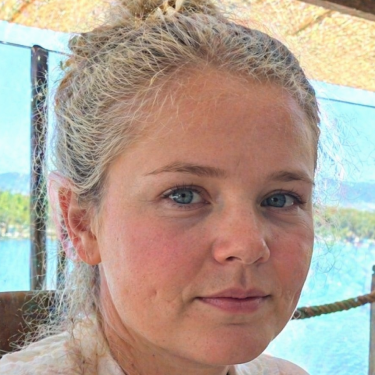
Lena K.
Germany
"We used BabyMorph almost as a joke during my third trimester — something to do on a Sunday afternoon. What came out was a baby girl with very light eyebrows, a wider forehead, and this particular way the nose sits slightly to the left. She was born six weeks later. The eyebrows. The forehead. The nose. Nobody believes it was generated before she arrived."
Their AI baby result
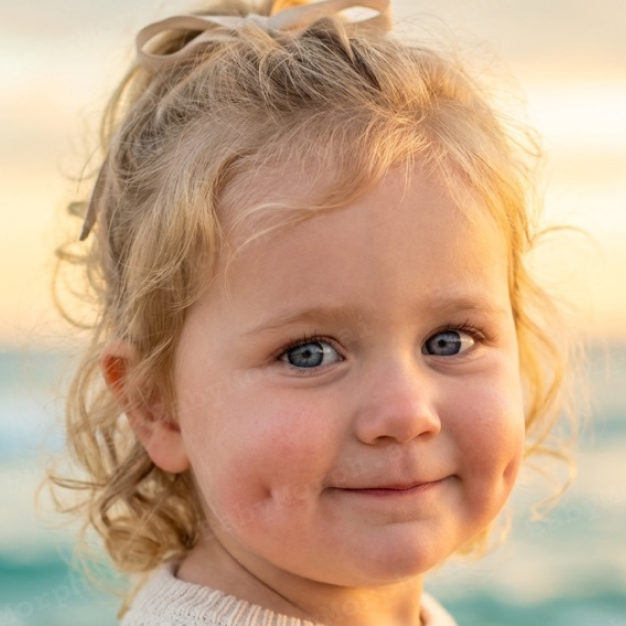

Jason T.
United States
"I have an Asian wife and I've made a habit out of breaking these AI baby tools. Every single one I've tried has completely failed. BabyMorph actually blended her features and mine in a way that made sense — you could see both of us in there without one canceling out the other. People keep asking if it's a real photo."
Their AI baby result
Frequently Asked Questions
Can two blue-eyed parents have a brown-eyed baby?
Yes, in about 1% of cases. Eye color depends on more than one gene, so a hidden melanin-boosting variant carried by a blue-eyed parent can occasionally produce a brown-eyed child.
What percentage of blue-eyed couples have blue-eyed babies?
Roughly 95%. The remaining 4–5% break down into green, hazel, or (rarely) brown, depending on modifier genes both parents happen to carry.
Can two blue-eyed parents have a green-eyed baby?
Yes, about 4% of the time. Green requires medium melanin plus the right combination of modifier genes — occasionally passed through blue-eyed parents who carry hidden variants.
Why do some blue-eyed babies' eyes turn brown later?
Melanin production ramps up during the first 6–12 months of life. If the baby inherited a hidden melanin-boosting allele, the iris can gradually darken from blue to green, hazel, or brown by the first birthday.
Is blue really recessive?
In the simplified model, yes — blue is recessive to brown at the OCA2/HERC2 level. In reality, at least a dozen other genes modify the outcome, which is why simple dominant/recessive rules don't always predict eye color perfectly.
How do genes influence a baby's eye color?
A baby's eye color is determined by a complex interplay of multiple genes, not just one. While OCA2 and HERC2 are primary drivers, other <em>modifier genes</em> like SLC24A4 and TYR influence the amount of melanin produced and deposited in the iris. This polygenic inheritance explains why eye color can sometimes deviate from what simple Mendelian genetics might predict.
When do babies' eyes get their permanent color?
Most babies' eyes settle into their permanent color between 6 to 12 months of age. While many are born with blue or grey eyes due to undeveloped melanin, melanocytes in the iris increase pigment production over the first year. In some cases, eyes can continue to darken slowly up to the age of three as melanin levels stabilize.
Can grandparent eye color affect a baby's eyes?
Yes, grandparent eye color can indirectly influence a baby's eye color. Genetic variants are passed down through generations, so a grandparent with brown eyes, for instance, could pass a hidden melanin-boosting allele to a blue-eyed parent, who then passes it to the grandchild. This is a common reason why diverse family heritages might see unexpected eye colors in offspring, even with blue-eyed parents.