Will My Baby Have Blue Eyes If Parents Have Brown Eyes?
Can two brown-eyed parents have a blue-eyed baby? Learn how HERC2, OCA2, family history and infant development shape eye colour.
Two brown-eyed parents can have a blue-eyed baby, but it is not a simple matter of one “brown gene” overcoming one “blue gene”. Eye colour is shaped by several genes that affect how much melanin the iris produces, where it is deposited, and how light scatters through the iris tissue. Family history can offer useful clues, yet it cannot provide a guaranteed answer before birth.
Why two brown-eyed parents may have a blue-eyed child
The familiar school genetics example describes brown eyes as dominant and blue eyes as recessive. It is a useful starting point, but it is incomplete. In its simplest version, each brown-eyed parent carries one variant associated with brown eyes and one variant associated with blue eyes. If both pass on their blue-associated variant, their child may have blue eyes.
Using this simplified model, two brown-eyed parents who each carry a hidden blue-eye variant would have roughly a 25% chance of a blue-eyed child in each pregnancy. However, real eye-colour inheritance is more complex. Brown eyes do not always mean that a person carries the same combination of pigmentation variants, and blue eyes can arise through more than one genetic route.
It is therefore more accurate to say that blue eyes are possible when both brown-eyed parents have inherited genetic variants that permit low iris melanin in their child. The likelihood is generally higher when blue eyes appear in close relatives, particularly siblings, parents, grandparents, aunts, or uncles.
The key distinction: visible colour versus inherited variants
Your visible eye colour is your phenotype: the result of your genes interacting during development. Your genotype is the collection of gene variants you carry, including variants that may not be visible in your own eyes. A brown-eyed parent may have enough melanin-related variants to produce brown irises while still carrying variants associated with lighter eyes.
This is why two brown-eyed siblings can have children with different eye colours, even when they have children with partners who also have brown eyes. Each child inherits a newly shuffled set of parental DNA.
The genes most strongly linked to blue and brown eyes
Researchers have identified many regions of the genome involved in eye pigmentation. The best-known influence in people of European ancestry lies on chromosome 15, where the HERC2 and OCA2 genes work closely together.
A regulatory region within HERC2 affects how actively OCA2 is used in iris pigment cells. OCA2 helps regulate melanin production and transport. Some HERC2 variants reduce OCA2 activity in the iris, leading to less melanin and making blue or grey eyes more likely. Other variants allow higher OCA2 expression, which is more commonly associated with brown eyes.
Other genes modify this central pathway. These include TYR, which encodes tyrosinase, an enzyme needed for melanin synthesis; TYRP1; SLC24A4; SLC45A2; and IRF4. Their effects can help explain why eye colours range across dark brown, light brown, hazel, green, grey, and blue rather than falling into two neat categories.
Genes such as MC1R are better known for their role in red hair and skin pigmentation, but pigmentation pathways overlap. EDAR, PAX3, and RUNX2 are relevant to aspects of facial, hair, and craniofacial development rather than being primary determinants of iris colour. In practice, no single gene can accurately describe a child’s complete appearance.
| Family pattern | What it can suggest | What it cannot prove |
|---|---|---|
| Both parents have brown eyes; blue-eyed relatives on both sides | Both parents may carry lower-melanin iris variants | That a child will definitely have blue eyes |
| Both parents have brown eyes; no known blue-eyed relatives | A blue-eyed child is less obviously supported by family history | That blue eyes are impossible |
| One parent has blue eyes and one has brown eyes | The brown-eyed parent’s inherited variants become particularly important | A fixed 50:50 outcome |
| Parents have hazel, green, or amber eyes | Intermediate pigmentation patterns may be present | A simple dominant/recessive prediction |
What brown eyes can hide genetically
Brown irises contain more eumelanin, the dark brown-black form of melanin, than blue irises. The actual shade can vary considerably: very dark brown eyes, warm chestnut eyes, golden brown eyes, and light brown eyes may all be described as “brown”, although their underlying pigmentation patterns are not identical.
A parent with light brown or hazel eyes may have a different combination of pigment-related variants from a parent with very dark brown eyes. This does not mean that lighter brown eyes automatically make blue-eyed children more likely. It simply shows why visible categories are imperfect genetic labels.
Several features make family predictions less certain:
- Relatives’ eye colours may be remembered inaccurately, especially hazel, grey, and green eyes.
- Eye colour can look different under daylight, indoor lighting, and in photographs.
- Parents can carry variants inherited from earlier generations without displaying blue eyes themselves.
- Many small-effect genes influence the final amount and distribution of iris pigment.
- Population ancestry changes how informative common European HERC2/OCA2 patterns are for a particular family.
In families with mixed ancestry, the conventional blue-versus-brown chart is especially limited. Genetic studies of eye colour have historically been strongest in European populations, and the same marker may not carry identical predictive value across all ancestral backgrounds.
When a child’s eye colour becomes visible
Eye colour at birth is not always the final colour. The iris often contains relatively little melanin in newborns, particularly in babies with lighter skin pigmentation. As pigment cells become more active after birth, the eyes may darken or develop a more mixed appearance.
| Child’s age | Typical eye-colour changes | How reliable the visible colour is |
|---|---|---|
| Birth to 3 months | Many eyes appear blue-grey, slate, or dark grey; lighting can be misleading | Usually too early for confidence |
| 3 to 6 months | Melanin production may begin to make brown, hazel, green, or darker grey tones clearer | Useful early indication, but change remains possible |
| 6 to 12 months | Most major colour shifts have become apparent | Often fairly informative |
| 1 to 3 years | Subtle darkening or hazel/green patterning can continue | Usually close to the settled colour |
| Age 3, 6, 10, and 18 | Colour commonly remains stable, though perceived shade varies with light and iris details mature | Stable for most children, not absolutely unchanged |
For age-based facial renderings, eye colour at age 3 is generally a more meaningful estimate than newborn eye colour. At ages 6, 10, and 18, the main visual differences usually come from facial proportions, eyelids, brow shape, skin tone, and lighting rather than a major biological change in iris colour.
Blue, grey, green, and hazel are not interchangeable
Blue eyes are not blue because the iris contains blue pigment. Instead, low melanin allows light scattering within the front layers of the iris, producing a blue appearance. Grey eyes also usually contain low pigment, but their collagen structure and light scattering can create a less saturated, silvery effect.
Green and hazel eyes are more difficult to predict. They often reflect moderate pigment levels combined with uneven pigment distribution. Hazel eyes may look green in one setting and brown or gold in another because the centre and outer iris contain different amounts of melanin. A child genetically inclined towards lighter eyes may therefore develop blue, grey, green, or hazel rather than a clearly defined shade predicted from a family photograph.
What an evidence-based prediction can and cannot say
A careful prediction uses both parents’ visible traits and, where available, wider family patterns. It can identify plausible outcomes and rank them by likelihood. For example, two brown-eyed parents with blue-eyed parents or siblings have a more credible pathway to a blue-eyed child than two brown-eyed parents from families in which lighter eyes have never been observed.
However, a photograph cannot reveal all inherited variants, and even direct genetic information does not produce certainty for every eye colour category. The most responsible approach is probabilistic: blue eyes may be possible, perhaps more or less likely depending on known relatives, but not guaranteed by a single feature in either parent.
Frequently asked questions
Can two dark-brown-eyed parents have a blue-eyed baby?
Yes. It is biologically possible if both parents carry combinations of variants associated with lower iris melanin and the child inherits the relevant combination. It may be less likely when both parents and their close relatives consistently have very dark eyes, but family appearance alone cannot rule it out.
If my parents both have brown eyes but I have blue eyes, is that normal?
Yes. This is a well-recognised outcome of multi-gene inheritance. It can occur when your parents each carry lighter-eye-associated variants that are not apparent in their own brown eyes. It does not, by itself, indicate anything unusual about parentage or health.
Will my baby’s blue-grey newborn eyes stay blue?
Not necessarily. Many babies’ eyes appear blue-grey in the first months because the iris has not yet produced its longer-term melanin level. Changes are most noticeable between about 3 and 12 months, although subtle shifts can continue until around age 3.
Does eye colour affect eyesight?
Ordinary blue, brown, hazel, green, and grey eye colours do not determine visual acuity. Very light pigmentation can be relevant in rare conditions such as albinism, which involves broader pigment and vision differences. A child with unusual light sensitivity, involuntary eye movements, or concerns about vision should be assessed by an optometrist or paediatric eye specialist.
What our users say
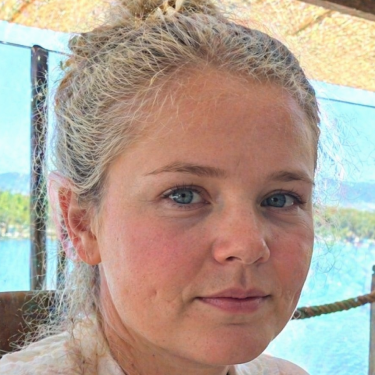
Lena K.
Germany
"We used BabyMorph almost as a joke during my third trimester — something to do on a Sunday afternoon. What came out was a baby girl with very light eyebrows, a wider forehead, and this particular way the nose sits slightly to the left. She was born six weeks later. The eyebrows. The forehead. The nose. Nobody believes it was generated before she arrived."
Their AI baby result
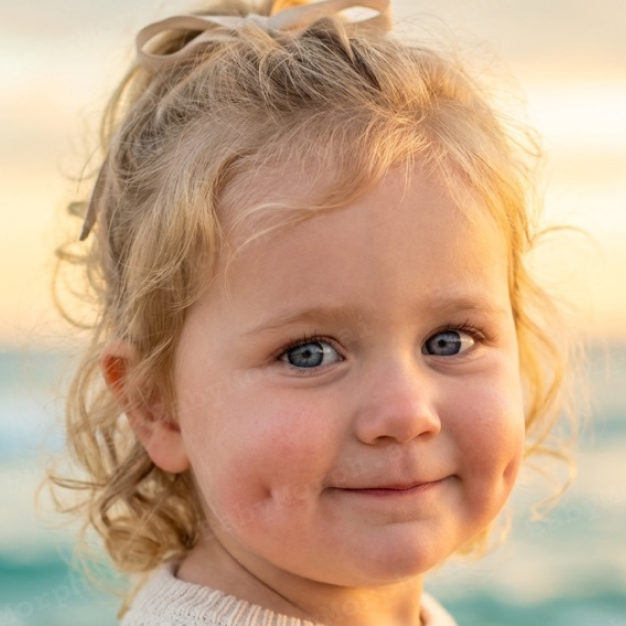

Jason T.
United States
"I have an Asian wife and I've made a habit out of breaking these AI baby tools. Every single one I've tried has completely failed. BabyMorph actually blended her features and mine in a way that made sense — you could see both of us in there without one canceling out the other. People keep asking if it's a real photo."
Their AI baby result
Frequently Asked Questions
What are the chances of brown-eyed parents having a blue-eyed baby?
If both parents carry the recessive blue-eye gene, there is roughly a 25% (1 in 4) chance that the baby will have blue eyes.
When can you tell a baby's permanent eye color?
Most babies are born with blue or grey eyes. The permanent color usually settles between 6 and 12 months as melanin develops.
Can two parents with brown eyes have a child with blue eyes?
Yes, two brown-eyed parents can have a blue-eyed child, especially if both parents carry genetic variants associated with lower iris melanin. While brown eyes are often considered dominant, eye color inheritance is complex, involving multiple genes. The likelihood increases if blue eyes are present in close relatives on both sides of the family.
What genes determine a baby's eye color?
Several genes determine a baby's eye color, with <em>HERC2</em> and <em>OCA2</em> on chromosome 15 being the most influential for blue and brown eyes in people of European ancestry. <em>HERC2</em> regulates <em>OCA2</em> activity, which affects melanin production. Other genes like <em>TYR</em>, <em>TYRP1</em>, and <em>SLC24A4</em> also play a role, contributing to the wide spectrum of eye colors.
How does family history influence a baby's eye color?
Family history offers valuable clues, but no guarantees, regarding a baby's eye color. If blue eyes appear in close relatives like siblings, parents, or grandparents, it suggests that the brown-eyed parents may carry variants for lighter eyes. However, the exact combination of inherited genes is unique to each child, so past patterns don't predict with certainty.
Why do some brown-eyed people carry blue eye genes?
Brown-eyed individuals can carry 'blue eye genes' because their visible eye color (phenotype) results from the interaction of multiple genes during development, while their genotype includes all gene variants they possess. A brown-eyed parent might have enough melanin-producing variants to show brown eyes, yet still carry other variants associated with lighter eye colors that can be passed to their offspring.
Can an AI baby generator predict my baby's eye color?
An AI baby generator like BabyMorph can offer predictions for your baby's eye color based on complex algorithms that analyze parental photos and genetic probabilities. While these tools provide fascinating insights into potential appearances, they offer estimations rather than medical or genetic certainties. Eye color inheritance is intricate and influenced by many factors.
Do different shades of brown eyes affect a child's eye color?
Different shades of brown eyes, from very dark to light brown or hazel, indicate varying underlying pigment patterns and genetic combinations. A parent with lighter brown or hazel eyes might have a different mix of pigment-related variants than one with very dark brown eyes. While this doesn't automatically increase the likelihood of blue-eyed children, it highlights the complexity of genetic inheritance beyond simple categories.