Will My Baby Have Green Eyes If Both Parents Do?
Two green-eyed parents may have a green-eyed child, but hazel, blue and brown remain possible. Learn the genetics and eye-colour timeline.
Two green-eyed parents are more likely than average to have a green-eyed child, but green is not a single-gene trait with a guaranteed outcome. Eye colour depends on how much melanin is deposited in the iris, how that pigment is distributed, and how light scatters through the iris tissue. A child of two green-eyed parents may have green eyes, but hazel, blue or brown eyes are all biologically plausible.
Why green eyes do not follow a simple inheritance rule
Green eyes are among the least common natural eye colours globally. They usually arise from a relatively low to intermediate amount of eumelanin, the brown-black form of melanin, in the front layers of the iris. Unlike brown eyes, which contain more visible melanin, green irises owe much of their appearance to light scattering through a lightly pigmented iris combined with a small amount of yellow-brown pigment.
The familiar school genetics model treats brown as dominant and blue as recessive. It can illustrate a basic principle, but it is too limited to explain green eyes reliably. Eye colour is polygenic: many genetic variants contribute small or moderate effects, and their combination determines the final pigment level.
The major eye-colour region: HERC2 and OCA2
The best-established genetic influence lies on chromosome 15, in and around the HERC2 and OCA2 genes. A regulatory variant in HERC2, often described as rs12913832, affects the activity of OCA2. The OCA2 protein helps regulate melanin production in melanocytes, the pigment-making cells found in the iris.
Variants associated with lower OCA2 activity are strongly associated with blue eyes, especially in people with European ancestry. However, green eyes often occur in people whose inherited variants produce a middle range of iris pigmentation rather than the very low pigment level more typical of blue eyes. This is why two people who both appear green-eyed can carry different collections of variants affecting their child’s eye colour.
Other loci also matter. Variants near TYR, TYRP1, SLC24A4, IRF4 and ASIP have associations with pigmentation and eye-colour variation. These genes influence melanin synthesis, transport, type and regulation. Their individual effects are usually not enough to determine eye colour alone.
What are the likely eye-colour outcomes?
There is no clinically validated universal percentage that applies to every green-eyed couple. Ancestry, extended family history and the specific variants each parent carries all change the odds. Still, looking at relatives gives useful context. If both parents have clear green eyes and both families contain many green- or blue-eyed relatives, a lighter-eyed child is more likely than if either family includes numerous brown-eyed close relatives.
| Family pattern | More plausible child outcomes | Why the result can vary |
|---|---|---|
| Both parents green-eyed; many blue or green eyes among grandparents and siblings | Green, blue and grey are relatively plausible; hazel is also possible | The family may carry several variants linked with lower iris melanin, but the exact combination is reshuffled in each child. |
| Both parents green-eyed; brown or hazel eyes common in close relatives | Green and hazel remain likely possibilities; brown is possible | Both parents may carry pigmentation variants associated with higher melanin expression. |
| One or both parents describe their eyes as green-hazel | Hazel, green, brown and occasionally blue | Hazel is especially variable and may look greener or browner under different lighting conditions. |
| Both parents have green eyes but have different ancestral backgrounds | A broad range, including green, hazel and brown | Similar visible eye colour can result from different genetic pathways and pigment distributions. |
A brown-eyed child is therefore not evidence that anything unusual has happened. It can result when the child inherits enough variants promoting greater iris melanin production. Equally, blue eyes can occur when the inherited combination produces very low melanin in the anterior iris. Siblings can have noticeably different eye colours because each conception involves a new combination of parental DNA.
Green versus hazel: an important distinction
Many predictions become less certain because “green” and “hazel” are used interchangeably. Green eyes tend to look fairly uniform green or grey-green across the iris. Hazel eyes often have a golden, amber or brown ring around the pupil, with greener outer areas. Iris colour also changes in photographs according to daylight, flash, clothing and white balance.
For family assessment or an AI image input, it is best to use a clear photograph taken in indirect natural light. Identify the dominant iris colour rather than a reflection or a small central ring. This does not reveal genotype, but it reduces a common source of error in visual comparisons.
How iris colour develops after birth
Eye colour at birth is provisional for many babies. Melanocytes are already present in the iris before birth, but their melanin output may increase after exposure to light and through early developmental signalling. A newborn’s blue-grey appearance does not necessarily indicate genetically blue eyes.
| Child’s age | What may be visible in the iris | How dependable the apparent colour is |
|---|---|---|
| Birth to 6 months | Often blue-grey, slate or darkening brown; colour can shift rapidly | Low |
| 6 to 12 months | Early green, hazel or brown tones may emerge as iris pigment increases | Moderate |
| 1 to 3 years | Most children show their recognisable eye-colour family | Reasonably high, though subtle changes remain possible |
| Age 3 | Green versus hazel is usually much easier to judge | High for broad colour category |
| Ages 6, 10 and 18 | Usually stable colour, with changes in perceived brightness and flecks | High, but photographs still alter appearance |
By the age of 3, the age used in many child-face visualisations, eye colour is usually sufficiently established for a realistic broad rendering. At ages 6, 10 and 18, the principal colour generally remains stable. What may change is the visibility of amber flecks, a darker limbal ring at the iris edge, or the way green appears under different lighting.
What an image-based prediction can and cannot infer
A facial image can capture visible parental traits such as apparent iris shade, iris contrast, facial pigmentation and overall colouring. It can use those visual cues to create a coherent possible representation of a child at a chosen age. It cannot directly read the parents’ DNA, identify the rs12913832 variant in HERC2, or determine which alleles will be passed to a particular child.
This distinction matters most for green eyes because they sit between low- and high-pigment outcomes. A sensible visual prediction should treat green as a plausible outcome when both parents are green-eyed, rather than implying certainty. It should also allow for natural variation: one child might have soft grey-green irises, another more golden green, and a sibling may be hazel.
- Use well-lit, forward-facing parent photographs where both irises are visible.
- Consider close relatives, especially full siblings and grandparents, when thinking about likely colour range.
- Separate true green from green-hazel where possible.
- Expect broad eye-colour prediction to be more reliable than an exact shade, fleck pattern or limbal ring.
- Remember that eye colour is independent of a child’s health, personality and visual ability in the usual case.
When eye colour needs medical attention
Most variation in eye colour is normal. However, a newly developing difference in colour between the two eyes, a white pupil in photographs, marked light sensitivity, cloudiness or an apparently enlarged eye should be discussed promptly with a GP, health visitor, optometrist or paediatric eye specialist. These signs are not explained by ordinary inherited green, blue or brown variation.
Rare pigment conditions can affect eye and hair pigmentation. For example, changes in genes such as TYR can be involved in forms of albinism, which may affect vision as well as colouring. This is distinct from the ordinary polygenic differences that produce green eyes in otherwise healthy families.
Frequently asked questions
Will two green-eyed parents definitely have a green-eyed baby?
No. Green is a common outcome to consider, but not a certainty. Depending on inherited variants and family history, the child may have green, hazel, blue, grey or brown eyes. Two visibly green-eyed parents can each carry variants that increase iris melanin in their child.
Can two green-eyed parents have a brown-eyed child?
Yes. Brown eyes can occur if the child inherits a combination of variants that leads to higher melanin deposition in the iris. The simple brown-dominant, blue-recessive model does not account adequately for the genetics of green and hazel eyes.
At what age will I know whether my child has green eyes?
Many children show a recognisable direction by 6 to 12 months, but colour may continue changing through the second and sometimes third year. By age 3, the broad category of green, hazel, blue or brown is usually established.
Do green eyes become darker with age?
They can appear to change in early childhood as pigment production settles. After childhood, the underlying colour is usually stable, although green eyes can look lighter, greyer or more golden with lighting, pupil size, clothing and photography conditions.
Punnett square: two green-eyed parents
Eye colour is polygenic, but a simplified two-locus model explains most outcomes. Green-eyed parents are usually bb at the main brown locus and carry one green allele each (Gg).
| Parent 2: G | Parent 2: g | |
|---|---|---|
| Parent 1: G | GG — green | Gg — green |
| Parent 1: g | Gg — green | gg — blue |
Estimated outcome: roughly 75% green or green-hazel, roughly 25% blue, and brown in under 5% of cases when a hidden brown allele is present in one family line.
Curious about your own pairing? Run it through the Baby Eye Color Calculator.
What our users say
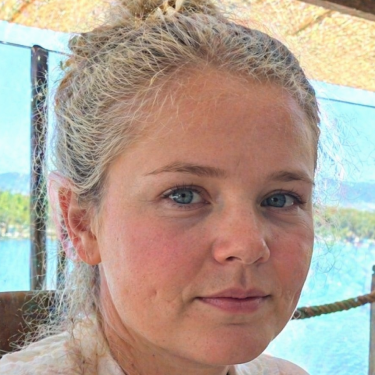
Lena K.
Germany
"We used BabyMorph almost as a joke during my third trimester — something to do on a Sunday afternoon. What came out was a baby girl with very light eyebrows, a wider forehead, and this particular way the nose sits slightly to the left. She was born six weeks later. The eyebrows. The forehead. The nose. Nobody believes it was generated before she arrived."
Their AI baby result
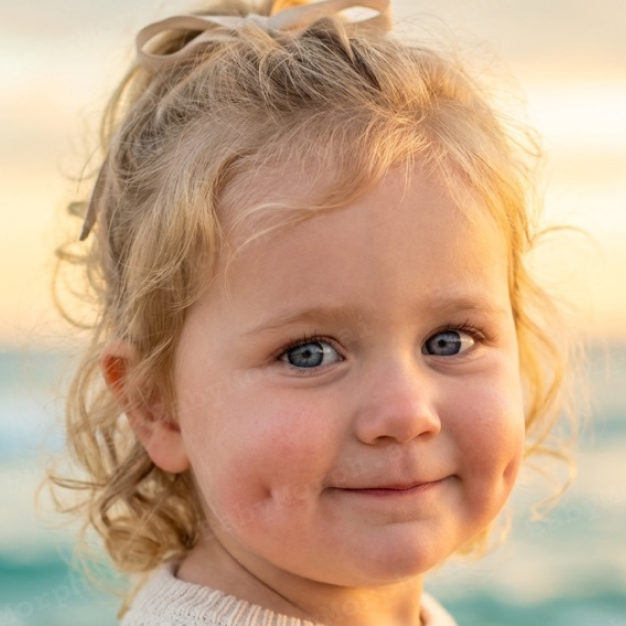

Jason T.
United States
"I have an Asian wife and I've made a habit out of breaking these AI baby tools. Every single one I've tried has completely failed. BabyMorph actually blended her features and mine in a way that made sense — you could see both of us in there without one canceling out the other. People keep asking if it's a real photo."
Their AI baby result
Frequently Asked Questions
Can two green-eyed parents have a blue-eyed baby?
Yes. Green-eyed individuals typically carry recessive blue eye traits, giving the child roughly a 25% chance of inheriting blue eyes.
How rare are green eyes globally?
Green eyes are exceptionally rare, accounting for only about 2% of the world's population, mostly concentrated in Northern and Central Europe.
What determines a child's eye colour inheritance?
A child's eye colour is determined by multiple genes, not just one simple dominant/recessive pair. The HERC2 and OCA2 genes on chromosome 15 are major contributors, regulating melanin production in the iris. Other genes like TYR, TYRP1, and IRF4 also play a role, influencing melanin synthesis and distribution. This complex interplay explains why two green-eyed parents can have children with blue, hazel, or even brown eyes.
Why don't green eyes follow simple inheritance rules?
Green eyes do not follow simple Mendelian inheritance rules because eye colour is a polygenic trait, meaning many genes contribute to the final outcome. Unlike the oversimplified brown-dominant, blue-recessive model, green eyes result from a moderate amount of melanin and specific light scattering in the iris. This complexity means that even if both parents have green eyes, they may carry different genetic variants that can lead to a wider range of eye colours in their children.
When does a baby's eye colour become permanent?
A baby's eye colour typically becomes more stable and recognizable by the age of 3, though subtle changes can continue. At birth, many babies have blue-grey eyes, which is provisional. Melanocytes in the iris increase melanin production over the first few years due to light exposure and development. While early green or hazel tones might emerge from 6 to 12 months, the colour seen at age 3 is usually a good indicator of the child's permanent eye colour.
Can green-eyed parents have a brown-eyed child?
Yes, it is biologically plausible for green-eyed parents to have a brown-eyed child. Although less common, both parents can carry genetic variants associated with higher melanin expression. If the child inherits enough of these variants, their iris may produce more melanin, resulting in brown eyes. This is particularly true if brown or hazel eyes are common in the family's broader genetic history or if the parents have diverse ancestral backgrounds, even if their own eyes are green.
What is the difference between green and hazel eyes?
The distinction between green and hazel eyes lies in their appearance and pigment distribution. Green eyes tend to be a fairly uniform green or grey-green across the iris. Hazel eyes, however, often feature a golden, amber, or brown ring around the pupil with greener outer areas, making them appear more variable. When using BabyMorph for predictions, it's best to provide clear photos in natural light and identify the dominant iris colour to avoid misinterpretation.
How accurate are eye colour predictions for children?
Predicting eye colour for children can be complex due to the polygenic nature of the trait. While tools like BabyMorph can offer plausible outcomes based on parental features, there's no guaranteed certainty. Ancestry, extended family history, and the specific genetic variants each parent carries all influence the odds. The visible eye colour of the parents is just one piece of the puzzle; the underlying genetic makeup, especially for traits like green eyes, means a range of outcomes is always possible.
What are the exact odds of green eyes if both parents have green eyes?
Using the simplified two-locus model, about 75% of children of two green-eyed parents have green or green-hazel eyes and about 25% have blue eyes. Brown eyes stay possible but uncommon, because a green-eyed parent can still carry an unexpressed brown allele from a grandparent.
Can two green-eyed parents have a brown-eyed baby?
Yes, though it is rare. Green eyes usually mean no strong brown-pigment allele is expressed, but additional pigment genes such as those near HERC2, OCA2, SLC24A4 and TYR can combine to push a child's iris toward light brown or deep hazel.