How Accurate Is an AI Baby Generator?
What AI baby generators get right, what they cannot predict, and how close BabyMorph results really are to real newborn faces.
How accurate is an AI baby generator, really?
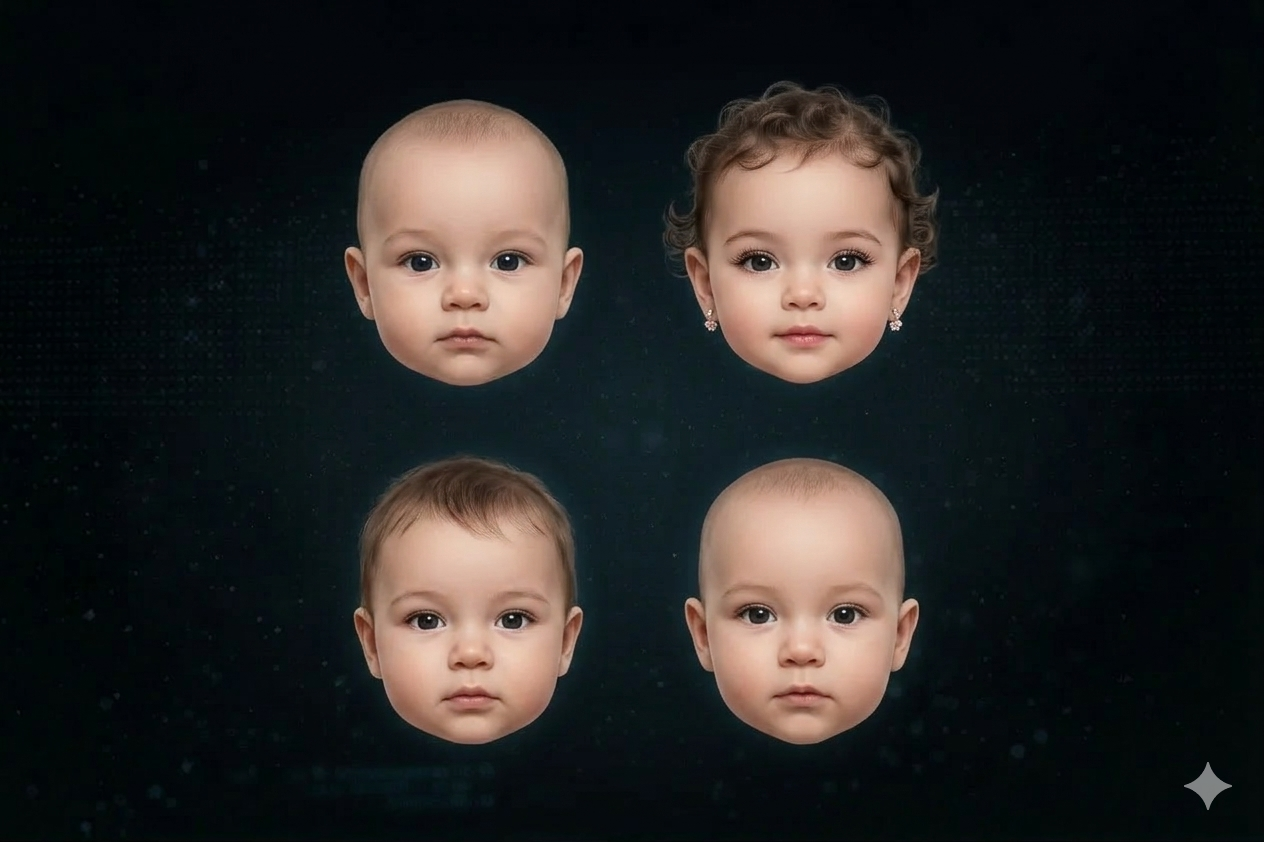
The honest answer: AI baby generators are visually convincing but not scientifically predictive. They produce a plausible face that could be your child based on parental features — not a guarantee of what your child will look like. Understanding the difference is the key to using these tools well.
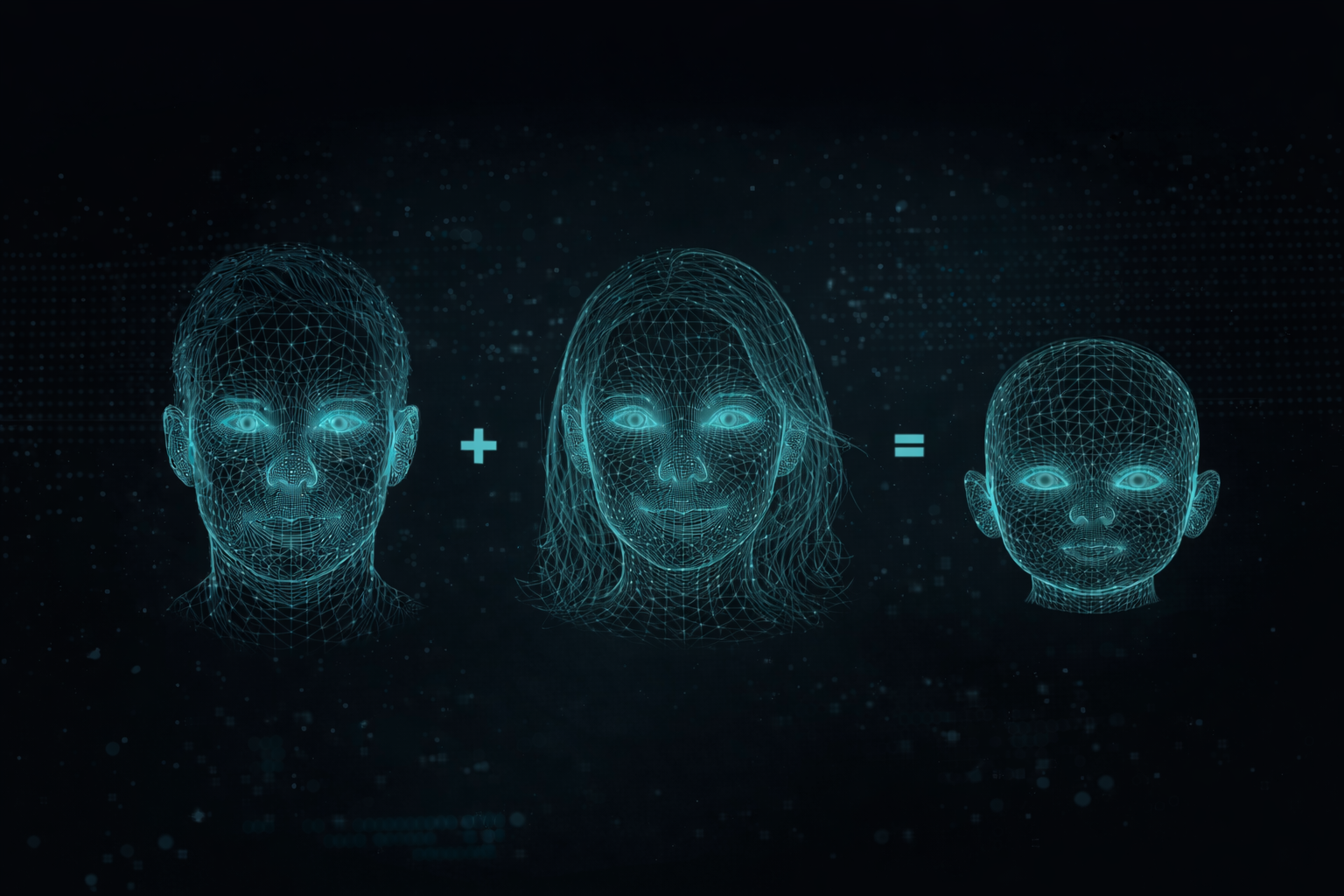
Modern generators like BabyMorph use diffusion models trained on millions of parent–child photo pairs. They accurately capture inherited features that show up in the majority of children: face shape, skin tone, hair color, nose bridge, and general eye shape. What they cannot predict is the ~50% of your baby's genome that comes from recessive alleles, random recombination, and the specific gene combinations you don't even know you carry.
What AI baby generators do well
- Dominant features: traits like brown eyes, dark hair, and darker skin tones are usually inherited faithfully, and generators reproduce them accurately.
- Facial architecture: midface width, jawline, chin shape, and forehead proportions all follow polygenic inheritance patterns the models have learned.
- Skin tone blending: mixed-heritage pairings produce children with intermediate melanin levels, and modern generators nail this within a couple of shades.
- Ethnic blending: the best generators (including BabyMorph) preserve East Asian midface prominence, Afro-Caribbean nasal structure, and other population-specific traits in mixed families rather than defaulting to a generic average face.
What AI baby generators can't predict
- Recessive surprises: two brown-eyed parents can have a blue-eyed baby. Two straight-haired parents can have a curly-haired baby. A generator won't guess these outcomes because they depend on hidden alleles.
- Random genetic recombination: even siblings from the same parents can look very different. A single AI image cannot capture that natural variation range.
- Health conditions and syndromes: AI generators are cosmetic previews, not medical tools. They cannot detect or predict any inherited condition.
- Post-natal changes: hair color can darken until age 2, eye color usually stabilizes between 6–12 months, and facial architecture keeps developing through puberty.
How accurate is BabyMorph specifically?
User reports consistently note that BabyMorph gets 3 to 4 major features right — usually eye shape, nose bridge, hair color, and skin tone — when compared to the actual baby that's born later. Exact-match predictions (a photo indistinguishable from the real newborn) happen for a small percentage of users, typically when parents have strong dominant features that are easy for the model to blend.
What sets BabyMorph apart is its handling of mixed-race families and its variation between generations (the model injects a small diversity nudge each time so users don't get identical faces). This matches real biology, where siblings differ even with identical parents.
How to get the most accurate result
- Upload clear, front-facing photos of both parents. Good lighting and a neutral expression let the AI capture bone structure and pigment accurately.
- Try multiple age options — a baby, a 10-year-old, and an 18-year-old give a fuller picture because different features mature at different ages.
- Generate several variations if your plan allows. The genetic lottery is wide, and multiple outputs represent that range better than a single image.
- Combine with a probability tool like our Baby Eye Color Calculator for a data-backed estimate of specific traits like eye color.
Why some AI baby generators fail
Cheap or older AI baby tools fail for one of three reasons: they average parent faces (giving a bland composite), they lose ethnic features (defaulting to a Western-looking baby regardless of input), or they overweight one parent's contribution (making the baby a copy of the mother or father). BabyMorph is engineered to avoid all three: opposite-gender parent contribution is enforced, mixed-race blending is preserved, and per-generation variation prevents copy-paste outputs.
Reddit and social media reports
User reviews on Reddit, TikTok, and parenting forums generally place modern AI baby generators in the "surprisingly close on 2–4 features" bucket. The most common feedback: the AI predicted eye color and hair color correctly, but the exact face shape only became clear as the baby grew. This matches what the science predicts — pigment traits are easier to model than complex craniofacial geometry.
Try it and see
The best way to judge accuracy is to try it yourself. The BabyMorph AI baby generator generates a full preview from two parent photos in seconds. For a probability-based estimate of eye color specifically, run our Baby Eye Color Calculator. Browse more genetics deep-dives on the BabyMorph blog.
Frequently Asked Questions
How accurate is AI baby generator?
AI baby generators are visually plausible but not scientifically predictive. They reliably capture dominant inherited traits like eye color, hair color, skin tone, and general face shape, but they can't predict recessive outcomes (like a blue-eyed baby from two brown-eyed parents) or random genetic recombination.
Are AI baby generators real or fake?
The images are real AI-generated photos — not fake in the sense of being stock images — but they represent one plausible outcome from your parental DNA, not a guaranteed prediction. Think of them as a well-informed guess based on millions of parent–child photo pairs.
Can AI predict what my baby will look like?
Partially. AI can predict features driven by dominant genes (~50–60% of visible traits) with reasonable accuracy. It cannot predict traits controlled by hidden recessive alleles or random recombination, which is why real siblings from the same parents often look quite different.
Which AI baby generator is most accurate?
Accuracy depends on how the model handles mixed-race families, ethnic features, and per-generation variation. <strong>BabyMorph</strong> is specifically engineered to preserve East Asian, African, and other population-specific features rather than defaulting to a Western average face.
Why do AI baby generators sometimes get eye color wrong?
Eye color is polygenic and depends on hidden variants both parents may carry. A generator can predict the most likely outcome but can't detect a rare modifier gene. For a probability breakdown across all parent combinations, use a dedicated calculator like ours.
Do AI baby predictions match real babies later?
User reports consistently mention 3–4 features matching the actual newborn — usually pigment traits (eye color, hair color, skin tone) plus one facial feature like the nose bridge or eye shape. Exact-match predictions are rare because facial architecture keeps developing after birth.
What information does an AI baby generator use?
AI baby generators use photos of both parents to analyze facial architecture, skin tone, hair color, and eye shape. They are trained on millions of parent-child image pairs to learn how these features are commonly inherited. The AI then blends and modifies these parental traits to generate a plausible image of a child.
How can I improve AI baby generator accuracy?
To get the most accurate results, use clear, front-facing photos of both parents with good lighting and neutral expressions. Generating multiple variations can also provide a broader range of possible outcomes, as human genetics inherently allow for significant natural variation even among siblings. Combining with a probability tool for specific traits like eye color can also be helpful.