Will My Baby Have Hazel Eyes? Hazel + Brown Parents
Learn how hazel and brown eye colour is inherited, which genes matter, and when your child’s iris shade may become clear.
Hazel eyes are often described as a blend of brown, green and gold, but genetically they are not a simple halfway point between brown and blue. If one parent has hazel eyes and the other brown, a child may have brown, hazel, greenish-hazel or, less commonly, blue-grey eyes depending on the wider family pattern. The outcome reflects many genes influencing iris pigment, pigment distribution and how light scatters through the iris.
What makes an eye colour hazel?
Hazel is a visible iris pattern rather than a single, neatly defined pigment category. Most hazel irises have a moderate amount of eumelanin, the dark brown-black pigment also involved in skin and hair colour. The pigment is often concentrated closer to the pupil, producing a warm amber or brown centre, while the outer iris appears green, olive, grey-green or golden in different lighting.
Unlike true blue eyes, which have very little melanin in the front layers of the iris, hazel eyes usually contain enough pigment to look brown in dim light or from a distance. Their greener appearance arises partly from light scattering in the iris stroma, the fibrous tissue beneath the surface. This is why hazel eyes can appear to change colour with clothing, daylight, pupil size and photographs. The iris itself is not rapidly making new green or brown pigment in response to a shirt; rather, the balance of reflected and scattered light changes.
Hazel eyes, central heterochromia and amber eyes
These appearances are commonly confused. Central heterochromia means the inner ring around the pupil is a distinctly different colour from the outer iris, such as a copper-brown centre with a blue-green edge. It may occur in hazel eyes, but not all hazel eyes show a sharply defined ring. Amber eyes are more uniformly golden, yellow-brown or copper coloured, with less green at the iris edge. A brown iris may also have gold flecks without being genetically or visually classified as hazel.
The genetics behind hazel and brown eyes
The old classroom model of brown as “dominant” and blue as “recessive” is useful only as a very rough introduction. Brown eyes are often associated with higher melanin production, and brown can be common in families, but eye colour does not follow one dominant gene. Hazel is particularly difficult to predict because it depends on pigment quantity and pigment patterning.
The best-studied region for common European eye-colour variation is on chromosome 15. Variants in HERC2 influence the activity of the nearby OCA2 gene in iris cells. OCA2 helps regulate melanin production and transport. Certain HERC2 variants reduce OCA2 expression and are strongly associated with blue eyes, while variants allowing greater OCA2 activity are more often associated with brown or hazel eyes.
However, OCA2 and HERC2 are not the whole story. Genes such as TYR, which encodes tyrosinase, affect a key step in melanin synthesis. SLC24A4, SLC45A2 and IRF4 are also linked with pigmentation variation in population studies. MC1R is better known for red hair and freckling, but can contribute to the broader balance of eumelanin and pheomelanin. The genetic architecture differs among ancestral populations, so a prediction model based only on Northern European blue-versus-brown markers is incomplete for many families.
Genes shape the biological range, but they do not provide a reliable at-home percentage for “hazel versus brown”. A parent’s visible eye colour is a useful clue, yet it does not reveal all the variants they carry. Grandparents, siblings, aunts and uncles can provide meaningful context, especially where blue, green or grey eyes recur on either side.
What a hazel-eyed and brown-eyed pair may pass on
A hazel-eyed parent and a brown-eyed parent are more likely to have a child with a medium-to-high melanin iris phenotype than two blue-eyed parents. In practical terms, brown and hazel are plausible outcomes. Greenish-hazel can also occur, particularly if either family has green, grey or blue-eyed relatives. A blue-eyed child is possible when both parents carry combinations associated with low iris melanin, but it is generally less likely when both parents visibly have brown-spectrum eyes.
| Family pattern | More plausible child outcomes | What it can suggest |
|---|---|---|
| Hazel parent and brown parent; few light eyes in relatives | Brown, dark hazel, amber-brown | Higher-pigment iris variants may be common in both families |
| Hazel parent and brown parent; blue or grey eyes on both sides | Brown, hazel, greenish-hazel; blue-grey remains possible | Both parents may carry variants linked to reduced iris melanin |
| Hazel parent with obvious green outer iris; brown parent with light-brown eyes | Hazel, light brown, greenish-hazel | Moderate pigmentation and iris patterning may be more likely |
| Very dark brown parent and hazel parent | Brown or hazel, with a wide range of shade | Visible shade alone cannot identify the underlying gene variants |
It is important not to treat this table as a probability calculator. Two brown-eyed parents can have a blue-eyed child, and a hazel-eyed parent can have a child with a much darker brown iris. These are ordinary outcomes of multiple inherited variants combining in a new way, not evidence that eye colour has been inherited incorrectly.
Why relatives matter more than one eye-colour label
“Brown” covers a large spectrum, from almost black-brown to honey brown. “Hazel” is similarly broad. Looking at family photographs in neutral daylight may reveal patterns that a single label misses:
- Whether either parent had noticeably lighter eyes in childhood.
- Whether blue, grey, green or hazel eyes occur in grandparents and siblings.
- Whether the hazel parent has a brown centre with green edges, or a mainly golden iris.
- Whether the brown-eyed parent has amber, olive or green flecks.
- Whether ancestry includes populations in which eye-colour variants are less represented by standard European genetic studies.
When hazel or brown eyes become visible
Newborn eye colour is a poor guide to the final result. Many babies, particularly those with lighter skin pigmentation, initially have blue-grey or slate-coloured eyes because relatively little melanin is present in the iris at birth. Melanocytes are already there; their pigment production and distribution continue after birth. Babies with darker initial eyes may also develop lighter flecks or warmer tones over time.
| Age | Typical iris changes | How useful the colour is for prediction |
|---|---|---|
| Birth to 6 months | Blue-grey, dark grey or brownish eyes may all shift as melanin production increases. | Low; an early colour is not necessarily final. |
| 6 to 12 months | Brown or hazel undertones often become clearer; some eyes continue to darken. | Moderate, but change remains common. |
| 1 to 3 years | Most children have a recognisable stable colour; hazel rings and green edges may emerge gradually. | Good for broad colour, less certain for fine patterning. |
| Age 3, 6, 10 and 18 | The basic colour is usually established by 3; contrast, flecks and perceived lightness can mature subtly through childhood and adolescence. | Increasingly reliable for appearance, though lighting still changes how hazel reads. |
For a child rendered at age 3, the most defensible expectation is an established broad iris category: brown, hazel, greenish-hazel, green, blue or grey. At ages 6 and 10, iris texture and the contrast between a golden centre and outer ring may look more defined. By 18, the underlying eye colour is normally long settled, although photographs can still make hazel eyes look predominantly brown or green.
How to interpret a baby-face eye-colour prediction
Any visual prediction should be read as a plausible family-informed appearance, not a genetic test or a promise. Eye colour is especially sensitive to image conditions. A portrait taken beside a window may highlight green and gold scattering in a hazel iris, while a low-light indoor image may make the same iris appear brown.
The most useful result is one that reflects the likely range: for example, medium brown with amber flecks, hazel with a warm brown centre, or olive-green hazel. Fine details such as an exact number of flecks, a sharp limbal ring, or perfectly matching left and right iris patterns cannot be inferred confidently from parental photographs. Natural asymmetry is common, and children do not inherit a parent’s iris texture as a copied image.
Frequently asked questions
Can a hazel-eyed and brown-eyed couple have a blue-eyed baby?
Yes. It is possible if both parents carry combinations of variants associated with lower iris melanin, often reflected by blue or grey eyes elsewhere in the family. It is not the most straightforward expectation from the parents’ visible colours alone, but it is biologically ordinary.
Are hazel eyes rarer than brown eyes?
Globally, brown eyes are the most common eye colour. Hazel eyes are less common, although their frequency varies greatly by ancestry and by how observers classify mixed brown-green-gold irises. There is no universal clinical boundary separating hazel from light brown or green-hazel.
Why did my baby’s blue-grey eyes turn hazel?
Melanin production in the iris can increase during infancy and early childhood. If pigment develops unevenly, a child may retain a lighter outer iris while developing a golden or brown centre, creating a hazel appearance. This is a common developmental change.
Can eye colour still change after age three?
Major changes are less common after age three, but subtle darkening, warmer flecks and clearer central heterochromia may become noticeable later. Changes that are sudden, occur in only one eye, or are accompanied by pain, redness or altered vision should be assessed by an eye-care professional.
Punnett square: hazel parent + brown parent
Most brown-eyed parents are Bb (one pigment-raising allele) rather than BB; hazel parents behave like bb with additional green/amber modifiers.
| Brown parent: B | Brown parent: b | |
|---|---|---|
| Hazel parent: b | Bb — brown | bb — hazel or green |
| Hazel parent: b | Bb — brown | bb — hazel or green |
Estimated outcome: roughly 50% brown and 50% hazel or green when the brown parent is Bb; if the brown parent is BB, nearly all children are brown-eyed.
Compare every pairing in the Baby Eye Color Calculator.
What our users say
Lena K.
Germany
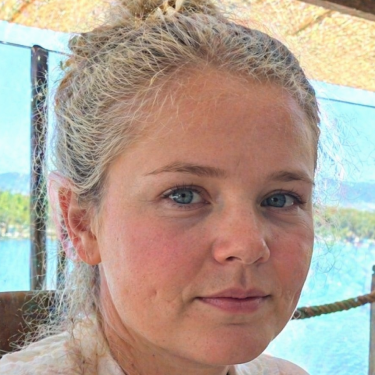
"We used BabyMorph almost as a joke during my third trimester — something to do on a Sunday afternoon. What came out was a baby girl with very light eyebrows, a wider forehead, and this particular way the nose sits slightly to the left. She was born six weeks later. The eyebrows. The forehead. The nose. Nobody believes it was generated before she arrived."
Their AI baby result

Jason T.
United States
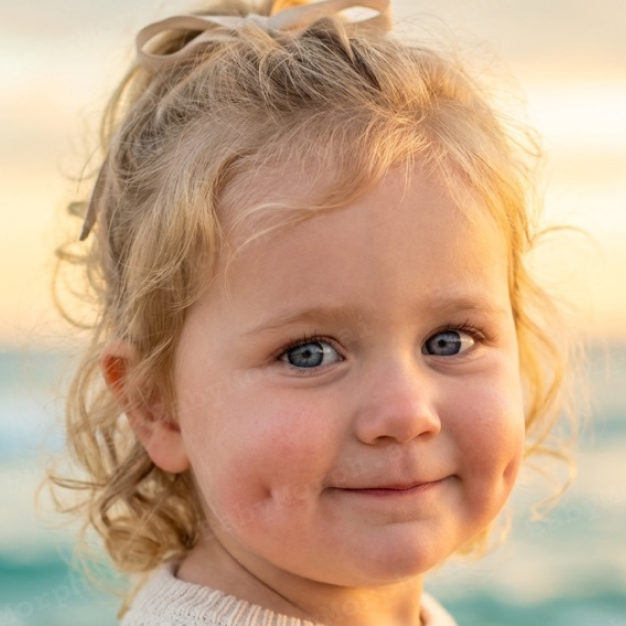
"I have an Asian wife and I've made a habit out of breaking these AI baby tools. Every single one I've tried has completely failed. BabyMorph actually blended her features and mine in a way that made sense — you could see both of us in there without one canceling out the other. People keep asking if it's a real photo."
Their AI baby result
Frequently Asked Questions
What is the difference between hazel and green eyes?
Green eyes have a solid, uniform green hue with low melanin, while hazel eyes contain a mixture of green, brown, and gold burst patterns around the pupil.
Can a brown-eyed parent pass down a hazel gene?
Yes. If the brown-eyed parent has a lighter-eyed parent or grandparent, they can pass down the recessive trait to create a hazel-eyed child.
What factors determine a child's eye color?
A child's eye color is determined by <em>multiple genes</em>, not just one dominant or recessive gene, that influence the amount and distribution of melanin in the iris. Genes like HERC2, OCA2, and TYR play significant roles, along with others. This complex genetic interplay is why predicting exact eye color can be challenging, even for tools like BabyMorph.
How do hazel eyes appear to change color?
Hazel eyes appear to change color due to the way light interacts with the various pigments and structures within the iris, not because the iris is making new pigment. The balance of reflected and scattered light shifts with clothing, lighting conditions, and pupil size, making the green, gold, and brown tones more or less prominent. This optical effect creates the illusion of color variation.
Is hazel eye color dominant or recessive?
Hazel eye color is neither strictly dominant nor recessive, as eye color inheritance is <strong>polygenic</strong> and involves many genes rather than a simple Mendelian pattern. While brown eyes are often associated with higher melanin production, hazel eyes are particularly complex to predict because they depend on both pigment quantity and specific patterning within the iris. The old 'dominant brown, recessive blue' model is an oversimplification.
When does a baby's true eye color become clear?
A baby's true eye color typically becomes clear between 6 months and 3 years of age, as melanin production in the iris continues to develop and darken over time. While many babies are born with blue or grey eyes, this initial color may change significantly as the genetic programming for melanin production becomes fully expressed. Observing family patterns can offer clues to the eventual shade.
What is the genetic difference between hazel and amber eyes?
Amber eyes are generally more uniformly golden, yellow-brown, or copper-colored, with less green at the iris edge, while hazel eyes display a visible pattern of brown, green, and gold. Both involve moderate amounts of eumelanin, but the distribution and light scattering effects differ. Amber eyes often lack the distinct outer green ring seen in many hazel irises, appearing more solid in hue.
Can two brown-eyed parents have a hazel-eyed child?
Yes, two brown-eyed parents can absolutely have a hazel-eyed child. Since eye color is influenced by multiple genes, both parents can carry variants for lighter eye colors without visibly having them. These variants can combine in their child to produce hazel eyes, especially if there are hazel, green, or blue eyes in either family's wider ancestry. This complexity is why AI generators like BabyMorph consider extended family history.
What are the chances of hazel eyes with a hazel and a brown parent?
About 50% when the brown-eyed parent carries a low-pigment allele, and close to 0 to 10% when that parent carries two brown alleles. Family history helps: blue or green eyes among the brown parent's own parents or siblings makes the carrier scenario much more likely.
Why do hazel eyes look different in different light?
Hazel irises have an uneven distribution of melanin, often with a warmer ring near the pupil. Light scattering in the low-pigment outer zone changes with brightness, pupil size and surrounding colours, so the same eye can read green indoors and light brown in sunlight.