Will My Baby Have Curly Hair If Parents Have Straight Hair?
Can straight-haired parents have a curly-haired baby? Learn how follicle biology, family history and age affect hair texture.
Two parents with straight hair can have a child whose hair becomes wavy or curly, although a strongly curly result is less likely when both parents and their close relatives consistently have very straight hair. Hair texture is not controlled by one simple “curly” or “straight” gene. It reflects the shape of the growing hair follicle, the internal structure of each fibre, ancestry, developmental hormones and the particular mix of many inherited variants.
Why straight-haired parents can have a curly-haired child
The familiar classroom model of a dominant curly-hair allele and a recessive straight-hair allele is useful as a first illustration of inheritance, but it does not describe real hair texture well. Human curl pattern is a polygenic trait: many genetic variants contribute small or moderate effects, and their combined result can differ from either parent’s visible hair type.
A parent with apparently straight hair may carry variants associated with wave, curl, greater fibre asymmetry or a more curved follicle. Those variants may not create obvious curls in that parent because they are balanced by other straightening variants. A child can inherit a different combination, including curl-associated variants from both sides of the family.
This is particularly plausible where there is a family history of:
- wavy or curly hair in grandparents, siblings, aunts, uncles or cousins;
- hair that curls in humid weather, after swimming or when grown longer;
- parents whose childhood hair was curlier than their adult hair;
- mixed ancestry, where hair-fibre traits may have been inherited from several ancestral populations;
- one or both parents using heat styling, chemical straightening or short cuts that obscure their natural texture.
In practical terms, two naturally pin-straight-haired parents with straight-haired relatives are more likely to have a straight-haired child. But “more likely” is not “guaranteed”. A child may develop loose waves, ringlets around the nape, or an overall texture that is distinctly curlier than either parent’s current hair.
The biology behind curl pattern
Follicle shape matters more than a single gene
Hair emerges from a follicle in the skin. A relatively straight, symmetrical follicle tends to produce straighter fibres. A curved or asymmetrical follicle can cause the fibre to grow in a curved path, producing waves or curls. The cross-section of the fibre also matters: rounder fibres are often associated with straighter hair, while more elliptical or irregular fibres more readily bend and twist.
The hair shaft is built largely from keratin proteins. Its shape depends on how keratin is arranged across the fibre, the distribution of sulphur-containing bonds, and the behaviour of the inner root sheath while the hair is forming. These are developmental processes, not simply a visible trait switched on at birth.
Genes associated with hair texture
Researchers have identified several loci linked to hair morphology, though no genetic test can currently give a precise, universal curl prediction for an individual baby.
TCHH, the trichohyalin gene, is among the best-known genes associated with hair shape, particularly in people of European ancestry. Trichohyalin helps structure the inner root sheath and developing hair fibre. Variants near TCHH have been associated with straighter or curlier hair patterns in population studies.
PRSS53 is involved in hair-shaft formation and has been associated with curliness in several genetic studies. Rare damaging changes in this gene can affect hair structure more dramatically, while common variants contribute more subtly to ordinary texture differences.
EDAR affects ectodermal structures including hair follicles, teeth and sweat glands. A well-studied EDAR variant, more common in East Asian and Native American populations, is associated with thicker, straighter hair fibres and altered follicle characteristics. Its presence does not make all hair straight, but it can shift the overall probability towards straighter, coarser-feeling hair.
Other contributors include keratin-related genes and regions influencing follicle development. Genes such as PAX3 and RUNX2 are better known for broader craniofacial and developmental roles than for determining ordinary curl pattern, yet they illustrate an important point: the skin, follicle, skull and facial tissues develop through interconnected pathways. A baby-face image cannot directly read these genes from a photograph; it can only estimate likely visible patterns from family features.
How family patterns alter the likelihood
There is no reliable percentage that applies to every pair of straight-haired parents. The most useful evidence is the natural, untreated hair texture across both families, especially in childhood and before regular heat styling. Hair can appear straighter when it is short, damaged, heavily conditioned, or weighted down by length.
| Family pattern | Most plausible child outcomes | Why certainty is limited |
|---|---|---|
| Both parents and most close relatives have very straight hair | Straight hair is most likely; slight wave remains possible | Many texture variants are shared, but hidden minor variants can still recombine |
| Both parents look straight-haired, but each has curly or wavy relatives | Straight or wavy hair likely; curly hair is a realistic possibility | A child may inherit curl-promoting variants from both family lines |
| Parents had curls as children but straighter hair as adults | Wavy or curly early childhood hair is more plausible | Hormonal changes and hair length may have altered the parents’ adult texture |
| One parent’s hair is chemically straightened or regularly heat-styled | Cannot be judged from current appearance alone | Natural follicle output may be substantially hidden by styling practices |
It is also worth separating curl pattern from hair colour and thickness. The genes OCA2 and HERC2 are influential in variation in eye and pigmentation traits, while MC1R has a recognised role in red hair and fairer pigmentation. TYR and SLC24A5 participate in melanin biology and skin pigmentation. These genes do not provide a simple explanation for curliness. A baby may inherit dark, fine, straight hair; light, dense, curly hair; or any other combination.
When a child’s natural texture becomes visible
Newborn hair is a poor final guide. Many babies shed much of their first hair during the first six months, then grow a new texture that can look completely different. The hair follicles are present before birth, but the visible fibre and scalp coverage change rapidly after delivery.
| Age represented | What hair texture may look like | How dependable it is |
|---|---|---|
| Birth to 12 months | Fine, patchy, silky, fuzzy or temporarily curly hair | Low; infant hair commonly sheds and regrows |
| Age 3 | First clearer impression of density, wave and curl direction | Moderate; texture may still change noticeably |
| Age 6 | More established childhood curl pattern and fibre thickness | Moderately useful, though not necessarily adult texture |
| Age 10 | Often similar to the pre-pubertal long-term pattern | Fairly informative before hormonal changes |
| Age 18 | Adult-like density, diameter and texture are more likely | Most informative, but hormones and grooming still affect appearance |
Puberty can alter sebum production, fibre diameter and the way hair behaves. Some children lose curls during later childhood, while others develop stronger waves or curls in adolescence. Pregnancy, thyroid conditions, ageing and medication can also change an adult’s texture, which is one reason parental hair today may not perfectly reflect what they passed on.
What AI images can and cannot infer about hair
AI-generated child portraits use visual patterns in parent photographs to create a plausible age-specific appearance. For hair, the system may draw on visible curl radius, apparent density, hairline, colour, facial ancestry cues and similarities found in training examples. It does not sequence the child’s DNA, identify a parent’s TCHH or EDAR variants, or know which variants will combine at conception.
Hair prediction is especially uncertain when photographs show tied-back hair, curls altered with styling tools, wet hair, artificial colour, hats, low resolution or very different lighting. A useful image should therefore be viewed as one biologically plausible visual scenario, not evidence that a child will have a particular curl pattern at age three, six, ten or eighteen.
For the best family-based estimate, compare natural photos of both parents at several ages and, where possible, photographs of grandparents and siblings. Look for recurring features: loose S-waves, corkscrew curls, thick straight strands, a curly nape, or hair that changes markedly with humidity. Repeated family patterns carry more meaning than a single carefully styled adult portrait.
Frequently asked questions
Can two straight-haired parents have a baby with very curly hair?
Yes. It is possible, particularly when curl or wave occurs in the wider family. The child may inherit a combination of multiple texture-related variants that is more curl-promoting than either parent’s visible combination. It is less likely, though still not impossible, when both family lines have consistently very straight natural hair.
Is curly hair dominant over straight hair?
Not in the simple, dependable way often taught in introductory genetics examples. Hair texture involves many genes, follicle anatomy and developmental influences. Describing curliness as purely dominant can lead to misleading predictions about real families.
Why was my baby born with straight hair but became curly later?
First infant hair often falls out and is replaced during the first year. The replacement hair may have a different thickness, colour and curl pattern. Texture can continue to evolve through toddlerhood, childhood and puberty as the hair fibre and scalp environment change.
Can hair products make a child genetically curly or straight?
No. Products, heat and chemical treatments can temporarily or, in the case of chemical processing, longer-term alter the appearance of the existing hair shaft. They do not change the inherited follicle characteristics that guide future hair growth.
Punnett square: two straight-haired parents
Hair texture behaves like an incomplete-dominance trait: CC tends to be curly, Cc wavy, and cc straight. If both parents are genuinely cc, curls are very unlikely — but a wavy-leaning parent may actually be Cc with straightened or heavy hair.
| Parent 2: C | Parent 2: c | |
|---|---|---|
| Parent 1: C | CC — curly | Cc — wavy |
| Parent 1: c | Cc — wavy | cc — straight |
Estimated outcome: two truly straight-haired (cc) parents have close to a 0% chance of tight curls and a small chance of loose waves; if one parent is secretly Cc, roughly 50% of children are wavy.
What our users say
Lena K.
Germany
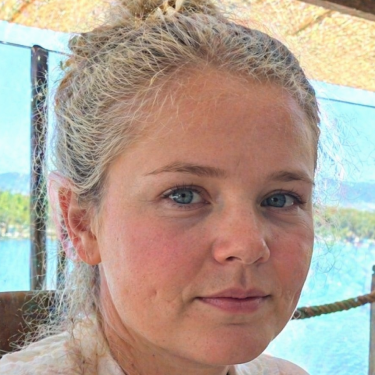
"We used BabyMorph almost as a joke during my third trimester — something to do on a Sunday afternoon. What came out was a baby girl with very light eyebrows, a wider forehead, and this particular way the nose sits slightly to the left. She was born six weeks later. The eyebrows. The forehead. The nose. Nobody believes it was generated before she arrived."
Their AI baby result

Jason T.
United States
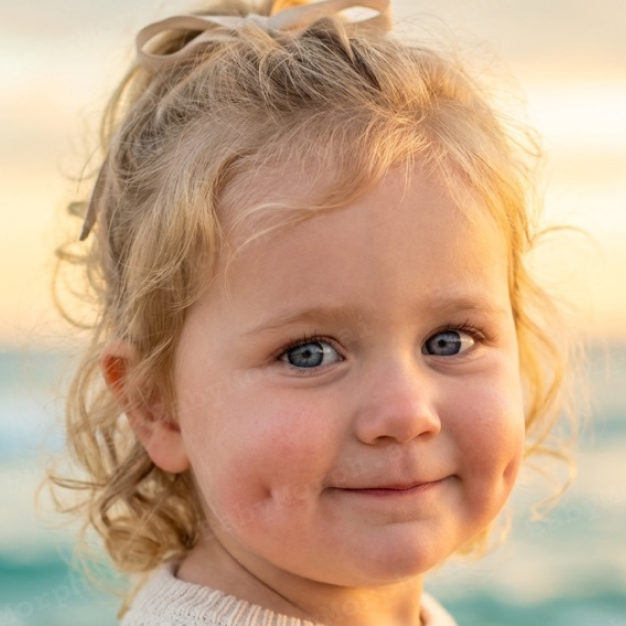
"I have an Asian wife and I've made a habit out of breaking these AI baby tools. Every single one I've tried has completely failed. BabyMorph actually blended her features and mine in a way that made sense — you could see both of us in there without one canceling out the other. People keep asking if it's a real photo."
Their AI baby result
Frequently Asked Questions
Can two straight-haired parents have a curly-haired baby?
Yes. Due to incomplete dominance and multi-gene tracking, if both parents carry recessive wavy or curly traits, the baby can develop curly hair.
When does a baby's permanent hair texture develop?
A baby's initial hair often sheds in the first few months. The permanent texture and thickness typically emerge between 6 and 18 months of age.
What determines a child's hair curl pattern?
A child's hair curl pattern is a polygenic trait, meaning many genetic variants contribute to its final appearance. It reflects the shape of the hair follicle, the internal structure of each hair fibre, ancestry, developmental hormones, and the combined effect of multiple inherited genes from both parents. Factors like hair-related genes such as <em>TCHH</em>, <em>PRSS53</em>, and <em>EDAR</em> play significant roles.
Can hair texture change from childhood to adulthood?
Yes, hair texture can change from childhood to adulthood due to hormonal shifts and hair length. For example, parents who had curlier hair as children might find their hair becoming straighter as adults. This suggests that a child could also experience similar changes, developing waves or curls that were not apparent in their parents' adult hair.
What is a polygenic trait in hair genetics?
A polygenic trait in hair genetics means that many different genes contribute small or moderate effects to the overall curl pattern. Unlike simple dominant/recessive traits, the combined result of these multiple genes can produce a hair texture different from either parent's visible hair type. This complexity is why straight-haired parents might carry hidden variants for wave or curl that manifest in their child.
Do curved hair follicles make hair curly?
Yes, a curved or asymmetrical hair follicle tends to produce curlier hair fibres. Hair emerges from the follicle, and its shape significantly influences the hair's path of growth. A relatively straight, symmetrical follicle produces straighter hair, while a curved follicle causes the fibre to grow in a curved path, resulting in waves or curls. The cross-section of the hair fibre also matters, with more elliptical shapes promoting curliness.
Can a baby's hair become curlier in humid weather?
Yes, a baby's hair, like an adult's, can become curlier in humid weather, after swimming, or when grown longer. This is often a sign that there are underlying curl-associated variants present, even if the hair appears straight under other conditions. Humidity can cause hair to absorb moisture and swell unevenly, enhancing any existing tendency for waves or curls.
How do genetic tests predict hair curl for a baby?
Currently, no genetic test can give a precise, universal curl prediction for an individual baby. While researchers have identified several gene loci linked to hair morphology, such as <em>TCHH</em> and <em>PRSS53</em>, their interactions are complex. These tests can indicate predispositions but cannot fully account for all polygenic factors, environmental influences, and developmental changes. Tools like BabyMorph estimate visible patterns from parental features rather than direct genetic analysis.
What are the odds of a curly-haired baby if both parents have straight hair?
If both parents are truly straight-haired at the texture locus, tight curls are close to 0% and loose waves remain possible at a low rate. Because texture is influenced by several genes including TCHH, EDAR and WNT10A, grandparents' curls can still reappear when a parent carries an unexpressed wave allele.
Does baby hair texture change as the child grows?
Yes. Newborn hair is often shed and replaced between 3 and 12 months, and the follicle shape that determines curl can keep maturing until puberty. Many babies born with straight hair develop waves by age two or three.