Will My Baby Have Dimples? The Genetics of Cheek Dimples
Learn how cheek dimples arise from facial anatomy, why inheritance is not simple, and when dimples may appear during childhood.
Cheek dimples are small indentations that appear when a person smiles, usually near the corners of the mouth. They are often described as a simple dominant inherited trait, but real family patterns are less tidy. Whether a child develops dimples depends on facial muscle anatomy, connective tissue attachments, cheek fat, skin thickness and inherited facial proportions. A parent with obvious dimples may have a child without them, while a child may show dimples that are subtle or not noticed until later childhood.
What creates a cheek dimple?
The familiar smile dimple is usually associated with variation in the zygomaticus major, the muscle that lifts the corners of the mouth during smiling. In many people, this muscle runs as a single band from the cheekbone towards the mouth. In some people with cheek dimples, it may divide into two bundles, or attach to the skin and deeper cheek tissues in a slightly different pattern.
When the child smiles, this altered pull can tether a small area of skin inward while the surrounding cheek moves outward. The result is a visible hollow or crease. This is not a defect or illness: it is a common anatomical variation.
Not all facial indentations are the same
Parents often use “dimples” for several different features. These may have different anatomical causes and different chances of persisting.
| Feature | Typical location | Likely anatomical basis | How stable it tends to be |
|---|---|---|---|
| Cheek smile dimple | Near the mouth corners | Variation in zygomaticus major and skin attachment | Often persistent, but visibility can change |
| Chin dimple or cleft | Centre of the chin | Soft-tissue and underlying chin-shape variation | Usually more stable through growth |
| Infant cheek crease | Anywhere in a full baby cheek | Facial fat pads, skin folding and expression | May fade as facial proportions change |
| Lower-back dimples | Above the buttocks | Skin attachment over the pelvis | Separate trait from cheek dimples |
Are dimples really inherited as a dominant trait?
The short answer is that dimples often run in families, but calling them a straightforward dominant trait overstates the evidence. A classic dominant model would mean that one inherited version of one gene reliably produces dimples. Human facial traits rarely work so cleanly, and no single “dimple gene” has been established for ordinary cheek dimples.
Families can nevertheless show a strong pattern because relatives share many genetic variants affecting facial muscles, skull shape, cheek volume, skin structure and the way soft tissues attach. They also share ancestry, which can influence average facial proportions. A dimple may look as though it has skipped a generation when it was actually present but faint in one parent, obscured by fuller cheeks, or visible only in certain smiles.
Why the same inherited tendency can look different
- Penetrance: a child may inherit a tendency towards a dimple-forming muscle pattern without developing a clearly visible indentation.
- Expression: one sibling may have deep bilateral dimples, while another has one shallow dimple on only one side.
- Facial growth: cheek fat and jaw growth can reveal or disguise an underlying tether over time.
- Photography: lighting, head rotation and whether a child gives a broad genuine smile greatly affect visibility.
If one parent has pronounced, persistent cheek dimples and close relatives also have them, the child’s chance is plausibly above the population average. It is not, however, possible to give a medically reliable percentage from parental appearance alone. Two dimpled parents can have a child without visible dimples, and two parents without obvious dimples can have a dimpled child.
Genes that shape the face, even if none is a “dimple gene”
Research into facial genetics has identified many loci associated with normal variation in facial form, but these findings do not yet amount to a clinical test for dimples. Genes influence the broad structures within which dimples are seen: cheekbone projection, midface width, jaw development, pigmentation and soft-tissue distribution.
For example, PAX3 has been associated in population studies with aspects of nasal bridge and facial shape. RUNX2 is important in bone development and has been linked to variation in craniofacial proportions. EDAR affects ectodermal structures such as hair and teeth and is associated with some facial soft-tissue features in particular populations. These genes illustrate why facial appearance is polygenic, not why a particular child will definitely have a cheek dimple.
Other familiar appearance genes are even less informative for dimples. OCA2 and HERC2 contribute substantially to common eye-colour variation, especially blue versus brown eye patterns in people of European ancestry. MC1R influences red hair and freckling, while TYR and SLC24A5 contribute to pigmentation pathways. These may help explain colouring, but they do not provide a shortcut to predicting smile dimples.
When dimples become visible as a child grows
A dimple is an expression-dependent feature, so it cannot always be judged in a newborn photograph. Newborn faces are round, facial muscles are still maturing, and early smiles are often reflexive rather than socially responsive. The changing balance of facial fat, muscle control and bone growth can make a dimple appear, deepen or become less obvious.
| Age stage | What commonly changes | How informative dimples are |
|---|---|---|
| Birth to 12 months | Full cheeks and rapid facial growth; early smiles become purposeful | Creases can be temporary and difficult to classify |
| Age 3 | More coordinated expressions; toddler cheek fullness remains common | A consistent smile dimple may be recognisable |
| Age 6 | Face lengthens and baby fat often reduces | Underlying dimples may look clearer or less deep |
| Age 10 | Midface and jaw continue to grow before puberty | Persistent dimples are usually easier to assess |
| Age 18 | Adult facial proportions and soft-tissue distribution are more established | Best indication of the long-term visible pattern |
For age-based facial renderings at 3, 6, 10 and 18, a dimple should therefore be treated as a variable expression feature rather than a fixed mark. A realistic representation may show it faintly at one age and more clearly at another, particularly where the family trait is subtle.
What parental photos can and cannot tell you
Photos are useful for identifying visible family resemblance, especially when several images show each parent smiling naturally from the front. It is worth checking whether the indentation appears in both posed and spontaneous smiles, whether it is on one or both cheeks, and whether grandparents or siblings share it.
However, a photo cannot reveal the exact muscle arrangement beneath the skin. It may also exaggerate a dimple through side lighting or conceal it through a neutral expression. A child’s face combines inherited features in a new way; they may inherit one parent’s cheek shape, the other parent’s smile mechanics, or neither feature in an obvious form.
Frequently asked questions
Can a baby be born with cheek dimples?
Yes, some are visible very early, especially during crying or smiling. Others become noticeable only after social smiling develops at around two to three months. Early cheek folds alone do not prove that a lasting smile dimple is present.
Can dimples disappear as a child gets older?
They can appear to disappear. Changes in cheek fat, skin tension, tooth and jaw development, and the strength of facial expressions can reduce their visibility. A true muscle-related dimple often remains, but may become shallower or show only in a broad smile.
If both parents have dimples, will their child definitely have them?
No. Having two dimpled parents increases the family evidence for the trait, but it does not guarantee a visible dimple. The feature depends on multiple inherited influences and developmental variation rather than a confirmed single-gene dominant rule.
Are one-sided dimples genetic?
They can be. Facial anatomy is not perfectly symmetrical, and a child may inherit a tendency for dimple formation that is expressed more strongly on one side. One-sided dimples are common and are usually simply a normal variation in muscle attachment or soft tissue.
What our users say
Lena K.
Germany
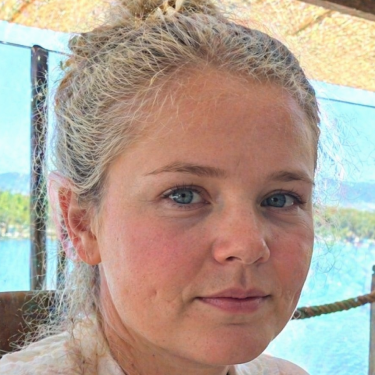
"We used BabyMorph almost as a joke during my third trimester — something to do on a Sunday afternoon. What came out was a baby girl with very light eyebrows, a wider forehead, and this particular way the nose sits slightly to the left. She was born six weeks later. The eyebrows. The forehead. The nose. Nobody believes it was generated before she arrived."
Their AI baby result

Jason T.
United States
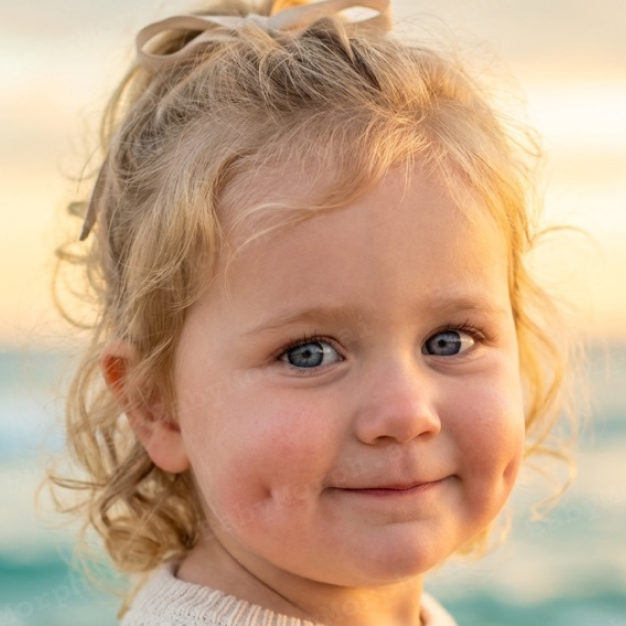
"I have an Asian wife and I've made a habit out of breaking these AI baby tools. Every single one I've tried has completely failed. BabyMorph actually blended her features and mine in a way that made sense — you could see both of us in there without one canceling out the other. People keep asking if it's a real photo."
Their AI baby result
Frequently Asked Questions
Can two parents without dimples have a baby with dimples?
It is highly unlikely since dimples are a dominant trait. However, due to variable expressivity, a parent might carry the gene faintly without prominent dimples showing.
Are babies born with dimples that disappear later?
Yes. Some babies have temporary dimples due to baby fat in their cheeks. As they grow and the facial structure thins out, these fat-induced dimples can fade away.
What causes cheek dimples genetically?
Cheek dimples are generally thought to arise from variations in the <strong>zygomaticus major muscle</strong>, which lifts the corners of the mouth during smiling. In some individuals, this muscle may divide into two bundles or attach differently to the skin, causing an indentation when smiling. While often described as a dominant trait, it's not a simple one-gene inheritance; multiple factors contribute.
Are dimples truly a dominant inherited trait?
The inheritance of dimples is more complex than a simple dominant trait, despite popular belief. While dimples often run in families, no single 'dimple gene' has been definitively identified. Facial traits are polygenic, meaning many genes and anatomical factors like muscle structure, fat pads, and skin attachments play a role in their appearance and expression.
Will my child have dimples if I have them?
If you have pronounced, persistent cheek dimples, your child's chance of having them is likely above average, but it's not a guarantee. The visibility of dimples can be affected by factors like facial growth, cheek fat, and muscle development, meaning a child might inherit the tendency but express it differently or later in life. BabyMorph can offer a fun prediction, but it's not medical advice.
What is the difference between dimples and other facial indentations?
While 'dimples' is often used broadly, the familiar smile dimple near the mouth corners is typically due to a variation in the zygomaticus major muscle. Other indentations, like chin dimples or clefts, arise from underlying bone and soft-tissue variations. Infant cheek creases are often due to facial fat pads and may fade as a child grows, making them distinct from persistent smile dimples.
When do cheek dimples become most noticeable?
Cheek dimples can become most noticeable as a child grows, particularly after toddlerhood. Newborns have full cheeks and developing facial muscles, making early dimples hard to classify. As facial fat reduces and the face lengthens around ages 6-10, underlying dimples may become clearer. Adult facial proportions provide the best indication of a persistent dimple pattern.
Can dimples appear later in childhood?
Yes, dimples can appear or become more noticeable later in childhood. Factors like the reduction of baby fat, changes in facial muscle development, and overall bone growth can reveal or deepen an underlying tendency for dimples that wasn't apparent in infancy. A dimple is an expression-dependent feature, often becoming clear with more coordinated, broad smiles.