Will My Baby Have Blue Eyes? Hazel + Blue Parents
Can a hazel-eyed and blue-eyed parent have a blue-eyed baby? Explore iris genes, family clues and when eye colour settles.
A blue-eyed baby is certainly possible when one parent has hazel eyes and the other has blue eyes, but the outcome cannot be calculated from eye colour alone. Hazel is a variable phenotype: some hazel eyes are predominantly green-gold with relatively low iris pigment, while others contain enough brown pigment to make blue eyes less likely in a child. Several genes influence how much melanin the iris produces, where it is deposited, and how light is scattered through the front layers of the eye.
Why hazel and blue eyes can produce different outcomes
Blue eyes do not contain blue pigment. They usually result from low melanin concentration in the front layer of the iris, called the iris stroma. Light entering the eye is scattered by the tissue structure, with shorter blue wavelengths more likely to be reflected back to the observer. This is similar to the optical process that contributes to the blue appearance of the sky.
Hazel eyes contain more melanin than typical blue eyes, but less uniformly distributed pigment than many brown eyes. A hazel iris often has a brown or amber ring around the pupil, with green, gold or grey tones towards the outer iris. This pattern reflects both pigment amount and pigment distribution. Therefore, “hazel” is not one genetic category.
The important distinction: low-pigment versus brown-dominant hazel
A parent described as hazel-eyed may carry genetic variants associated with low iris melanin, particularly if their eyes look green-grey in most light and only show a small amber centre. In that situation, a blue-eyed child may be relatively plausible, especially if the hazel-eyed parent has blue-eyed relatives.
Conversely, hazel eyes with substantial brown colouring, a darker outer iris, or strong brown pigment in both eyes may indicate a greater tendency towards melanin production. A child can still have blue eyes, but the chance may be lower depending on the genetic variants inherited from both sides of the family.
| Parental appearance and family pattern | What it may suggest | Possible child eye-colour outcomes |
|---|---|---|
| Blue-eyed parent and light hazel-eyed parent with blue-eyed relatives | Both parents may carry variants linked with low iris melanin | Blue, grey, green or hazel are all plausible |
| Blue-eyed parent and hazel-eyed parent with a strong brown centre | Hazel-eyed parent may have more pigment-promoting variants | Hazel, green and light brown may become more likely; blue remains possible |
| Blue-eyed parent and hazel-eyed parent with brown-eyed parents or siblings | There may be a stronger family tendency towards higher iris melanin | Hazel or brown-toned eyes may be more likely than blue, though not guaranteed |
| Both parental families include many blue or grey eyes | Low-pigment variants may be common on both sides | Blue or grey eyes may be comparatively likely |
The genes involved are more complex than a dominant-recessive chart
The familiar classroom explanation that brown eyes are dominant and blue eyes are recessive is a useful starting point, but it does not adequately explain hazel, green, grey, amber or many family outcomes. Eye colour is polygenic, meaning several inherited loci contribute to the visible result.
OCA2 and HERC2
The strongest known contributors to common European variation in blue and brown eye colour lie in and around OCA2 and HERC2 on chromosome 15. OCA2 affects melanin production in melanocytes, the pigment-producing cells found in the iris. A regulatory region within HERC2 influences how actively OCA2 is expressed.
One widely studied variant, rs12913832 in HERC2, is strongly associated with blue eyes in European populations because it can reduce OCA2 expression in the iris. However, it is not a universal blue-eye switch. Its effects depend on the rest of a person’s genome, ancestry and interacting pigmentation genes.
Other pigmentation loci
Genes including TYR, TYRP1, SLC24A4, SLC45A2 and IRF4 also influence melanin synthesis, transport or regulation. MC1R is especially relevant to red hair and fair pigmentation, although its relationship with eye colour is less direct than that of OCA2 and HERC2. Population-specific variants matter too, so ancestry affects how informative a simple blue-versus-hazel family history can be.
This is why two hazel-eyed people may have quite different genetic backgrounds, and why a blue-eyed parent does not make a blue-eyed baby certain. The most useful clues are the eye colours of grandparents, siblings, previous children and close relatives, rather than the two parental labels alone.
What can reasonably be estimated from family history?
Without genetic testing, it is more honest to think in ranges and scenarios than to quote a precise percentage. If the hazel-eyed parent has one or two blue-eyed parents, or several blue-eyed siblings, the family evidence supports a meaningful possibility of a blue-eyed child. If the hazel-eyed parent comes from a family in which brown and dark hazel eyes are common, blue may be less frequent but remains biologically possible.
- Look at the hazel-eyed parent’s own parents: blue or grey eyes are particularly informative.
- Note whether the hazel colour appears light green-grey, amber, or predominantly brown.
- Consider the blue-eyed parent’s family history as well; blue eyes in several relatives suggest similar low-pigment variants may be widespread.
- Remember that siblings can inherit different combinations of variants, so one child’s eye colour does not determine the next child’s.
- Treat consumer genetic results cautiously: common pigmentation markers improve estimates but cannot fully predict hazel and green outcomes.
AI-generated family visualisations can use visible parental features and population-level trait associations to create a plausible appearance. They cannot inspect the baby’s unrevealed combination of DNA variants, so they should represent a likely-looking scenario rather than a genetic promise.
When a child’s eye colour usually becomes visible
Newborn eye colour is often provisional. Melanocytes in the iris may produce relatively little melanin at birth, particularly in babies with lighter pigmentation backgrounds. As melanin production increases after birth, eyes can darken or develop a more mixed appearance. This means a baby who appears blue in early photographs may later develop grey, green, hazel or brown eyes.
| Age | What is commonly visible | How stable is eye colour? |
|---|---|---|
| Birth to 6 months | Blue-grey or slate-toned eyes are common, even in babies whose eyes later darken | Usually not stable |
| 6 to 12 months | Increasing melanin may create brown, green or hazel tones | Often changing |
| 1 to 3 years | The central amber ring and mixed tones characteristic of hazel eyes may become clearer | More reliable, but subtle changes can continue |
| Age 3 | Most children show a recognisable eye-colour category | Usually a good working estimate |
| Ages 6, 10 and 18 | Colour is generally stable; lighting, pupil size and clothing can still alter its apparent shade | Mostly stable |
For a child rendered at age 3, blue, grey, green or hazel may be reasonable possibilities in this parental combination. By ages 6, 10 and 18, the main difference is not normally a dramatic genetic change in eye colour, but a more mature facial context that can make the same iris look brighter, darker or more contrasted.
Why eye colour can look different from one photograph to another
Hazel eyes are particularly sensitive to viewing conditions. Warm indoor light can emphasise amber pigment; daylight may bring out green or grey components. A dilated pupil can make the iris appear darker because less of the coloured iris is visible, while a constricted pupil may make a golden centre more obvious.
Surrounding features also affect perception. Dark eyelashes, skin tone, hair colour and clothing produce contrast effects that can make a blue-grey iris seem more blue or a hazel iris more green. This is one reason a single parent photograph is a limited basis for distinguishing blue, grey, green and hazel inheritance.
Frequently asked questions
Can a hazel-eyed parent and a blue-eyed parent have a blue-eyed baby?
Yes. A blue-eyed child is possible, particularly when the hazel-eyed parent has blue or grey eyes in their close family. The exact likelihood depends on multiple pigmentation variants rather than a single dominant or recessive gene.
Does hazel count as brown for eye-colour genetics?
Not reliably. Hazel eyes often include some brown or amber melanin, but they are distinct from uniformly brown eyes in pigment amount and distribution. Grouping all hazel eyes with brown eyes loses useful information about the likely inherited pattern.
When will I know whether my baby’s eyes will stay blue?
Many changes occur during the first year, and eye colour is often clearer between ages one and three. A blue appearance at birth or at a few months old is not confirmation that the eyes will remain blue.
Can blue eyes turn hazel after age three?
Major changes after age three are less common, but subtle shifts can occur through childhood. Some irises develop slightly more amber or green pigmentation, while changes in lighting and contrast can make an established colour appear different.
Punnett square: hazel parent + blue parent
A hazel parent typically carries one pigment-raising allele (Bb); a blue-eyed parent is usually bb.
| Blue parent: b | Blue parent: b | |
|---|---|---|
| Hazel parent: B | Bb — hazel/brown | Bb — hazel/brown |
| Hazel parent: b | bb — blue or green | bb — blue or green |
Estimated outcome: about 50% blue or green, about 50% hazel or light brown.
Check your own combination with the Baby Eye Color Calculator.
What our users say
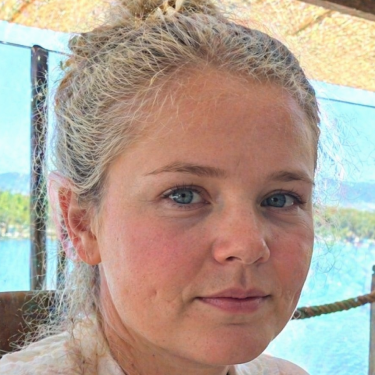
Lena K.
Germany
"We used BabyMorph almost as a joke during my third trimester — something to do on a Sunday afternoon. What came out was a baby girl with very light eyebrows, a wider forehead, and this particular way the nose sits slightly to the left. She was born six weeks later. The eyebrows. The forehead. The nose. Nobody believes it was generated before she arrived."
Their AI baby result
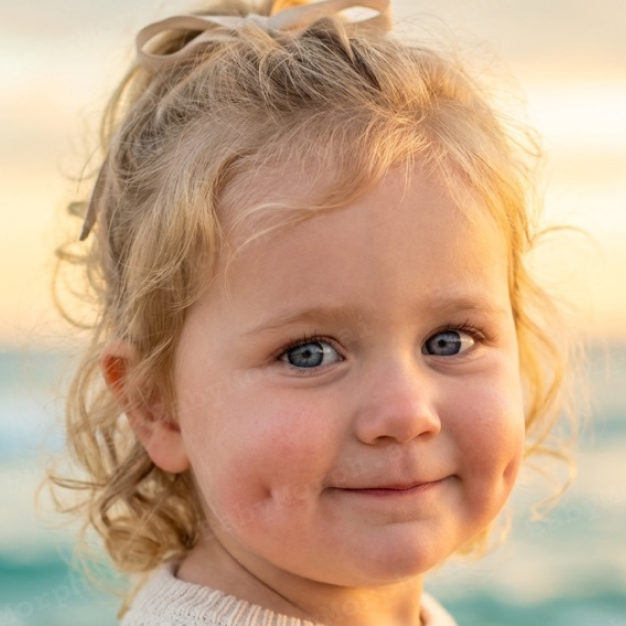

Jason T.
United States
"I have an Asian wife and I've made a habit out of breaking these AI baby tools. Every single one I've tried has completely failed. BabyMorph actually blended her features and mine in a way that made sense — you could see both of us in there without one canceling out the other. People keep asking if it's a real photo."
Their AI baby result
Frequently Asked Questions
Can a hazel parent and blue parent have a brown-eyed child?
It is extremely unlikely. Because neither parent has solid dominant brown eye genes, the child will almost always inherit blue, green, or hazel eyes.
Do hazel eyes change color over time?
Hazel eyes look different based on lighting, clothing color, and pupil dilation due to the multi-layered pigmentation of the iris.
Can a blue-eyed parent and a hazel-eyed parent have a blue-eyed baby?
Yes, a blue-eyed baby is certainly possible when one parent has hazel eyes and the other has blue eyes. The likelihood depends on the specific genetic variants inherited by the hazel-eyed parent, particularly whether their hazel eyes are low-pigment (more green-grey) or brown-dominant. Family history, such as blue-eyed relatives on both sides, can offer further clues.
What family history clues predict a blue-eyed baby with a hazel parent?
The eye color of the hazel-eyed parent's relatives, especially parents and siblings, offers valuable insight. If they have blue-eyed parents or many blue-eyed siblings, it suggests a higher likelihood of carrying low-pigment variants, making a blue-eyed child more plausible. The specific shade of hazel (e.g., light green-grey versus strong brown) is also a clue.
Is brown eye color dominant and blue eye color recessive?
Eye color inheritance is more complex than a simple dominant-recessive model, as it is influenced by multiple genes. While brown is often considered dominant and blue recessive, genes like <em>OCA2</em> and <em>HERC2</em>, along with several others, interact to produce the full spectrum of eye colors, including hazel, green, and grey.
Does having a blue-eyed parent guarantee a blue-eyed child?
No, a blue-eyed parent does not guarantee a blue-eyed baby. Eye color is polygenic, meaning multiple genes from both parents contribute to the outcome. Even if a parent has blue eyes, the combination of genetic variants inherited by the child can lead to other eye colors like green or hazel, especially if the other parent has more pigment-producing genes.
When does a baby's eye color become permanent?
A baby's eye color usually begins to settle between six months and one year of age, though it can continue to shift for several years. Many babies are born with blue or grey eyes due to low melanin production at birth, and the final color emerges as melanocytes begin to produce and deposit more pigment in the iris.
How do AI baby generators predict eye color outcomes?
AI baby generators like BabyMorph can create a likely-looking scenario for your future child based on visible parental features and population-level trait associations. However, they cannot inspect the baby's exact, unrevealed combination of DNA variants. Therefore, they represent a plausible visualization rather than a guaranteed genetic promise of eye color.
What percentage chance is there of blue eyes with a hazel and a blue parent?
Around 50%. Half of the children inherit the low-pigment allele from both parents and show blue or blue-green eyes; the other half inherit one pigment-raising allele from the hazel parent and usually settle into hazel or light brown.
Will a blue-eyed newborn from this pairing stay blue?
Not always. Melanin keeps accumulating in the iris for the first 6 to 12 months, and in this pairing a subset of blue newborns shifts toward green or hazel by the first birthday. The colour is generally stable by age three.