Baby Hair Color Genetics: What Shade Will Your Baby Have?
How baby hair colour is inherited: eumelanin vs pheomelanin, the MC1R and HERC2 genes, why newborn hair darkens, and what two parents can realistically expect.
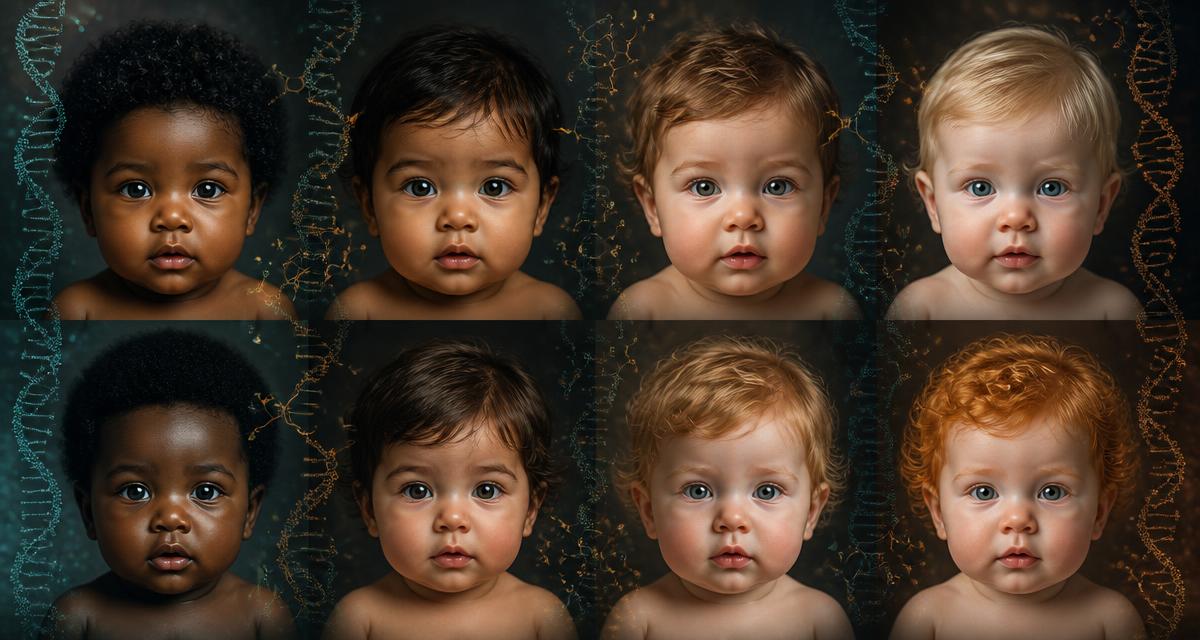
Right after "what colour will the eyes be?", the next question almost every expecting parent asks is about hair. Will the baby be blonde like mum? Will grandad's red hair reappear? Baby hair colour genetics is more predictable than eye colour in some ways and far less predictable in others — and almost none of it follows the single dominant/recessive square you were taught at school.
Hair colour is really just two pigments
Every natural human hair shade comes from a mix of exactly two pigments produced by melanocytes at the base of each follicle:
- Eumelanin — the brown-to-black pigment. A lot of it gives black hair, a moderate amount brown, very little gives blonde.
- Pheomelanin — the red-to-yellow pigment. When it dominates because eumelanin is low, you get red or strawberry blonde.
Hair colour is therefore a ratio plus a quantity, not a switch. That is why shades sit on a continuous scale — ash blonde, honey, light brown, chestnut, dark brown, jet black — instead of falling into neat boxes. We go deeper into that gradient in Blond vs. Brown Hair Pigment: Eumelanin Distribution.
The genes that set the dial
Hair colour is polygenic: dozens of genes each nudge pigment production up or down. A handful carry most of the weight:
- MC1R — the melanocortin 1 receptor. Working copies push melanocytes toward eumelanin. Two loss-of-function variants shift production to pheomelanin, which is the classic path to red hair. This is why red hair usually behaves recessively: two carrier parents with brown hair can have a redhead. See Will My Baby Have Red Hair? The Mystery of the MC1R Gene.
- HERC2 / OCA2 — the same region that dominates eye colour also influences how much melanin the follicle makes, which is why blue eyes and light hair travel together so often. Compare with Baby Eye Color Genetics Explained.
- KITLG, TYR, TYRP1, SLC24A4, IRF4 — modifier genes that explain most of the difference between blonde, light brown and dark brown, and much of how strongly hair darkens with age.
What two parents can realistically expect
These are tendencies from population data, not guarantees — a modifier gene from a grandparent can override any of them.
| Parents | Most likely outcome | Realistic surprises |
|---|---|---|
| Both black/dark brown | Dark brown to black | Lighter brown; red only if both carry an MC1R variant |
| Both blonde | Blonde, often darkening in childhood | Light or mid brown by school age |
| One dark, one blonde | Mid to dark brown | Blonde infancy that darkens; ash or golden brown |
| One red, one dark | Dark hair carrying a red variant | Auburn or copper highlights; true red if the dark parent is a carrier |
| Both red | Red | Shade ranges from copper to deep auburn |
Why newborn hair is not final hair
Babies are born with lanugo and then fine vellus hair, which is usually lighter and thinner than the hair they will keep. Melanocyte activity ramps up through the first two years, so:
- Blonde or near-white newborn hair very often darkens between ages 1 and 5.
- Hair rarely gets lighter with age in childhood — the usual direction is darker.
- Red tones can appear later, when the first true hair replaces the newborn coat.
- Texture is set by a different set of genes entirely — see Understanding Baby Hair Textures and Curl Patterns.
A practical rule: the shade at around age 2 is a much better predictor of adult hair than the shade at birth.
How AI predicts hair colour from parent photos
A DNA test can read MC1R and HERC2 directly. Photo-based prediction works differently: BabyMorph's model reads the visible pigment signal in both parents' photos — hair luminosity, warm/cool tone, root-to-tip variation, brow and lash colour, which are strong proxies for baseline melanin — and synthesises a child face whose pigment sits in the plausible range for that pairing, rather than simply copying one parent.
What that means in practice: the model is reliable about range (this pairing will not produce jet-black hair) and honest about chance (a recessive red allele carried silently by both parents cannot be seen in a photograph). Treat the result as a well-informed visualisation, not a genetic report. You can try it on the AI baby generator, and check the related trait with the baby eye colour calculator.
Quick takeaways
- Two pigments, eumelanin and pheomelanin, produce every natural shade.
- Hair colour is polygenic; MC1R matters most for red, HERC2/OCA2 for overall lightness.
- Two brown-haired parents can absolutely have a redhead or a blonde.
- Newborn hair usually darkens — judge at age 2, not at birth.
- Photo-based AI predicts a plausible range, not a genotype.
Frequently Asked Questions
What determines a baby's hair color?
Baby hair colour is set by the amount and ratio of two pigments made in the hair follicle: eumelanin (brown-black) and pheomelanin (red-yellow). Dozens of genes control how much of each is produced, with MC1R, HERC2/OCA2, KITLG, TYR and IRF4 carrying most of the effect. Because it is polygenic, hair colour falls on a continuous scale rather than into simple dominant/recessive categories.
Can two brown-haired parents have a blonde or red-haired baby?
Yes. Blonde hair results from low eumelanin production, and red hair usually requires two low-function MC1R variants. Brown-haired parents can each silently carry one of these variants and pass both to the child, producing a blonde or red-haired baby even though neither parent shows the trait.
Will my baby's newborn hair color change?
Very often, yes. Newborns have fine, lightly pigmented hair, and melanocyte activity increases through the first two years, so blonde or light hair frequently darkens between ages one and five. Hair rarely lightens with age in childhood. The shade at around age two is a much better predictor of adult hair colour than the shade at birth.
Can AI predict a baby's hair color from parent photos?
AI can predict a plausible range. BabyMorph reads visible pigment cues in both parents' photos — hair luminosity, warm or cool tone, brow and lash colour — and generates a child whose pigment sits within the realistic range for that pairing. It cannot detect recessive variants that are invisible in a photograph, such as a hidden red-hair allele, so it is a visualisation rather than a genetic test.