Blond vs. Brown Hair Pigment: Eumelanin Distribution
How eumelanin, pigment genes and childhood development shape blond and brown hair, from newborn changes to adulthood.
Blond and brown hair differ less in the presence or absence of pigment than in the amount, type and placement of pigment within each hair shaft. The key dark pigment is eumelanin: lower concentrations usually allow hair to look blond, while denser eumelanin production creates shades from light brown to near-black. A child’s eventual colour is shaped by many inherited variants, changing pigment activity through childhood, and ordinary environmental effects such as ultraviolet exposure.
What eumelanin does inside a hair fibre
Hair colour is made in the follicle, the small skin organ that produces each individual hair. Specialised pigment cells called melanocytes transfer packets of pigment, called melanosomes, into the growing hair cells. Once the strand emerges from the scalp, its pigment pattern is largely fixed; sunlight can bleach or alter the visible surface, but it does not recolour the strand from within.
Two principal melanin families influence natural human hair colour:
- Eumelanin produces brown-to-black pigment. Its total quantity and the size, number and distribution of melanosomes are especially important for distinguishing blond from brown hair.
- Pheomelanin produces red-yellow pigment. It can give blond hair a golden, strawberry or copper cast and may be noticeable beneath brown eumelanin in auburn or warm brown shades.
Blond hair is not necessarily pigment-free. In many naturally blond children, the hair shaft contains modest amounts of eumelanin, often with yellowish pheomelanin and considerable light scattering from the fibre itself. Brown hair generally contains more eumelanin-packed melanosomes, which absorb more light and create a deeper appearance. This is a continuum rather than a set of sharply separated biological categories. “Dark blond”, “light brown” and “mousy brown” commonly overlap in both family descriptions and pigment measurements.
Distribution matters as well as pigment quantity
Two people can have broadly similar eumelanin production but visibly different hair because pigment is arranged differently through the cortex, the main inner layer of the shaft. Larger or more densely packed melanosomes tend to create a darker visual result. Hair diameter also affects colour perception: a fine blond strand may look lighter because more light passes through or reflects from it, whereas a thicker strand can look richer and darker even when pigment differences are modest.
Colour may vary across the scalp and along a single strand. The crown, nape and underlayers can be darker than the hair around the face. Ends often look lighter after sun exposure, washing, friction and weathering. These variations do not mean that a child has inherited several separate hair colours; they are normal consequences of follicle biology and exposure.
The genes behind blond and brown shades
Natural hair colour is polygenic, meaning it arises from the combined effects of many genetic locations rather than from one simple “blond gene” or “brown gene”. A parental hair colour can provide useful clues, but it cannot identify the exact variants passed to a child, nor how those variants will interact.
MC1R is among the best-known pigmentation genes. It helps regulate the balance between eumelanin and pheomelanin in melanocytes. Certain MC1R variants are strongly associated with red hair, freckles and reduced eumelanin production, especially when a child inherits relevant variants from both parents. However, MC1R also contributes to the warmer or cooler quality of some blond and brown hair; it is not a complete explanation for either colour.
OCA2 and HERC2, particularly the regulatory region within HERC2 that influences OCA2 activity, are well established in pigmentation research. Their effects are often discussed in relation to eye colour, but they can also contribute to differences in melanin production affecting hair and skin. Variants in and around TYR, which encodes tyrosinase, matter because tyrosinase is an essential enzyme in melanin synthesis. Reduced activity can lower pigment output, while ordinary variation in the pathway helps shape normal colour diversity.
Other relevant loci include SLC24A5, involved in melanosome function and strongly associated with pigmentation variation in several populations; ASIP, which can influence signalling towards pheomelanin; and IRF4, associated with hair colour variation, freckling and pigment traits. The effect of any one variant depends on ancestry and on the other variants a child inherits. A DNA result cannot responsibly be translated into an exact shade such as “honey blond” or “medium ash brown”.
Why parental shades are informative but not decisive
Two brown-haired parents can have a blond child, particularly if both carry combinations associated with lower eumelanin production. Likewise, a blond-haired parent and a brown-haired parent may have children ranging from blond to brown, sometimes with noticeable variation between siblings. This does not require an unusual explanation: each child receives a different genetic combination, and pigment genes have effects of differing sizes.
| Family pattern | Reasonable expectation | Why the outcome can differ |
|---|---|---|
| Two naturally blond parents | Blond or dark blond is relatively more likely | Variants supporting higher eumelanin may be present but not visible in either parent |
| One blond parent, one medium-brown parent | A broad blond-to-brown range is plausible | Multiple loci, including OCA2/HERC2, MC1R and TYR-pathway variants, combine independently |
| Two brown-haired parents with blond relatives | Brown may be common, but blond remains possible | Lower-pigment combinations can reappear in a child |
| Red or strawberry-blond hair in close relatives | Warm tones or red influence may be more plausible | MC1R-related variants can be carried without producing clearly red parental hair |
Why a baby’s first hair is not a final answer
Newborn hair is a poor guide to later hair colour. Some babies are born with dark hair that sheds in the first months, then grows back much lighter. Others begin with pale hair and gradually develop more eumelanin through toddlerhood and the early school years. The first coat may also be sparse, uneven or partly replaced by new follicles entering a different growth cycle.
During fetal development, melanocytes migrate from the neural crest into the skin and hair follicles. Pigment production is already active before birth, but its intensity and follicular regulation continue to mature after birth. Hormonal signalling, developmental programming and the gradual establishment of each follicle’s pigment output can all change the visible shade.
Hair colour from birth to age 18
| Age | What is commonly visible | How stable is the shade? |
|---|---|---|
| Birth to 12 months | Temporary newborn hair, shedding and replacement are common | Low stability |
| Age 3 | A recognisable blond, brown, red or mixed tendency is often established | Still liable to darken or warm |
| Age 6 | Many children show their clearer childhood shade; sun-lightened ends may be obvious | Moderately stable, especially for darker brown hair |
| Age 10 | Blond hair may have shifted towards dark blond or light brown; texture can also change | Often more informative than early childhood |
| Age 18 | Puberty-related changes in pigment and hair diameter have usually settled | Most stable, though adult changes still occur |
For age-based facial and appearance renderings at 3, 6, 10 and 18, the most biologically sensible approach is not to copy a newborn’s hair shade across every age. A pale-haired toddler may realistically become dark blond or light brown by age 10, while a child with clearly dark brown hair at age 3 is more likely to remain within the brown range. These are likelihoods, not guarantees.
Blond hair that darkens and brown hair that lightens
Gradual darkening is particularly familiar in children of northern and eastern European ancestry, where a bright early blond may become ash blond, dark blond or light brown during childhood. Increased eumelanin deposition and changes in hair shaft thickness can both contribute. The shift may be slow enough that families notice it only when comparing annual photographs.
Brown hair can appear lighter for different reasons. Summer ultraviolet exposure breaks down pigment in the exposed portion of the shaft, producing golden or reddish highlights. Chlorine, salt water and physical wear can enhance this contrast, although they do not alter the genetic pigmentation programme of newly grown hair. A brown-haired child may therefore look distinctly lighter in late summer than in winter.
Nutrition and health can affect hair quality, growth and lustre, but they do not ordinarily transform genetically typical blond hair into brown hair or vice versa. Sudden patchy colour change, marked hair loss, scalp inflammation or fragile hair warrants discussion with a GP, health visitor or dermatologist rather than assumptions about inherited pigment.
Frequently asked questions
Can two brown-haired parents have a blond child?
Yes. Brown hair does not behave as a single dominant switch. Two brown-haired parents may each carry variants associated with lower eumelanin production, and a child can inherit a combination that produces blond or dark blond hair. The chance cannot be calculated accurately from parental colour alone.
At what age can you tell whether a child will stay blond?
Age 3 gives a better indication than birth, but it is still early. Many childhood blonds darken between ages 4 and 10. By adolescence, colour is usually more settled, although sun exposure and later adult hormonal changes can still alter its appearance.
Does eye colour predict blond or brown hair?
There is an association because some pigmentation genes, including OCA2 and HERC2, influence both traits. But eye and hair colour are not locked together. Blue-eyed people can have dark brown hair, and brown-eyed people can be naturally blond.
Is golden blond caused by the same pigment as red hair?
Golden blond can reflect a mixture of low eumelanin and visible yellow-red pheomelanin. Red hair usually involves a more pronounced shift towards pheomelanin, often influenced by MC1R variants. Golden blond and red hair overlap biologically but are not identical pigment patterns.
What our users say
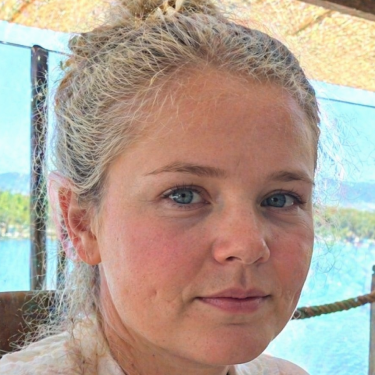
Lena K.
Germany
"We used BabyMorph almost as a joke during my third trimester — something to do on a Sunday afternoon. What came out was a baby girl with very light eyebrows, a wider forehead, and this particular way the nose sits slightly to the left. She was born six weeks later. The eyebrows. The forehead. The nose. Nobody believes it was generated before she arrived."
Their AI baby result
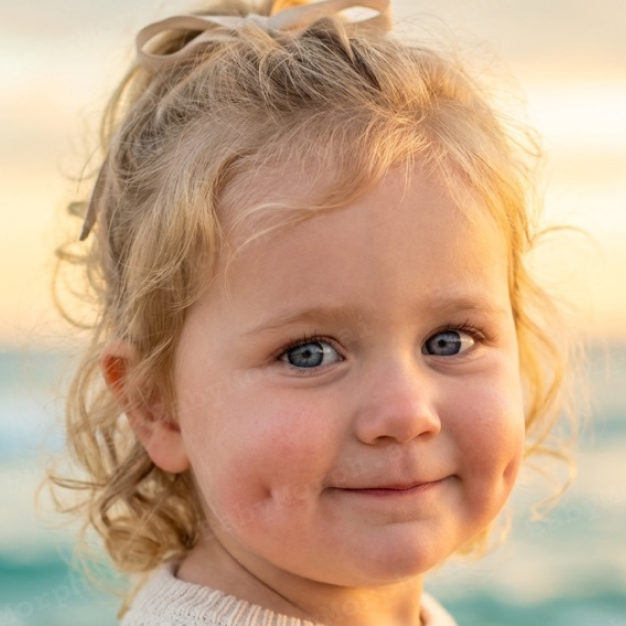

Jason T.
United States
"I have an Asian wife and I've made a habit out of breaking these AI baby tools. Every single one I've tried has completely failed. BabyMorph actually blended her features and mine in a way that made sense — you could see both of us in there without one canceling out the other. People keep asking if it's a real photo."
Their AI baby result
Frequently Asked Questions
When do these specific traits mature fully?
While core structural baselines emerge at birth, overall skeletal proportionality and cartilage mapping continue adjusting actively through childhood.
How does eumelanin influence blond versus brown hair color?
Eumelanin primarily determines the darkness of hair color; <em>lower concentrations typically result in blond hair</em>, while a denser production leads to shades ranging from light brown to black. Blond hair isn't pigment-free but contains modest amounts of eumelanin, often with pheomelanin, while brown hair has more eumelanin-packed melanosomes that absorb more light.
Can hair color change naturally over time?
Yes, <em>hair color can change naturally from childhood into adulthood</em>, influenced by genetics and environmental factors. Newborn hair is often a poor indicator of adult hair color, and variations can occur across the scalp or along a single strand due to sun exposure, friction, and biological processes. These changes reflect normal follicle biology and external influences.
What is the role of genes in determining hair color?
Natural hair color is <em>polygenic, meaning it results from the combined effects of many genetic locations</em>, not a single 'blond' or 'brown' gene. Genes like MC1R, OCA2/HERC2, TYR, SLC24A5, ASIP, and IRF4 all contribute to the amount, type, and distribution of pigments, shaping the final shade and its variations. The interaction of these variants determines a child's eventual hair color.
Why can two brown-haired parents have a blond child?
Two brown-haired parents <em>can indeed have a blond child</em>, especially if both carry genetic variants associated with lower eumelanin production that may not be visible in their own hair. Each child receives a unique combination of genes, and these pigment genes have varying effects, allowing for such outcomes without unusual genetic explanations. This is a common genetic phenomenon.
How does hair pigment distribution affect color perception?
Pigment distribution significantly affects how hair color is perceived; <em>two individuals with similar eumelanin production can have visibly different hair</em> if the pigment is arranged differently. Larger or more densely packed melanosomes create a darker visual result. Hair diameter also plays a role, with finer strands often appearing lighter due to increased light passage or reflection, even with modest pigment differences.
How accurate is BabyMorph at predicting hair color?
BabyMorph provides <em>potential hair color predictions based on parental genetic inputs and established inheritance patterns</em>, but cannot guarantee an exact shade. Hair color is influenced by many genes, and while our AI uses sophisticated algorithms to identify likely outcomes, the complexity of polygenic inheritance means there's always a range of possibilities, reflecting natural human variation. We aim for realistic possibilities, not definitive answers.
What is eumelanin and pheomelanin?
Eumelanin and pheomelanin are the two principal types of melanin that determine natural human hair color. <em>Eumelanin produces brown-to-black pigment</em>, with its concentration and distribution being key to distinguishing blond from brown hair. <em>Pheomelanin produces red-yellow pigment</em>, contributing golden, strawberry, or copper casts to blond hair and warmer tones to brown or auburn shades.