Red Hair Genetics: Double Recessive Allele Paths
How MC1R allele pairs and modifier genes shape red hair, from carrier inheritance paths to changing copper shades through adulthood.
Red hair is most often linked to variants in the MC1R gene, but the familiar idea of “two recessive red-hair genes” is only a useful starting point. Rich copper, auburn and strawberry-blonde shades arise from a combination of pigment chemistry, inherited variants and developmental changes in the hair follicle. A child can inherit red-hair-associated variants from two dark-haired parents, while a red-haired parent may have a child with brown or blond hair.
Why red hair is often described as recessive
The strongest known genetic contributor to natural red hair is MC1R, located on chromosome 16. This gene gives instructions for the melanocortin 1 receptor, a protein on pigment-producing cells called melanocytes. In the hair follicle, this receptor helps determine which broad type of melanin is made:
- Eumelanin, the brown-to-black pigment associated with darker hair.
- Phæomelanin, the yellow-red pigment associated with ginger, strawberry-blonde and copper hair.
When MC1R signalling works strongly, melanocytes are more likely to produce eumelanin. Certain MC1R variants reduce this signalling, shifting pigment production towards phæomelanin. Many of these variants behave in a recessive-like way: a person usually needs to inherit two red-hair-associated MC1R alleles, one from each parent, for vivid red hair to become likely.
However, “recessive” does not mean guaranteed. There are dozens of recognised MC1R variants, and their effects differ. Some are classed as stronger “R” variants, including R151C, R160W and D294H, because they have a clearer association with red hair and fair, freckle-prone skin. Others, sometimes called “r” variants, have milder or less consistent effects. Two strong variants are more likely to produce classic ginger hair than one strong and one weak variant, but neither combination creates an absolute outcome.
Carrier parents and the familiar one-in-four estimate
If each parent carries one red-hair-associated MC1R variant and one more typical MC1R copy, each pregnancy has an estimated 25% chance of receiving the variant from both parents. It also has a 50% chance of producing a child who carries one variant, and a 25% chance of receiving neither of those particular variants. These are probabilities for each conception, not a pattern that must appear across a family.
This simplified model applies best when both parents carry the same clearly functional red-hair-associated variant and when other pigment genes have limited visible influence. Real families are often more complicated: parents may carry different MC1R variants, may have variants whose functional effect is uncertain, or may pass on other genes that lighten, darken or alter the apparent warmth of hair.
The allele paths that can lead to copper hair
Think of each parent as having two MC1R copies. A child receives one from each. The combinations below illustrate why parental hair colour alone is not a reliable guide to what they may carry.
| Parental MC1R pattern | Possible child pattern | Likely visible implication |
|---|---|---|
| Two carriers: one usual-function allele and one strong red-hair-associated allele each | About 25% inherit two associated alleles | Classic red or copper hair becomes plausible, particularly with fair skin and low eumelanin background. |
| One red-haired parent with two associated alleles; one non-carrier parent | Children generally inherit one associated allele | Most will be carriers rather than red-haired, though hair may show warmth depending on other genes. |
| One red-haired parent; one carrier parent | Roughly half may inherit two associated alleles | Red hair is relatively likely, but shade can range from strawberry blond to deep auburn. |
| Parents with different weak or mixed-effect MC1R variants | Many possible variant pairs | Outcome is less predictable; auburn, light brown with red tones, freckles or no obvious red hair are all possible. |
Visible red hair can therefore skip apparent generations. A brown-haired parent may carry one MC1R variant without looking ginger. If their partner also carries a relevant variant, their child may inherit a combination that makes reduced MC1R signalling more apparent. This is why family history matters beyond parents and siblings: red-haired grandparents, aunts, uncles or cousins can be clues to carrier status, though not proof.
Genes beyond MC1R shape the final shade
MC1R has an unusually large role in red hair, but it does not operate alone. Hair colour is polygenic, meaning many loci contribute small or moderate effects. The exact balance affects whether a child’s hair appears pale strawberry blond, bright orange-copper, muted ginger, chestnut auburn or brown with reddish highlights.
Genes that modify pigment quantity and tone
OCA2 and nearby regulatory variation in HERC2 are best known for their influence on eye colour, especially blue versus brown eye probability, but they also affect melanin biology more broadly. Lower melanin output can make phæomelanin-rich hair look brighter and lighter. TYR encodes tyrosinase, a key enzyme in melanin synthesis; common variation can influence pigment production, while rare damaging variants can cause forms of albinism and are medically distinct from ordinary red hair.
SLC24A5 contributes to pigmentation differences through melanosome function and is associated with lighter skin pigmentation in several populations. ASIP, which interacts with the same pigment-signalling pathway as MC1R, can favour phæomelanin production in some contexts. Variants near IRF4 are linked with lighter hair in childhood, freckling and pigment variation. No single one of these genes can be read as a simple “red-hair switch”.
Genes such as EDAR influence hair shaft thickness and shape, while facial-development genes including PAX3 and RUNX2 relate to aspects of craniofacial development rather than hair pigment itself. They matter when considering the overall appearance of a growing child, but they should not be treated as explanations for ginger hair.
Freckles, pale skin and sun sensitivity
Red hair often occurs alongside fair skin, freckles and a tendency to burn rather than tan, because reduced MC1R activity can affect skin pigment responses as well as hair. Yet these traits do not always travel together. A child with two relevant MC1R variants may have very few freckles in early childhood, and a person with freckles may not have visibly red hair. Sun exposure also changes how freckles appear, so they are partly genetic and partly environmental in their visible expression.
When red hair becomes clear from birth to adulthood
Newborn hair is a poor final indicator. Some babies are born with dark, sparse or surprisingly light hair that sheds during the first months. The replacement hair can have a noticeably different colour and texture because follicles begin a new growth cycle.
| Age represented | What is usually becoming visible | How stable red-hair appearance is |
|---|---|---|
| Birth to 12 months | Initial hair may shed; pigment level is often hard to judge. | Low stability. A reddish cast may be real but can change substantially. |
| Age 3 | Replacement scalp hair and early undertones are usually established. | Moderately informative; strawberry blond and copper shades are often recognisable. |
| Age 6 | Hair density, shaft texture and freckling pattern become clearer. | Often a good guide, although some hair deepens or dulls slightly. |
| Age 10 | Childhood pigment pattern is well expressed before most pubertal changes. | Generally stable, with possible seasonal lightening. |
| Age 18 | Pubertal hormonal effects on skin, hair texture and pigment have largely occurred. | Most representative of young-adult shade, though gradual darkening may continue. |
At age 3, a genetically red-haired child may look bright ginger, pale gold or strawberry blond. By ages 6 and 10, the difference between copper pigment and ordinary warm blond or light brown is usually easier to see. During adolescence, some red hair becomes deeper auburn or brownish-red as eumelanin production increases, while others retain a clear orange-copper tone.
What family information can and cannot tell you
A known red-haired parent, sibling or grandparent increases the plausibility that relevant MC1R variants are present in a family. Two red-haired parents are very likely to have children with red-hair-associated MC1R combinations, although shade still varies. Conversely, two parents with dark hair can have a red-haired child if both carry compatible variants.
Family photographs offer useful context but cannot identify exact alleles. Lighting can make auburn hair appear brown, and childhood blond hair can have a red cast without being genetically classic red hair. Direct-to-consumer genetic tests may report selected MC1R markers, but they do not assess every relevant variant or fully account for modifier genes. They are informative at most, not definitive forecasts of a child’s eventual shade.
Frequently asked questions
Can two non-red-haired parents have a naturally red-haired child?
Yes. If both parents carry a red-hair-associated MC1R allele, a child can inherit one from each. In the simplest carrier model, this occurs in about one quarter of pregnancies, but the actual chance depends on the particular variants and other pigmentation genes.
Does a red-haired parent always pass on red hair?
No. A red-haired parent will usually pass on one MC1R variant associated with reduced receptor function, but the child also needs the other parent’s contribution and a favourable wider pigment background for visible red hair to be likely.
Can red hair become darker with age?
Yes. Many children’s hair changes after infancy and again around puberty. Bright copper may become deeper auburn, and strawberry blond may look more blond or light brown in lower light. The underlying MC1R pattern does not change, but pigment output and hair structure do.
Are blue eyes required for red hair?
No. Red hair and blue eyes are both more common in some European-ancestry populations, but they involve overlapping rather than identical genetic influences. Blue eyes are strongly associated with regulatory variation near HERC2 and OCA2; red hair is more closely tied to MC1R.
What our users say
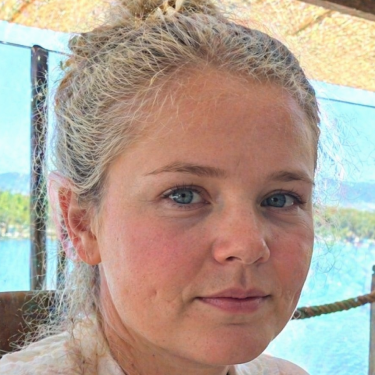
Lena K.
Germany
"We used BabyMorph almost as a joke during my third trimester — something to do on a Sunday afternoon. What came out was a baby girl with very light eyebrows, a wider forehead, and this particular way the nose sits slightly to the left. She was born six weeks later. The eyebrows. The forehead. The nose. Nobody believes it was generated before she arrived."
Their AI baby result
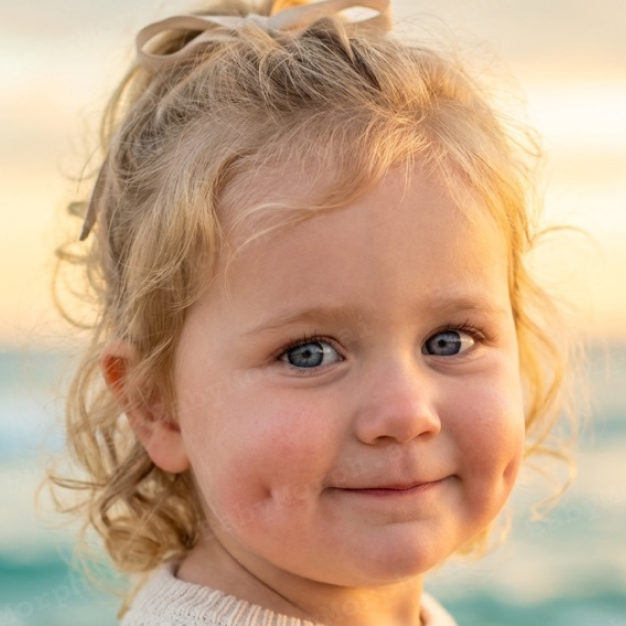

Jason T.
United States
"I have an Asian wife and I've made a habit out of breaking these AI baby tools. Every single one I've tried has completely failed. BabyMorph actually blended her features and mine in a way that made sense — you could see both of us in there without one canceling out the other. People keep asking if it's a real photo."
Their AI baby result
Frequently Asked Questions
When do these specific traits mature fully?
While core structural baselines emerge at birth, overall skeletal proportionality and cartilage mapping continue adjusting actively through childhood.
Can two dark-haired parents have a child with red hair?
Yes, two dark-haired parents can have a child with red hair if both carry a red-hair-associated <em>MC1R</em> allele. Red hair often behaves in a recessive-like way, meaning a child needs to inherit two such alleles, one from each parent, to express the trait. The parents themselves might not show red hair if they only carry one allele.
How do genes beyond MC1R influence hair color, including red shades?
Beyond <em>MC1R</em>, several other genes modify the final shade and intensity of red hair by affecting pigment quantity and tone. Genes like <em>OCA2</em>, <em>HERC2</em>, <em>TYR</em>, and <em>SLC24A5</em> contribute to overall melanin production and distribution, influencing whether red hair appears as bright copper, auburn, or a lighter strawberry blonde. <em>ASIP</em> also interacts with the pigment-signaling pathway, further shaping the outcome.
Is red hair strictly determined by recessive genes?
While red hair is often described as recessive, particularly regarding strong <em>MC1R</em> variants, it's not a strict absolute. There are dozens of <em>MC1R</em> variants with differing effects, some weaker than others. Additionally, red hair is a polygenic trait, meaning other genes contribute to the final shade, making the outcome less predictable than a simple recessive model suggests.
What is the likelihood of a child inheriting red hair from carrier parents?
If both parents are carriers, meaning each has one red-hair-associated <em>MC1R</em> variant and one typical copy, each child has an estimated 25% chance of inheriting two associated alleles and therefore having red hair. There's also a 50% chance of being a carrier and a 25% chance of inheriting neither specific variant. These probabilities apply to each individual pregnancy.
Can red hair appear in a child if neither parent has it?
Yes, red hair can certainly appear in a child even if neither parent has red hair. This happens when both parents are carriers of a red-hair-associated gene variant, most commonly in the <em>MC1R</em> gene. The child inherits one variant from each parent, resulting in the expression of red hair. This is why red hair can "skip" generations.
How does BabyMorph use genetics to predict a child's hair color?
BabyMorph uses a sophisticated AI model that considers various genetic inputs from both parents, including key genes like <em>MC1R</em> and known modifier genes, to predict a child's potential hair color. By analyzing allele combinations and their known phenotypic expressions, BabyMorph estimates the likelihood of different shades, including red, auburn, or strawberry blonde, based on established genetic principles.
Why is family history important for predicting a child's red hair?
Family history is important because red-haired relatives, even grandparents or cousins, can indicate that parents are carriers of red-hair-associated gene variants, even if the parents themselves do not have red hair. Understanding the broader family tree can provide valuable clues about potential allele paths and the likelihood of a child inheriting the genetic combination for red hair.