Curly vs. Wavy Hair Textures: The Intermediate Dilemma
Why children may develop hair between wavy and curly: follicle anatomy, polygenic inheritance, age changes and realistic family expectations.
Hair texture is often described as a simple choice between straight, wavy and curly, yet many children develop a pattern that sits convincingly between categories. Loose spirals, strong S-waves, waves at the roots with curls at the ends, and mixed textures across the scalp are all common. This “intermediate dilemma” is especially noticeable in families with varied ancestral backgrounds, but it is not caused by one parent’s hair type simply blending with the other’s. Hair shape emerges from follicle anatomy, many genetic variants, hormones and age-related changes in the growing scalp.
Why wavy and curly hair form differently
Each visible hair fibre is made in a living follicle beneath the skin. The follicle’s geometry strongly influences the strand that emerges from it. A relatively round, upright follicle tends to produce straighter fibres. More curved, asymmetrical follicles can create a bent or twisting shaft, producing waves or curls. The distribution of keratin proteins and chemical bonds within the fibre also matters.
Follicle shape is only part of the story
Curly hair is not simply “flat hair follicles”; that familiar explanation is too limited. Curvature arises from several related features: the angle of the follicle in the scalp, the shape of the hair bulb, uneven cell growth within the developing fibre, and the internal arrangement of keratin. A curved follicle can create a strand with an elliptical cross-section, but neither feature alone determines curl pattern perfectly.
Wavy hair often occupies a broad middle range. It may have enough asymmetry to form repeated S-shaped bends, but not enough to form stable corkscrew coils. Humidity, strand length, damage, styling and hair density can make that same child’s hair appear almost straight on one day and distinctly curly on another.
Texture categories describe appearance, not strict biology
Terms such as 2A, 2B, 2C, 3A and 3B can be useful for discussing care needs, but they are not genetic diagnoses. A child may have 2C waves around the crown, 3A ringlets at the nape, and looser waves along the hairline. This variation is normal because individual scalp follicles do not all have identical shape, growth rate or response to hormones.
The genetics of an intermediate hair texture
Hair texture is polygenic: it is influenced by many inherited DNA variants, each with modest or context-dependent effects. Older classroom models sometimes present curliness as a single dominant gene and straight hair as recessive. That model is not reliable enough for real families. It can explain neither the wide variety of wave patterns nor the fact that two curly-haired parents may have a wavy-haired child.
“Incomplete dominance” is a helpful visual analogy when a child’s texture appears intermediate between parental textures, but it should not be treated as the full biological explanation. In classical incomplete dominance, one gene has a predictable blended effect in a heterozygote. Human hair texture involves numerous loci, gene regulation and follicle development, so an intermediate result may reflect many combined variants rather than one neat genetic pairing.
Genes associated with hair form and fibre structure
Research has identified several genes and regions associated with hair shape, thickness or follicle characteristics. Their effects differ among populations, and possessing a variant does not guarantee a particular curl pattern.
- TCHH encodes trichohyalin, a protein important in the inner root sheath and hair-shaft formation. Variants near or within this gene have been associated with hair morphology in European-ancestry studies.
- EDAR influences ectodermal structures including hair follicles, teeth and sweat glands. The EDAR V370A variant is associated with thicker, straighter hair fibres in many East Asian and Indigenous American populations, though it is not a universal “straight-hair gene”.
- PRSS53 has been linked with hair shape in genome-wide association studies and appears relevant to follicle and shaft development.
- KRT genes, which encode keratins, and genes regulating keratin-associated proteins contribute to the fibre’s strength, diameter and ability to hold a bend.
- WNT signalling genes help establish hair follicles during embryonic development. Their influence is fundamental, but common inherited variation in this pathway does not translate into a simple consumer-level curl prediction.
Genes commonly discussed in pigmentation, including MC1R, OCA2, HERC2, TYR and SLC24A5, primarily affect melanin production or distribution rather than curl shape. They can still alter how texture looks: dark, glossy hair may make waves appear more defined, while lighter fine hair can make the same physical bends less visible.
What parent combinations can and cannot tell you
Parental hair is useful evidence, particularly when grandparents and siblings are considered, but it gives a range rather than a promise. A parent with apparently straight hair may carry variants associated with waves that are not visible in their own combination. Another parent may have curls that loosened with age, heat styling or hormonal changes. Family photographs from childhood are often more informative than adult hair alone.
| Observed parental pattern | Common child outcomes | Why the range remains broad |
|---|---|---|
| Both parents have loose waves | Straight-to-wavy, defined waves, or occasional loose curls | Both may carry variants for stronger or weaker follicle curvature. |
| One parent has straight hair, one has curls | Wavy hair is common, but straight and curly outcomes remain possible | Many texture-associated variants can combine in different ways. |
| One parent has waves, one has tight curls | Strong waves, loose curls, mixed curl zones, or tighter curls | Hair diameter, density and follicle angle modify the visible pattern. |
| Parents from different ancestral populations | Any texture on the straight-to-coily spectrum | Ancestry informs population frequencies, not an individual child’s fixed result. |
For children from multiracial families, it is tempting to expect a visually “halfway” texture. Some do develop pronounced waves or loose curls, but others resemble one side of the family more closely in this one trait. Ancestry is not a set of separate, indivisible packages, and hair-related variants can be inherited in many combinations. The most responsible prediction is usually a spectrum of plausible textures, not a single label.
When hair texture becomes visible
Newborn hair is a poor forecast of long-term texture. It may be sparse, fine, rubbed away at the back of the head or replaced within months. The first substantial childhood hair can differ in colour, density and curl pattern from both birth hair and later adult hair.
| Age | What is usually visible | How dependable texture assessment is |
|---|---|---|
| Birth to 12 months | Temporary infant hair; patchiness and shedding are common | Low; curls or waves may disappear or emerge later |
| Age 3 | More established density, fibre thickness and early wave pattern | Moderate; broad straight, wavy or curly tendency is often apparent |
| Age 6 | Childhood texture is usually clearer and easier to classify | Fairly good, although length and care routines affect definition |
| Age 10 | Pre-pubertal hair pattern, often with greater length and density | Good for current appearance, not necessarily final adult texture |
| Age 18 | Post-pubertal texture and mature scalp oil production | Most stable, though pregnancy, ageing, illness and medication can still alter hair later |
For age-rendered images at 3, 6, 10 and 18, the most realistic approach is to show gradual refinement rather than abrupt switches. A three-year-old with soft, uneven waves may plausibly have clearer waves at six, more weight-stretched curls at ten, and a somewhat different pattern after puberty.
Why puberty can change curls and waves
Hair follicles respond to hormones. During puberty, increased androgen activity can alter sebum production, shaft diameter and the follicle environment. Some teenagers find that formerly straight hair becomes wavier; others notice that childhood curls loosen as strands become thicker and longer. These shifts do not mean that their genes changed. Instead, inherited follicle traits are being expressed under a new hormonal setting.
Changes can also occur after major hormonal events in adulthood, including pregnancy and menopause. Thyroid disorders, nutritional deficiencies, chemotherapy and some medicines can affect density or shaft quality as well. A sudden, substantial texture change accompanied by shedding, scalp symptoms or fatigue merits discussion with a clinician.
Practical care for an uncertain or mixed texture
When a child’s hair seems caught between wavy and curly, care should protect the pattern rather than force a category. Heavy products can flatten fine waves, while harsh brushing can disrupt curls and create frizz. Begin with gentle, adjustable routines.
- Use a mild shampoo appropriate to the child’s scalp and wash frequency, rather than washing solely to control curl definition.
- Detangle damp hair with conditioner and a wide-tooth comb or flexible brush, starting at the ends.
- Apply a small amount of lightweight leave-in conditioner to dry-prone lengths; increase richness only if the hair needs it.
- Avoid frequent high heat, aggressive towel rubbing and tightly pulled styles, which can cause breakage at vulnerable edges.
- Photograph hair after gentle washing and air-drying over several months to see its natural pattern more clearly.
Frequently asked questions
Can two straight-haired parents have a curly-haired child?
Yes. Both parents may carry combinations of texture-associated variants that are not strongly expressed in their own hair, and wider family patterns matter. A curly outcome may be less expected in some families, but it is biologically plausible without implying anything unusual about parentage.
Will a baby’s newborn curls stay curly?
They may, but newborn hair is not a dependable guide. Many babies shed their first hair during the first year, and replacement hair can be straighter, curlier, darker, lighter, thicker or finer. A more useful indication usually emerges between ages two and four.
Does mixed ancestry always produce wavy hair?
No. Children with mixed ancestry can have straight, wavy, curly or tightly coiled hair. Population ancestry can affect the frequency of certain variants, but individual inheritance and follicle development determine the child’s actual texture.
Can hair products permanently make a child’s hair curlier or straighter?
Ordinary products can temporarily define, weigh down or relax the appearance of the natural pattern, but they do not change follicle genetics. Chemical relaxers, permanent waves and repeated high heat can alter the shaft and cause damage, so they should be approached cautiously, particularly in children.
What our users say
Lena K.
Germany
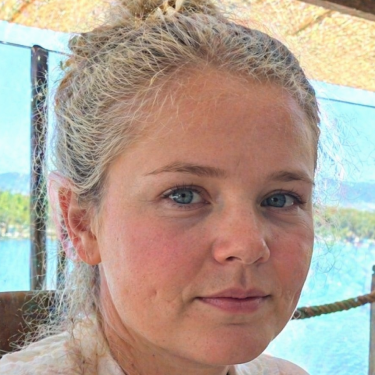
"We used BabyMorph almost as a joke during my third trimester — something to do on a Sunday afternoon. What came out was a baby girl with very light eyebrows, a wider forehead, and this particular way the nose sits slightly to the left. She was born six weeks later. The eyebrows. The forehead. The nose. Nobody believes it was generated before she arrived."
Their AI baby result

Jason T.
United States
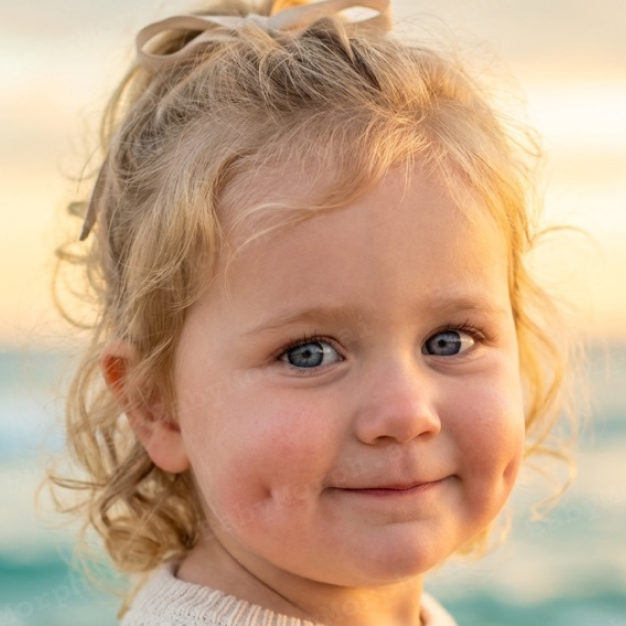
"I have an Asian wife and I've made a habit out of breaking these AI baby tools. Every single one I've tried has completely failed. BabyMorph actually blended her features and mine in a way that made sense — you could see both of us in there without one canceling out the other. People keep asking if it's a real photo."
Their AI baby result
Frequently Asked Questions
When do these specific traits mature fully?
While core structural baselines emerge at birth, overall skeletal proportionality and cartilage mapping continue adjusting actively through childhood.
Why does my child have wavy and curly hair?
Many children develop a hair pattern that sits between wavy and curly due to a complex interplay of follicle anatomy, multiple genetic variants, and changes in hair growth over time. This "intermediate dilemma" is common, and not simply a blend of parental hair types. <em>Hair texture can also appear different on various parts of the scalp</em>, leading to mixed patterns like 2C waves and 3A ringlets on the same head.
What causes wavy hair versus curly hair?
Wavy and curly hair form differently primarily due to the geometry of the hair follicle and the internal structure of the hair strand. A more curved or asymmetrical follicle tends to produce waves or curls, whereas a rounder follicle creates straighter hair. <em>The distribution of keratin proteins and the angle of the follicle in the scalp also contribute significantly</em> to the resulting curl pattern, often creating a broad middle range for wavy hair.
Is hair texture determined by one gene?
Hair texture is <strong>polygenic</strong>, meaning it is influenced by many inherited DNA variants, not just one gene. Older models suggesting curliness is a single dominant gene are not accurate enough to explain the wide variety of patterns observed in real families. This complexity allows for a broad spectrum of hair types, including intermediate textures, even among siblings.
Can genetics predict my baby's hair texture?
While genetics heavily influence hair texture, <em>predicting a baby's exact hair texture is complex</em> because it involves many genes and environmental factors. Tools like BabyMorph can offer insights into potential appearances based on parental photos, but they illustrate possibilities rather than certainties. Family history, especially childhood photos of parents, can be more informative than adult hair alone due to age-related changes.
What genes are associated with hair texture?
Several genes are associated with hair shape and fibre structure. Variants near or within genes like <em>TCHH, EDAR, and PRSS53</em> have been linked to hair morphology and follicle characteristics. KRT genes, which encode keratins, also contribute to the hair's strength and ability to hold a bend. These genes interact in complex ways, meaning a single variant doesn't guarantee a specific curl pattern.
Why do two curly parents have a wavy child?
Two curly-haired parents can have a wavy-haired child because hair texture is controlled by <strong>multiple genes with varying effects</strong>, not a simple dominant-recessive pattern. The combination of these genetic variants in the child might result in an intermediate expression of hair curvature that appears wavy, even if both parents express a curlier phenotype. This is a common outcome in polygenic inheritance.
How does hair texture change with age?
Hair texture can change significantly with age due to hormonal shifts and alterations in follicle activity. What appears as straight hair in a child might develop into waves or curls later, or vice-versa. <em>Many parents observe changes from infancy through puberty</em>, making childhood photos a more reliable indicator of a person's underlying hair texture potential than adult hair alone.