Understanding Baby Hair Textures and Curl Patterns
Learn how follicle shape, genetics and childhood development influence baby hair thickness, waves, curls and changing texture.
Baby hair can seem surprisingly unpredictable: two straight-haired parents may have a child with soft waves, while a curly-haired parent may initially have a baby with almost no visible curl. That is because hair texture is shaped by follicle anatomy, hair-shaft biology, developmental timing and many inherited gene variants rather than one simple “curly” or “straight” gene.
What creates a baby’s hair texture?
Hair texture describes the physical form of the hair fibre: straight, wavy, curly or tightly coiled. It is separate from hair colour, quantity and growth speed, although these features can change alongside one another in early childhood.
The follicle sets the basic pattern
The hair follicle is a small skin organ that produces each individual hair. Its shape and angle beneath the scalp have a major influence on the emerging fibre.
- More symmetrical, round follicles tend to produce straighter shafts.
- Slightly curved or oval follicles more often produce waves.
- Curved, hook-like follicles and markedly elliptical shafts are associated with curls and coils.
- The direction of growth also matters. Follicles positioned at different angles can create cowlicks, whorls and areas that appear curlier than others.
A curly fibre is not simply a straight fibre that has been twisted after it leaves the scalp. Within a curved follicle, cells may be laid down unevenly along different sides of the growing shaft. This produces a fibre that bends repeatedly as it emerges. Hair-shaft cross-section contributes too: straight hair is often closer to circular in section, whereas curlier hair is commonly more oval or flattened. These are tendencies, not rules that can identify an individual child.
Calibre, density and texture are different traits
Parents often say a baby has “thick hair” when they may mean one of three things. Hair calibre is the width of each strand. Density is the number of follicles per area of scalp. Volume is the visible fullness created by density, calibre, curl pattern and length. A child can have fine individual strands but very dense hair, or coarse strands with relatively low density.
Fine newborn hair does not reliably mean that the child will have fine hair later. A mature terminal hair fibre is usually wider and more pigmented than the early hairs seen in infancy.
The genetics behind straight, wavy and curly hair
Hair texture is polygenic, meaning that many gene variants contribute small or moderate effects. Family resemblance is informative, especially when patterns recur across siblings, grandparents and cousins, but it cannot provide a precise percentage chance for a particular curl type.
Genes researchers have linked to hair form
Several genes are associated with aspects of hair shape, diameter or follicle development. Their effects vary between populations and interact with one another.
| Gene or locus | Known biological role | Possible relevance to visible hair traits |
|---|---|---|
| EDAR | Signals during development of hair follicles, teeth and sweat glands | Variants are associated with thicker, straighter hair shafts in some East Asian populations. |
| TCHH | Produces trichohyalin, a protein involved in shaping the inner root sheath | Common variants have been associated with hair curliness, particularly in European-ancestry studies. |
| PRSS53 | Active in the hair follicle and linked to calcium handling in hair formation | Associated with straight-to-curly variation in genome-wide studies. |
| KRT71 | Encodes a keratin important in the inner root sheath | Rare disruptive variants can alter hair shape; research also supports a role in curl biology. |
| PAX3 | Helps regulate development of neural crest-derived pigment cells | More relevant to pigmentation and facial development, but may travel with visible family hair traits in ancestry-based patterns. |
Genes commonly discussed for colouring, such as MC1R, OCA2, HERC2 and TYR, chiefly influence pigment pathways rather than curl pattern. SLC24A5 contributes to variation in skin pigmentation, while RUNX2 has important roles in skeletal and craniofacial development. These genes do not let anyone read a baby’s future hair texture from a single DNA result.
When one parent has loose waves and the other has tight curls, their child may inherit any blend of the relevant variants. The result may be curls, waves, straight-looking hair with a curlier underlayer, or texture that changes as the shaft matures. A parent’s hair can also differ across the scalp, so family descriptions such as “straight” or “curly” are often less precise than they sound.
Why newborn hair often changes
The hair present at birth is not necessarily the hair that will define childhood. Hair follicles begin forming during fetal development, with scalp follicle development progressing broadly from the second trimester. Before birth, the body is covered by fine lanugo, much of which is shed before delivery. The scalp hair visible in a newborn may be soft, sparse, uneven or surprisingly full, but it is still responding to a changing hormonal environment.
The common shedding phase
Many babies lose some or much of their birth hair between about two and six months. This is usually a normal synchronised shift of follicles into the resting, or telogen, phase after birth. Replacement hair can grow in a different colour, density or texture. A baby born with silky straight hair may later grow waves; another born with dark curls may temporarily become sparse before new hair appears.
Friction can make loss look more dramatic at the back of the head, where a young baby rests against a mattress. This does not normally damage the follicles. Persistent scaling, inflammation, sharply defined bald patches, broken hairs or poor growth should be discussed with a GP, health visitor or paediatric clinician.
When curl pattern becomes visible
Texture becomes easier to judge once replacement hairs have grown long enough to express their natural bend. Even then, the pattern may continue evolving through childhood as follicles enlarge, shafts become more robust and grooming habits reveal or disguise waves.
| Age | What is commonly visible | How dependable is the texture? |
|---|---|---|
| Birth to 12 months | Birth hair, patchy regrowth, soft fine fibres and temporary shedding | Low; early hair frequently changes. |
| Age 3 | More established density and a recognisable straight, wavy or curly tendency | Moderate; the basic pattern is often apparent. |
| Age 6 | Longer fibres show ringlets, wave grouping, frizz tendency and strand calibre more clearly | Moderately high, though gradual change remains normal. |
| Age 10 | Childhood texture is usually consistent across several growth cycles | High for the pre-pubertal pattern. |
| Age 18 | Puberty-related hormonal changes may affect oiliness, diameter and apparent curl definition | High, but hair can still alter in adulthood. |
At age three, an image can reasonably represent a broad texture family, such as loose waves or springy curls, but not every individual curl’s eventual diameter or distribution. By six and ten, the inherited pattern is generally more legible. At eighteen, it is sensible to allow for the influence of puberty on scalp oil production and hair-fibre behaviour.
Environmental influences: real, but not a change of genes
Genes establish the developmental potential of the follicle, but the hair seen on a particular day is also affected by water, humidity, damage and care. Humidity forms and disrupts hydrogen bonds in the hair shaft, so wavy and curly hair may look straighter when stretched wet and more defined as it dries. Brushing dry curls can separate curl clumps and create a fuller, less defined appearance.
Frequent heat styling, bleaching and harsh chemical treatments can change the visible pattern by damaging the cuticle and cortex, but they do not rewrite the genes in the follicle. In young children, gentle cleansing, conditioner suited to the hair’s dryness, wide-tooth detangling and avoiding tight styles that pull on the scalp are usually more useful than trying to force a particular texture.
Frequently asked questions
Can two straight-haired parents have a curly-haired baby?
Yes. Both parents may carry combinations of variants associated with curl or wave formation that are not strongly visible in their own hair. Texture also reflects contributions from wider family lines, and a child’s follicles can combine inherited effects in a new way. It is possible, but no responsible assessment can assign a universal probability without detailed family and genetic information.
Does shaving a baby’s hair make it grow back thicker?
No. Shaving cuts the shaft above the skin and does not alter follicle number, hair diameter or growth rate. Regrowing hair may feel coarser because its cut end is blunt rather than naturally tapered, creating the impression of thickness.
Why is my baby’s hair curly underneath but straight on top?
Follicles vary across the scalp in orientation, shape and growth cycle. The underlayer may also be less exposed to friction, sun and brushing. Mixed textures are extremely common, particularly during the years when childhood hair is replacing early infant hair.
Will my child’s curls disappear at puberty?
They may loosen, tighten or become more prone to oiliness and frizz, but they do not always disappear. Hormonal changes can affect follicle activity and fibre diameter. The direction and degree of change differ between individuals, even within the same family.
What our users say
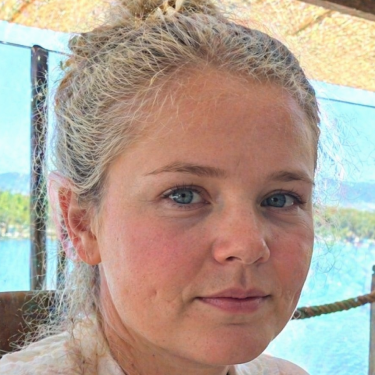
Lena K.
Germany
"We used BabyMorph almost as a joke during my third trimester — something to do on a Sunday afternoon. What came out was a baby girl with very light eyebrows, a wider forehead, and this particular way the nose sits slightly to the left. She was born six weeks later. The eyebrows. The forehead. The nose. Nobody believes it was generated before she arrived."
Their AI baby result
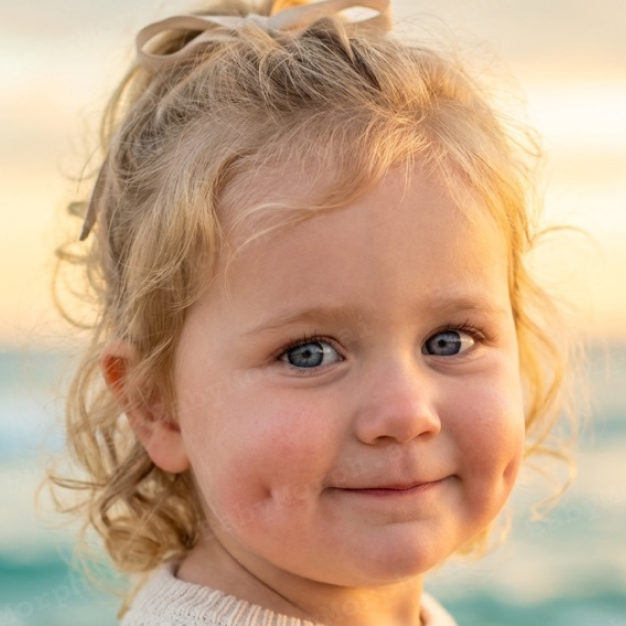

Jason T.
United States
"I have an Asian wife and I've made a habit out of breaking these AI baby tools. Every single one I've tried has completely failed. BabyMorph actually blended her features and mine in a way that made sense — you could see both of us in there without one canceling out the other. People keep asking if it's a real photo."
Their AI baby result
Frequently Asked Questions
When do these specific traits mature fully?
While core structural baselines emerge at birth, overall skeletal proportionality and cartilage mapping continue adjusting actively through childhood.
What determines a baby's hair texture?
A baby's hair texture is primarily determined by the <em>shape and angle of the hair follicles</em> beneath the scalp, alongside many inherited gene variants. Rounder follicles tend to produce straighter hair, while oval or curved follicles result in waves and curls. This foundational shape, combined with the biology of the hair shaft and developmental timing, dictates whether hair will be straight, wavy, curly, or coiled. Environmental factors and hormonal changes can also influence texture in infancy.
Can baby hair texture change over time?
Yes, it is very common for a baby's hair texture to change significantly throughout early childhood. The hair present at birth, often soft lanugo, frequently undergoes a natural shedding phase around 2-6 months. The replacement hair can grow in with a different color, density, or texture than the initial strands. As follicles mature and shafts thicken, a baby born with straight hair might develop waves, or one with curls might see temporary changes before their permanent pattern establishes. These changes are a normal part of development.
What is the difference between hair calibre and density?
Hair <em>calibre</em> refers to the individual width or diameter of each hair strand, indicating whether it is fine, medium, or coarse. <em>Density</em>, on the other hand, describes the number of hair follicles per square inch of the scalp. A baby can have fine individual strands (low calibre) but a very high number of follicles (high density), creating an appearance of fullness. Conversely, coarse strands (high calibre) with fewer follicles (low density) can also occur. These are distinct traits contributing to overall hair volume.
Is hair texture inherited from parents?
Yes, hair texture is inherited from parents, as it is a <em>polygenic trait</em> influenced by many gene variants rather than a single 'curly' or 'straight' gene. Family resemblance, observed across siblings, grandparents, and cousins, can be informative. However, predicting a precise curl type is complex because numerous genes contribute with small to moderate effects, and their interactions can lead to a wide spectrum of outcomes. Even if both parents have straight or curly hair, their child might exhibit a blend of textures or a pattern that evolves with age.
Which genes are linked to hair curliness?
Several genes have been linked to hair curliness and texture. For instance, common variants in the <em>TCHH gene</em>, which produces trichohyalin, have been associated with hair curliness, particularly in studies of European-ancestry populations. The <em>PRSS53 gene</em>, active in the hair follicle, is also connected to straight-to-curly variation. Additionally, the <em>KRT71 gene</em>, encoding a crucial keratin, plays a role in curl biology. These genes influence how hair shafts form and emerge from the scalp, contributing to the ultimate texture.
Why do some babies lose their hair around 2-6 months?
Many babies experience a normal and temporary hair loss phase, known as telogen effluvium, between approximately two and six months of age. This occurs because a large number of hair follicles simultaneously enter the resting (telogen) phase after birth, often due to hormonal shifts. As the new, permanent hair begins to grow, the older, finer baby hair sheds. This process is rarely a cause for concern and is a typical part of hair development. The replacement hair often grows in with a different texture, color, or density.
Can BabyMorph predict my child's hair texture?
BabyMorph primarily focuses on predicting facial features and overall appearance based on parental photos, not specific hair texture or curl patterns. While the appearance of hair in the generated image might reflect a general influence from the parents, accurately predicting complex polygenic traits like hair texture remains challenging. Hair texture is influenced by many genes that interact in subtle ways and can change significantly during early childhood. Therefore, BabyMorph offers a fun glimpse into potential likenesses rather than a definitive forecast of precise hair traits.