Polynesian Hair Genetics: Thickness and Density
How genes, follicle development and childhood growth shape hair thickness, density and texture in children with Polynesian heritage.
Hair described as “thick” can refer to several different features: a broad individual hair shaft, many follicles per square centimetre, a large overall hair mass, or a texture that makes the hair appear fuller. In families with Polynesian heritage, these traits may be common, but they are not uniform across individuals or islands. Hair appearance reflects many inherited variants, childhood development, age, grooming and, later, hormonal change.
Thickness, density and texture are separate traits
A parent may have hair that looks exceptionally full because each shaft is wide, even if their follicle density is average. Another may have fine individual hairs but a high number of active follicles. These distinctions matter when considering what a child may inherit.
Hair shaft diameter
Hair thickness usually means the diameter of the fibre emerging from the follicle. Human scalp hairs commonly range from roughly 40 to 120 micrometres wide. Wider shafts reflect the size and activity of the hair matrix, the rapidly dividing cells at the base of each follicle that form the hair fibre. Broad shafts tend to resist bending, hold volume and feel coarse or substantial between the fingers.
Variants in pathways involving EDAR, keratin genes such as KRT71 and KRT74, and structural hair genes including TCHH may influence shaft form and texture. The EDAR V370A variant has been associated in several East Asian-ancestry studies with thicker, straighter hair shafts and changes in some skin appendages. It is not a universal Polynesian marker, however, and its presence cannot establish how thick a particular child’s hair will be.
Follicle density
Density is the number of follicles established in the scalp. Most follicles form before birth; a person does not normally create a new set of scalp follicles during childhood. Density varies by scalp region and can be visually altered by shaft width, curl pattern and hair colour contrast against the scalp.
Genes involved in skin and follicle development, including WNT10A, EDA and EDAR, contribute to the biological systems that shape follicles. Their effects are usually small in people without a rare genetic condition. A child can therefore inherit a dense-looking head of hair without matching either parent exactly.
Texture and apparent volume
Curved or wavy fibres separate from one another more readily than straight fibres, often producing a fuller visual effect. Hair curvature has been linked to many loci, including TCHH, PRSS53 and several keratin-related regions. Humidity, fibre damage and hair length can also make texture look more or less pronounced.
What “Polynesian hair genetics” can and cannot mean
Polynesia includes many communities across a very large Pacific region, with distinct settlement histories and family lineages. Polynesian ancestry is often shaped by varying contributions from Austronesian-speaking ancestors, earlier Near Oceanian populations and, in many contemporary families, European, East Asian, South Asian or other ancestry. It is not scientifically accurate to treat all Polynesian people as having one hair type or one inherited set of variants.
Within the same whānau or extended family, one child may have dense, straight, dark hair, while a sibling develops a looser wave, finer shafts or lower visible density. These differences arise because the variants influencing hair are distributed across many chromosomes and are reshuffled at conception. Family observation is generally more useful than a broad ethnic label when estimating a child’s likely hair characteristics.
- Look at both biological parents, not only the parent with the most visibly voluminous hair.
- Include siblings, grandparents, aunts and uncles, especially where hair texture is consistent across generations.
- Separate childhood hair from adult hair: a parent’s present density may have changed with age, pregnancy, illness or styling.
- Remember that dark hair can appear denser because the scalp-hair contrast is stronger than with lighter hair.
Genes that contribute to hair form and pigmentation
No single routine genetic test can provide a reliable forecast of a child’s scalp hair density. Still, research identifies biological pathways that help explain why hair traits run in families.
| Trait or pathway | Examples of relevant genes/loci | What research supports | What it cannot determine alone |
|---|---|---|---|
| Follicle and skin appendage development | EDAR, EDA, WNT10A | Influence on ectodermal structures, including hair follicles | Exact childhood scalp density |
| Shaft shape and curl tendency | TCHH, PRSS53, KRT71 | Associations with straighter, wavier or curlier fibre form | A precise curl pattern or response to humidity |
| Hair pigment | MC1R, OCA2, HERC2, TYR | Melanin production and pigment variation | How dark hair makes density appear visually |
| Skin pigmentation context | SLC24A5, OCA2, TYR | Variation in pigmentation pathways across populations | Hair thickness or follicle number |
Hair pigmentation and hair density can be inherited independently. For example, MC1R is well known for its role in red-hair variation in some populations, while OCA2, HERC2 and TYR influence melanin biology. These genes may change the perceived contrast between hair and scalp, but they do not explain a thick hair shaft.
How parental combinations affect the likelihood of thick-looking hair
When both parents have broad shafts, high visible density or strongly textured hair, their child has a higher-than-average chance of showing one or more of these features. The probability is not a guarantee. Different combinations can produce a child whose hair resembles a grandparent more than either parent.
| Parental pattern | Reasonable expectation for a child | Main uncertainty |
|---|---|---|
| Both parents have broad, dense-looking hair | Greater likelihood of substantial hair volume | Whether volume comes from shaft width, density or texture |
| One parent has fine straight hair; one has coarse wavy hair | Intermediate or mixed fibre characteristics are plausible | Texture can vary considerably between siblings |
| Both parents have dark hair but different density | Dark pigmentation is likely, but density remains variable | Colour does not predict follicle number |
| Strong thick-hair pattern in grandparents | The trait may reappear in a child | Many contributing variants may not be inherited together |
It is also important to distinguish ordinary family variation from hair loss. Patchy loss, scalp scaling, broken hairs or an abrupt reduction in density in a child deserves assessment by a GP, dermatologist or paediatric clinician rather than an assumption that it is genetic.
When thickness and density become visible
Newborn hair is a poor guide to lifelong hair. Some babies are born with abundant scalp hair and shed much of it in the first months; others begin with sparse hair and develop a full head later. Follicles are present, but the growth cycle and fibre characteristics are still maturing.
| Age | What is usually becoming clearer | How dependable the appearance is |
|---|---|---|
| Birth to 12 months | Initial pigment, temporary newborn hair and early shedding | Low |
| Age 3 | Early childhood density, basic texture and growth direction | Moderate |
| Age 6 | More stable shaft thickness and a clearer wave or curl pattern | Moderately high |
| Age 10 | Pre-pubertal hair mass and scalp coverage | High for childhood appearance |
| Age 18 | Post-pubertal texture, oil production and mature styling behaviour | High, though adult changes can still occur |
At age 3, a child’s hair may still be finer or lighter than it will be later. By age 6, family texture patterns are often easier to recognise. Between ages 10 and 18, puberty can alter sebum production, hair diameter and the way the hair sits, particularly in adolescents with naturally wavy or curly fibres.
Frequently asked questions
Can a baby inherit very thick hair if only one parent has it?
Yes. Thick-looking hair can arise from variants inherited from one parent, from a combination of variants from both sides, or from traits seen more clearly in grandparents. One parent’s visibly fine hair does not cancel the other parent’s tendency towards broad shafts or high density.
Does Polynesian ancestry guarantee dense scalp hair?
No. Many people with Polynesian heritage have dense or substantial hair, but there is wide variation within and between families. Ancestry can inform broad probabilities, whereas close biological relatives provide more meaningful clues for an individual child.
Why did my child’s hair become thicker after toddlerhood?
Early baby hair is often replaced during the first year or two. The replacement fibres may be darker, wider, curlier or more numerous in visible coverage. This is a normal developmental change and does not mean new follicles suddenly formed.
Can hair thickness be predicted from hair colour?
Not reliably. Dark hair may look denser because it contrasts strongly with the scalp, but pigment genes and fibre-diameter genes are not the same. A child can have dark, fine hair or lighter, very broad hair shafts.
What our users say
Lena K.
Germany
"We used BabyMorph almost as a joke during my third trimester — something to do on a Sunday afternoon. What came out was a baby girl with very light eyebrows, a wider forehead, and this particular way the nose sits slightly to the left. She was born six weeks later. The eyebrows. The forehead. The nose. Nobody believes it was generated before she arrived."
Their AI baby result

Jason T.
United States
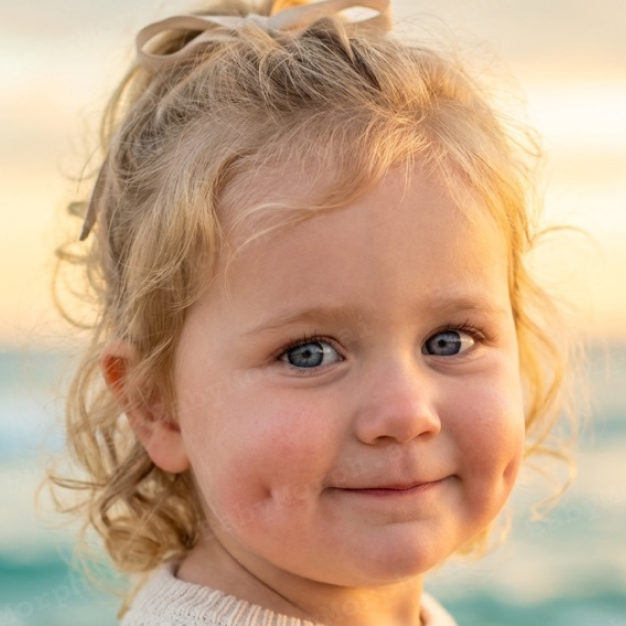
"I have an Asian wife and I've made a habit out of breaking these AI baby tools. Every single one I've tried has completely failed. BabyMorph actually blended her features and mine in a way that made sense — you could see both of us in there without one canceling out the other. People keep asking if it's a real photo."
Their AI baby result
Frequently Asked Questions
When do these specific traits mature fully?
While core structural baselines emerge at birth, overall skeletal proportionality and cartilage mapping continue adjusting actively through childhood.
What is considered thick hair in Polynesian genetics?
Hair described as 'thick' in Polynesian genetics can refer to a broad individual hair shaft, a high number of follicles per square centimetre, or a large overall hair mass that appears fuller. These traits are common in families with Polynesian heritage, but their specific manifestation varies due to diverse genetic contributions and individual development. Thickness, density, and texture are distinct traits that contribute to the overall appearance of hair.
How do genes influence hair thickness in Polynesian individuals?
Genes such as <em>EDAR</em>, <em>KRT71</em>, <em>KRT74</em>, and <em>TCHH</em> play a role in influencing hair shaft diameter and texture. For example, the <em>EDAR V370A</em> variant has been associated with thicker, straighter hair shafts in some populations, but it is not a universal marker for all Polynesian hair. These genetic influences determine the size and activity of the hair matrix, which forms the hair fiber, leading to varying degrees of thickness.
Can Polynesian hair density change after childhood?
While most scalp follicles are established before birth and new ones are not typically created during childhood, the <em>apparent</em> density of Polynesian hair can change. Factors like hair shaft width, curl pattern, hair color contrast against the scalp, and environmental influences can alter how dense hair appears. A parent's present density may also change with age, pregnancy, illness, or styling, even if the underlying follicle number remains constant.
Are all Polynesian hair types the same?
No, it is not scientifically accurate to treat all Polynesian people as having one hair type. Polynesia encompasses many communities with diverse settlement histories and family lineages, often including varying contributions from Austronesian, Near Oceanian, European, East Asian, or other ancestries. Within the same family, siblings can exhibit different hair characteristics due to the reshuffling of genetic variants that influence hair traits at conception, leading to a wide range of hair types.
How can I predict my child's hair type?
Predicting a child's exact hair type is best done by observing the hair characteristics of both biological parents, siblings, grandparents, aunts, and uncles, especially where hair texture is consistent across generations. No single genetic test can reliably forecast scalp hair density. Remember that a parent's current hair may differ from their childhood hair, and dark hair can appear denser due to stronger contrast with the scalp. Tools like BabyMorph can offer a visual prediction based on parental features, but genetic inheritance is complex.
Can hair thickness and density be inherited independently?
Yes, hair thickness and density can be inherited independently, as they are influenced by different sets of genes and biological pathways. For instance, genes like <em>MC1R</em>, <em>OCA2</em>, <em>HERC2</em>, and <em>TYR</em> influence hair pigmentation and color, which can alter the perceived contrast between hair and scalp, but they do not directly determine hair shaft width or the number of follicles. A person can have fine individual hairs but a high number of active follicles, illustrating this independence.
What role does texture play in hair volume?
Hair texture significantly influences apparent volume because curved or wavy fibers separate more readily than straight fibers, often creating a fuller visual effect. Genes such as <em>TCHH</em>, <em>PRSS53</em>, and several keratin-related regions are linked to hair curvature. Humidity, fiber damage, and hair length can also make texture look more or less pronounced, further contributing to the perception of volume, even if the underlying shaft width or follicle density is average. A BabyMorph prediction considers these textural elements in its output.