Widow's Peak Hairline Genetics and Frontal Placement
How widow’s peaks form, why they are not simply dominant, and how a child’s frontal hairline changes from birth to adulthood.
A widow’s peak is the small V-shaped point of scalp hair that extends downwards at the centre of the forehead. It can be striking, subtle, asymmetrical or absent, and it often appears to run in families. Although it has traditionally been described as a simple dominant inherited trait, modern genetics shows that frontal hairline placement is more complicated: it reflects early facial development, hair-follicle patterning, ancestry, hormone-related changes and many genetic variants acting together.
What creates a widow’s peak?
The visible hairline is the border between forehead skin and terminal scalp hair. In a classic widow’s peak, that border forms a central downward projection, producing a shallow or pronounced V. The effect is determined not by one individual hair, but by the placement and density of thousands of follicles along the front of the scalp.
Hair follicles are established before birth. During embryonic development, signals between the outer skin layer (ectoderm) and underlying connective tissue (dermis) determine where follicles form and what type of hair they later produce. The frontal hairline develops as part of this patterned scalp field. A widow’s peak can result when follicle-bearing scalp tissue extends slightly further down at the midline than it does immediately to either side.
Peak shape versus forehead shape
A pointed hairline is not the same thing as a narrow, broad, high or low forehead. These features influence one another visually, but they have separate anatomical roots:
- Widow’s peak: the central contour of the frontal scalp hairline.
- Hairline height: the vertical distance from the brow region to the hair-bearing scalp.
- Forehead width: the side-to-side dimension across the frontal bone and temples.
- Temple recession: reduced density or a higher hairline at the frontotemporal corners, often increasing with age in males.
- Facial midline: the central vertical axis of the forehead, nose, philtrum and chin; minor asymmetry is common.
A child may therefore inherit a clear central point from one side of the family while having the forehead breadth, brow prominence or overall facial proportions associated with the other.
Is a widow’s peak really a dominant trait?
The statement that widow’s peak is “dominant” is common in school genetics examples, but it is an oversimplification. There is no established single gene in which one version reliably produces a widow’s peak and the other reliably removes it in the general population. Family patterns can look dominant because a visible feature may occur in several generations, but this does not prove one-gene dominant inheritance.
In reality, frontal hairline contour is likely a polygenic trait. Many inherited variants can each make small contributions to follicle distribution, forehead morphology, hair density and the timing of age-related hairline change. Environmental and developmental variation also affects how clearly the feature is expressed.
Why family inheritance can still look strong
Parents pass on a mixture of variants influencing scalp and facial development. If several relatives share combinations that favour a central projection, the pattern may be recognisable across generations. However, siblings can differ substantially. One may have a crisp V at age six, another only a faint central point, and a third a nearly straight hairline despite sharing the same parents.
| Family pattern | What may be observed in a child | What it does and does not suggest |
|---|---|---|
| Both parents have a pronounced central point | A visible peak is more plausible, though depth and symmetry can differ | Suggests shared inherited influences; it does not guarantee the same shape |
| One parent has a peak, the other a straight hairline | Anything from a clear V to a subtle notch or straight line is possible | Not evidence for a simple 50:50 outcome |
| Neither parent has an obvious peak, but grandparents do | A child can still show one, especially if it is subtle in a parent | Multiple low-impact variants can be inherited without obvious parental expression |
| Peak appears stronger in adult male relatives | Childhood hairline may look different from the eventual adult hairline | Sex hormones and male-pattern hair changes can alter the outline later |
Genes and developmental pathways involved in frontal placement
Research has identified many genes involved in hair follicles, skin pigmentation and craniofacial development, but no routine genetic test can accurately forecast a child’s widow’s peak. It is useful to separate genes with a direct developmental role from genes associated with related visible features.
Follicles, scalp hair and hairline biology
Follicle formation depends on signalling pathways including WNT, SHH, BMP and EDA/EDAR. EDAR is particularly relevant to ectodermal structures: hair follicles, teeth and sweat glands. Some EDAR variants are associated with hair thickness and straighter hair form, especially in East Asian populations. Hair thickness can make a frontal point look more or less distinct, even if the underlying placement is similar.
Genes involved in hair growth cycling and follicle maintenance, including AR (the androgen receptor gene) and regions on chromosome 20p11, are relevant to androgenetic alopecia. They matter more for later changes in male hairline shape than for a young child’s naturally formed frontal placement. A prominent V in childhood does not predict future hair loss, and a straight childhood hairline does not prevent adult temple recession.
Craniofacial patterning and the forehead
The frontal bone and upper-face proportions develop through coordinated growth of the skull, facial mesenchyme and sutures. Genes such as RUNX2 influence bone formation, while PAX3 contributes to early craniofacial development and is associated with variation in facial morphology. These genes should not be interpreted as “widow’s peak genes”; rather, they illustrate why hairline appearance cannot be isolated from the shape of the forehead and face beneath it.
Pigmentation genes can alter visibility too. MC1R affects red-hair and lighter pigmentation patterns in many European populations. OCA2 and HERC2 contribute strongly to common eye-colour variation, while TYR and SLC24A5 participate in melanin biology. None determines frontal placement, but contrast between hair and skin can make a fine central point appear sharper in photographs.
When does the hairline become visible?
The basic follicle map is established prenatally, but the visible hairline changes considerably during infancy and childhood. Newborn hair is an unreliable guide because it may shed, grow unevenly or be altered by sleeping position and normal scalp maturation.
| Age | Typical hairline appearance | How useful it is for judging a widow’s peak |
|---|---|---|
| Birth to 6 months | Variable density; temporary shedding is common | Usually too early for a confident assessment |
| 6 to 18 months | Replacement hair emerges; texture and density may shift | A central point may begin to show, but can still change |
| Age 3 | Hairline is generally more stable and facial proportions remain childlike | A useful first view of frontal contour |
| Age 6 | Scalp coverage and hair pattern are usually well established | Often the clearest childhood representation |
| Age 10 | Forehead and face lengthen gradually; pre-pubertal changes begin for some | Peak depth may look different as proportions mature |
| Age 18 | Near-adult facial structure; hormone effects may begin to influence some hairlines | More informative, but still not a guarantee of later adult hair retention |
For age-progressed facial imagery, age three and six are best treated as estimates of the inherited childhood outline. At ten and eighteen, the same underlying genetics interacts with changing forehead proportions, hair texture, styling and, particularly in boys and young men, early androgen sensitivity.
Factors that can make the peak look different over time
Hairline shape is often more stable than hair density, but its apparent form can change. Curly or very thick hair can soften the edge. Fine, pale hair may obscure a shallow point. Cowlicks at the front can pull hair across the midline and mimic or hide a V-shaped contour. Hairstyles, wet hair, lighting and camera angle are also surprisingly influential in photographs.
During puberty, changes in hair shaft diameter and oil production may make the border look denser. In some males, maturation of the frontotemporal corners produces a more mature, slightly M-shaped hairline. This is distinct from a widow’s peak, although the two can coexist. Rapid recession, patchy loss, scalp inflammation or hair loss in a child warrants discussion with a GP or dermatologist rather than assumptions about family genetics.
Frequently asked questions
Can two parents without a widow’s peak have a child with one?
Yes. A subtle peak may not be noticed in a parent, and multiple inherited variants can combine differently in a child. Normal developmental variation and differences in hair density can also reveal a central point that is not obvious elsewhere in the family.
Does a widow’s peak predict male-pattern baldness?
No. A natural central V is not a diagnosis or a reliable predictor of androgenetic alopecia. Male-pattern hair loss is influenced by androgen signalling, age and many genetic factors, including variants near AR and 20p11, whereas a childhood widow’s peak reflects baseline frontal follicle placement.
Will a baby’s hairline stay the same?
The broad follicle pattern is established early, but the visible outline can change substantially in the first two years as newborn hair sheds and replacement hair grows. By around age three to six, the underlying childhood hairline is usually easier to assess.
Can an AI image determine whether a child will have a widow’s peak?
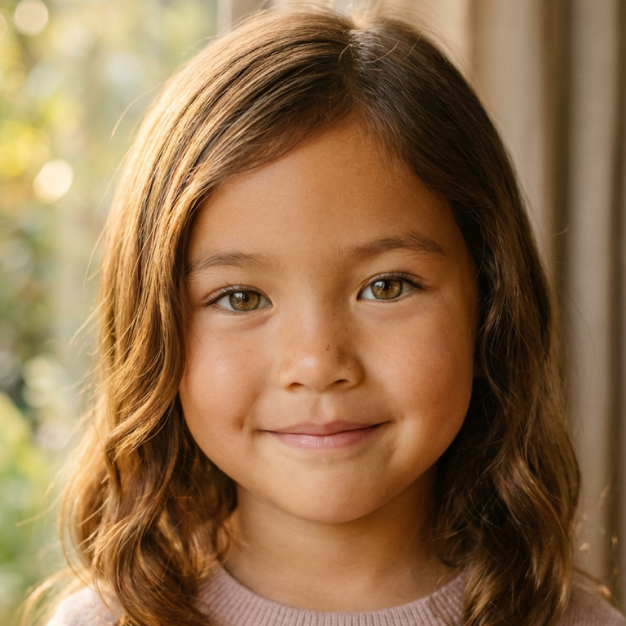
An AI image can provide a plausible visual estimate from parental facial and hairline cues, especially at childhood ages, but it cannot read all relevant genetic variants or predict follicle-level development with certainty. It should be viewed as a probability-based likeness rather than a genetic result.
What our users say
Lena K.
Germany
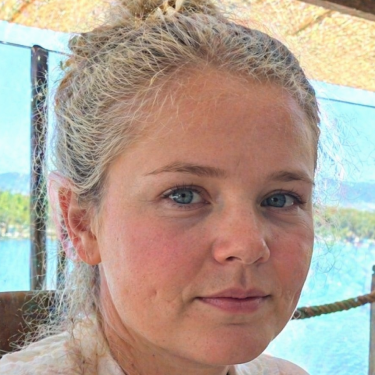
"We used BabyMorph almost as a joke during my third trimester — something to do on a Sunday afternoon. What came out was a baby girl with very light eyebrows, a wider forehead, and this particular way the nose sits slightly to the left. She was born six weeks later. The eyebrows. The forehead. The nose. Nobody believes it was generated before she arrived."
Their AI baby result


Jason T.
United States
"I have an Asian wife and I've made a habit out of breaking these AI baby tools. Every single one I've tried has completely failed. BabyMorph actually blended her features and mine in a way that made sense — you could see both of us in there without one canceling out the other. People keep asking if it's a real photo."
Their AI baby result
Frequently Asked Questions
When do these specific traits mature fully?
While core structural baselines emerge at birth, overall skeletal proportionality and cartilage mapping continue adjusting actively through childhood.
What causes a widow's peak hairline to form?
A widow's peak results from the patterned development of hair follicles during embryonic growth, where follicle-bearing scalp tissue extends slightly further down at the midline of the forehead. This creates a central downward projection, forming the characteristic V-shape. The specific shape and prominence are determined by the placement and density of thousands of follicles along the front of the scalp, established even before birth.
Is a widow's peak always a dominant genetic trait?
No, a widow's peak is not simply a dominant genetic trait, which is a common oversimplification in school genetics. Modern understanding suggests it is a <strong>polygenic trait</strong>, meaning many different genes each contribute small effects to its expression. Environmental factors and developmental variations also influence how clearly the feature is expressed, making its inheritance pattern more complex than a single dominant gene.
How does a child's hairline change from birth to adulthood?
A child's hairline can change significantly from birth to adulthood, influenced by ongoing facial development and, later, hormonal changes. While the initial pattern of hair follicles is set before birth, the prominence and shape of a widow's peak can become more or less distinct over time. In males, <em>sex hormones and male-pattern hair changes</em> can further alter the outline of the hairline, potentially creating or diminishing a peak that was present in childhood.
Can a child inherit a widow's peak if neither parent has one?
Yes, a child can still have a widow's peak even if neither parent obviously exhibits one, especially if the feature is subtle in a parent or present in grandparents. This occurs because frontal hairline contour is a <strong>polygenic trait</strong>. Many low-impact genetic variants can be inherited from both parents without showing obvious expression in them, but when combined in a child, these variants can result in a visible peak.
Are there specific genes that cause a widow's peak?
There is no single "widow's peak gene" that reliably produces or removes this trait. Instead, its formation involves many genes related to <em>hair follicle development, skin patterning, and craniofacial structure</em>, such as those in the WNT, SHH, BMP, and EDAR pathways. While variants in genes like EDAR can affect hair thickness or type, influencing how a peak appears, no routine genetic test can accurately predict a child's widow's peak with certainty.
Does a prominent widow's peak in childhood predict future hair loss?
No, a prominent widow's peak in childhood does not predict future hair loss or male-pattern baldness. The genes and developmental pathways involved in forming a child's natural frontal hairline are distinct from those contributing to age-related changes like androgenetic alopecia. A clear V-shape in youth does not indicate an increased risk of temple recession later in life, nor does a straight childhood hairline prevent it.
How can BabyMorph predict a child's future hairline?
BabyMorph utilizes advanced AI to analyze the facial features and hairline patterns from two parent photos to predict what a couple's future child might look like. While it cannot predict the exact interplay of all polygenic factors influencing a widow's peak, it can offer a <em>visual representation</em> based on the combined genetic influences inferred from parental characteristics. This provides an imaginative glimpse into potential facial and hairline traits for your future child.