Will My Baby Have Blue Eyes? Mixed-Race Genetics Explained
Can a mixed-heritage baby have blue eyes? Learn how OCA2, HERC2, family history and childhood development shape iris colour.
Blue eyes are possible in children with parents from different ancestral backgrounds, but they are never determined by ancestry labels alone. Eye colour comes from the amount and distribution of melanin in the iris, shaped by many genes inherited in particular combinations. A parent who appears brown-eyed may still carry variants associated with lighter eyes, while a blue-eyed parent does not automatically guarantee a blue-eyed child.
Why “mixed-race” is not an eye-colour genotype
Terms such as mixed-race, mixed heritage or multiracial describe family ancestry and social identity, not a single biological category. They cannot provide a reliable percentage chance of blue eyes without knowing the parents’ own eye colours, close family traits and, ideally, relevant DNA variants.
Blue eyes are more frequent in populations with northern and eastern European ancestry, particularly where light-eye-associated variants have been common for many generations. However, these variants can also be present in people with African, Middle Eastern, South Asian, East Asian, Latin American or Indigenous American ancestry because of historical population movement and diverse family histories. Conversely, a person with substantial European ancestry may have brown eyes and carry few of the genetic combinations needed for a blue-eyed child.
The useful question is therefore not “Which race is dominant?” Brown eye colour is not a racial trait, and blue eye colour is not simply recessive in the old schoolbook sense. The more informative questions are:
- What colour are each parent’s eyes in natural daylight?
- Do either parent’s parents, siblings or previous children have blue, grey, green or hazel eyes?
- Does either parent carry light-eye variants that are not visible in their own eye colour?
- How much melanin is likely to be produced in the child’s iris as it develops?
The genes most strongly associated with blue eyes
OCA2 and HERC2: the central light-eye region
The most influential genetic region for common blue versus brown eye variation lies on chromosome 15. The OCA2 gene helps regulate melanin production in melanocytes, the pigment-producing cells found in the iris, skin and hair. Nearby, a regulatory region within HERC2 affects how strongly OCA2 is switched on in the iris.
A well-studied HERC2 variant, often identified as rs12913832, can reduce OCA2 expression in iris tissue. Lower OCA2 activity generally means less melanin is deposited in the front layers of the iris. Light then scatters through the tissue, creating a blue or grey appearance. Blue irises do not contain blue pigment; their colour is largely an optical effect of low pigment and light scattering.
Two copies of the light-eye-associated version near HERC2 make blue eyes more likely, especially in people whose other pigmentation genes also favour low iris melanin. But this is not an absolute rule. Some people with the expected HERC2 pattern have green, hazel or light brown eyes, while other gene variants alter the result.
Other genes modify the final shade
Eye colour is polygenic: many genes contribute small or moderate effects. Variants in TYR, TYRP1, SLC24A4, SLC45A2, IRF4 and ASIP can influence pigment quantity or melanosome function. MC1R, best known for its role in red hair and fair skin, may also contribute to lighter pigmentation in some genetic backgrounds.
Genes associated with facial development, such as PAX3 and RUNX2, are not primary blue-eye genes, but facial structure changes how eyes are framed and perceived. EDAR has important effects on hair thickness, tooth form and some facial features in certain populations, yet it should not be treated as a direct predictor of iris colour.
What parental eye colours can and cannot tell you
Visible eye colour offers clues, but it does not reveal every inherited variant. A brown-eyed parent can carry a light-eye-associated HERC2 pattern inherited from a blue-eyed parent or grandparent. If the other parent has blue eyes, their child may inherit enough low-pigment variants to develop blue eyes. Equally, the child may inherit combinations that produce hazel, green or brown eyes.
| Parental pattern | What it suggests | Possible child outcomes |
|---|---|---|
| Both parents have blue eyes | Both often carry several low-melanin variants, especially around HERC2/OCA2. | Blue is likely, but grey, green or hazel can occur; brown is uncommon but biologically possible. |
| One blue-eyed and one brown-eyed parent | The brown-eyed parent may or may not carry light-eye variants. | Brown, hazel, green, grey and blue are all possible. Blue becomes more plausible with blue-eyed relatives on the brown-eyed parent’s side. |
| One blue-eyed and one hazel or green-eyed parent | The lighter-eyed parent may carry a mixed set of low- and moderate-melanin variants. | Blue, green, hazel and light brown are realistic outcomes; exact odds remain family-specific. |
| Both parents have brown eyes | Brown often reflects higher iris melanin, but hidden light-eye alleles may still be present. | Brown is generally more likely, although blue or green can occur when both pass on suitable combinations. |
It is tempting to assign simple numerical probabilities, such as “50% blue eyes” for a blue-eyed and brown-eyed pairing. That calculation works only in a highly simplified one-gene model and is not dependable for real families. DNA testing can improve estimates for particular common variants, but even genetic testing cannot promise a precise adult eye colour because many contributing variants remain incompletely understood.
When eye colour becomes visible
Newborn eye colour is often provisional. At birth, the iris may contain relatively little melanin, particularly in babies with genetic tendencies towards lighter pigmentation. As melanocytes respond to light exposure and developmental signals, pigment production can increase. A baby who looks blue-grey at six weeks may later develop green, hazel or brown eyes.
| Age | Typical eye-colour development | How confident is the visible colour? |
|---|---|---|
| Birth to 6 months | Many babies have blue-grey, slate or dark-looking eyes; early pigment levels can be misleading. | Low confidence for final shade. |
| 6 to 12 months | Brown, hazel and green tones may become clearer as melanin accumulates. | Moderate confidence, especially for clearly dark brown eyes. |
| 18 months to 3 years | Most children have a stable broad eye-colour category, though hazel and green may still shift subtly. | Usually a useful indication for a 3-year rendering. |
| 6 to 10 years | Colour is generally stable; changes are usually slight differences in warmth, flecks or contrast. | High confidence in broad colour. |
| 18 years | Adult iris pigmentation and the surrounding facial contrast are established. | High confidence, although small tonal changes can continue across life. |
For age-based visualisations at 3, 6, 10 and 18 years, the most defensible approach is to retain a consistent genetic eye-colour range rather than imply a dramatic unexplained change. A child whose family genetics suggest hazel may appear grey-green at age three and warmer hazel by age ten; that is more biologically plausible than changing from deep brown to clear blue.
Why blue, grey, green and hazel are difficult to separate
These labels describe appearance rather than sharply separate genetic categories. Blue and grey eyes both typically have low melanin, but grey irises may have denser collagen fibres or different light-scattering properties. Green and hazel eyes usually contain more melanin than blue eyes, often with yellowish lipochrome-like tones and uneven pigment distribution.
Lighting matters greatly. Warm indoor bulbs can make blue eyes look grey and hazel eyes look brown. Dark eyelashes, skin tone, hair colour and clothing can also alter perceived colour through contrast. This is especially relevant for children from mixed ancestral lineages, whose skin and hair pigmentation may not match assumptions people associate with a particular eye colour.
Frequently asked questions
Can a brown-eyed parent and a blue-eyed parent have a blue-eyed baby?
Yes. It is possible when the brown-eyed parent carries enough light-eye-associated variants and the child inherits a favourable combination from both parents. It is not guaranteed, because the brown-eyed parent may pass on variants supporting higher iris melanin instead.
Can two brown-eyed parents have a blue-eyed child?
Yes, although it is generally less common than a brown-eyed outcome. Both parents can carry variants associated with low iris melanin without showing blue eyes themselves. The likelihood depends on their broader genetic backgrounds and the variants passed to the child.
Are blue eyes rarer in babies with non-European ancestry?
Blue-eye-associated variants are less frequent in many populations, but frequency is not impossibility. A child’s chance depends on the variants present in their own family, not on a broad ancestry category. Family history is more informative than appearance-based assumptions.
Can a baby’s blue eyes turn brown?
They can. Increased melanin deposition during the first year, and sometimes through the second or third year, can shift blue-grey newborn eyes towards green, hazel or brown. Once a clearly brown iris has developed in early childhood, a later change to blue would be unusual and should be discussed with a clinician if it is sudden or affects only one eye.
What our users say
Lena K.
Germany
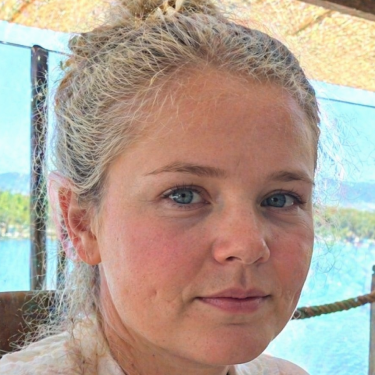
"We used BabyMorph almost as a joke during my third trimester — something to do on a Sunday afternoon. What came out was a baby girl with very light eyebrows, a wider forehead, and this particular way the nose sits slightly to the left. She was born six weeks later. The eyebrows. The forehead. The nose. Nobody believes it was generated before she arrived."
Their AI baby result

Jason T.
United States
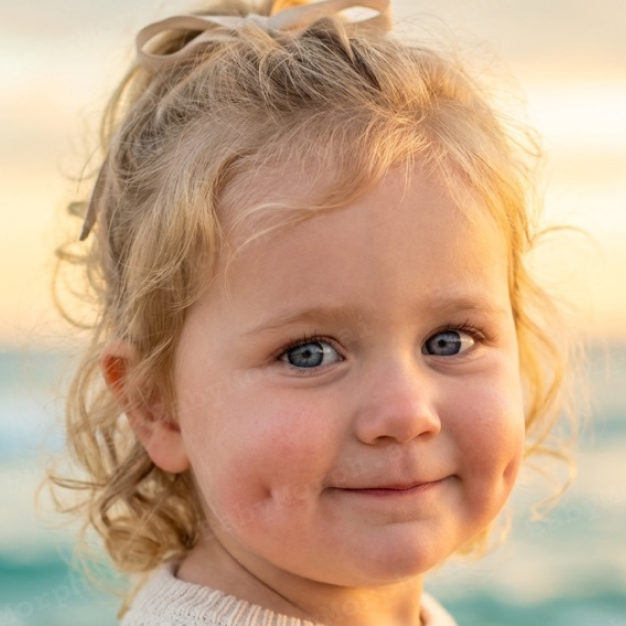
"I have an Asian wife and I've made a habit out of breaking these AI baby tools. Every single one I've tried has completely failed. BabyMorph actually blended her features and mine in a way that made sense — you could see both of us in there without one canceling out the other. People keep asking if it's a real photo."
Their AI baby result
Frequently Asked Questions
When do these specific traits mature fully?
While core structural baselines emerge at birth, overall skeletal proportionality and cartilage mapping continue adjusting actively through childhood.
Can mixed-heritage babies have blue eyes?
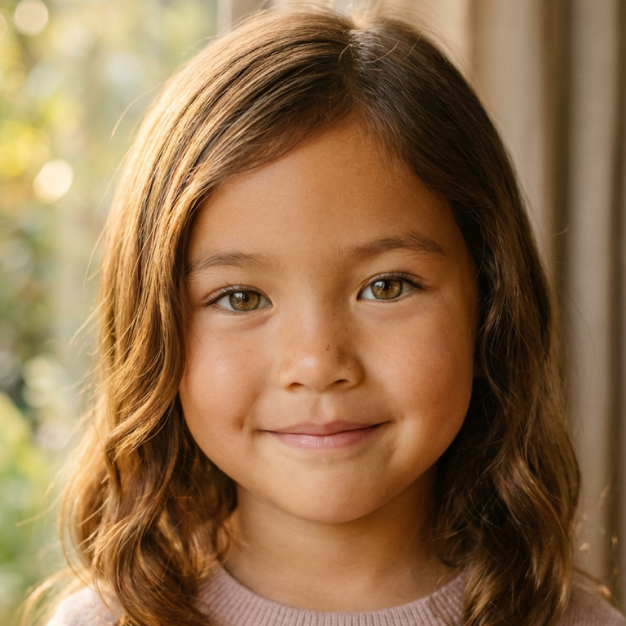
Yes, children with parents from different ancestral backgrounds can have blue eyes. Eye colour is determined by a combination of genes, not ancestry labels alone. A brown-eyed parent can carry genetic variants for lighter eyes, making blue eyes possible even if one or both parents have darker eyes, especially if there's a family history of lighter eye colours. Ancestry is complex and doesn't dictate a child's eye colour in isolation.
Which genes are most responsible for blue eyes?
The most influential genetic region for blue versus brown eye colour is on chromosome 15, involving the <em>OCA2</em> and <em>HERC2</em> genes. <em>OCA2</em> regulates melanin production, while a regulatory region within <em>HERC2</em> affects <em>OCA2</em>'s activity in the iris. A specific variant in <em>HERC2</em> (rs12913832) reduces <em>OCA2</em> expression, leading to less melanin and creating the appearance of blue eyes due to light scattering. Other genes also contribute to the final shade.
Does a brown-eyed parent mean no blue eyes for baby?
No, a brown-eyed parent can certainly have a child with blue eyes. The brown-eyed parent might carry genetic variants for lighter eye colours, such as the <em>HERC2</em> variant, which they inherited from a blue-eyed parent or grandparent. If the other parent has blue eyes or also carries light-eye variants, their child could inherit the necessary combinations to develop blue eyes. Eye colour inheritance is polygenic and complex, not a simple dominant/recessive trait.
How accurate are eye colour predictions from DNA tests?
DNA testing can improve estimates for common eye colour variants, but it cannot promise a precise adult eye colour. Eye colour is polygenic, meaning many genes contribute to the final shade, and not all contributing variants are fully understood. While certain gene combinations strongly suggest a likelihood of blue, green, or brown eyes, the exact shade can be influenced by other factors and developmental processes. Therefore, genetic tests provide probabilities rather than certainties.
When does a baby's true eye colour appear?
A baby's eye colour at birth is often provisional and can change. Many newborns, particularly those with a genetic predisposition for lighter eyes, have irises with relatively little melanin, appearing blue-grey. As the baby grows and melanocytes in the iris respond to light exposure and developmental signals, pigment production increases. This means a baby's eyes can change from blue-grey at a few weeks old to green, hazel, or brown later in their development, often settling by 6-12 months, sometimes later.
Do blue eyes contain blue pigment?
No, blue eyes do not contain blue pigment. Their colour is largely an optical effect resulting from low melanin content in the iris. When there is less melanin, light entering the eye is scattered by the collagen fibers in the iris stroma. Shorter, bluer wavelengths of light are scattered more efficiently, similar to how the sky appears blue. This light scattering, known as Rayleigh scattering, creates the blue appearance of the iris. <em>BabyMorph</em> helps predict eye color based on genetic likelihood, but the actual hue is a trick of light and pigment levels.
How does BabyMorph predict my baby's eye color?
BabyMorph predicts your baby's eye colour by analyzing the features from both parent photos. While it doesn't perform genetic testing, it uses advanced AI to understand subtle visual cues and patterns in parental eye colour, texture, and other related features that correlate with genetic predispositions. This allows it to generate a visual representation of a potential child, offering an exciting glimpse into possible eye colours, alongside other inherited traits. Our predictions are based on millions of data points, giving you a fun and insightful preview.