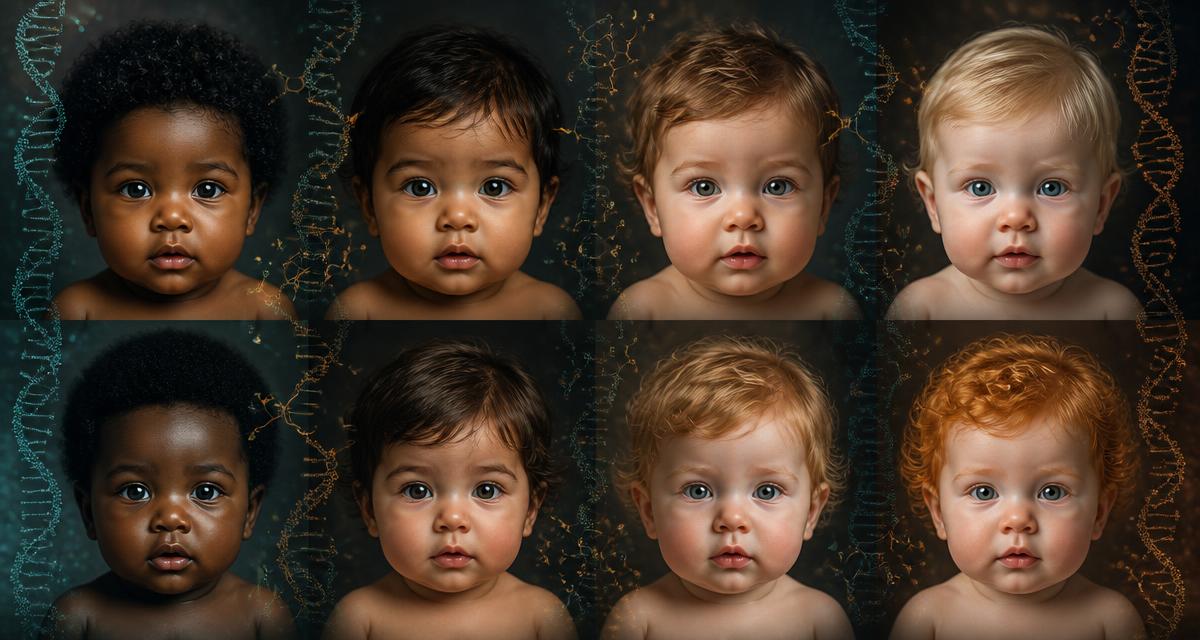
Will My Baby Have Red Hair? The Mystery of the MC1R Gene
How MC1R and other pigment genes influence a baby’s chance of red hair, changing shades from infancy to adulthood, and freckles.
Red hair is one of the most recognisable human traits, yet it is not inherited in the simple “red-haired parent equals red-haired child” pattern many families expect. Most natural red hair is linked to variants in MC1R, a gene that influences which pigment the hair follicle produces. However, the shade, visibility and persistence of red hair depend on several genes, the combination inherited from both parents, and developmental changes after birth.
What the MC1R gene does
MC1R stands for melanocortin 1 receptor. It is active in melanocytes, the pigment-producing cells found in hair follicles and skin. When the receptor works strongly, it tends to favour production of eumelanin: dark brown or black pigment. Certain MC1R variants reduce that signalling, shifting pigment production towards pheomelanin, the red-gold pigment associated with ginger, strawberry-blonde and auburn hair.
More than one hundred MC1R variants have been described. Some have a stronger association with red hair than others. Frequently studied red-hair-associated variants include R151C, R160W, D294H, R142H and D84E. In genetic shorthand, these are sometimes called “R” alleles for strong red-hair-associated variants, although this is an oversimplification: their effects are not identical in every person.
A child with two strongly functioning red-hair-associated MC1R variants is more likely to have visibly red hair, freckles and fair skin that burns easily. A child with one such variant may have brown, blonde or auburn hair and may simply be a carrier. Yet the outcome is not guaranteed. Other pigmentation genes can alter how much red pigment is apparent.
Why red hair is not a straightforward recessive trait
Red hair is often taught as a recessive characteristic. That description is useful as a starting point but not sufficiently precise for real families. Unlike a single-gene condition with one clear dominant and one clear recessive version, hair colour reflects multiple loci and variable gene activity.
Two copies increase the chance, not certainty
Each parent passes on one copy of MC1R. If both parents carry a red-hair-associated variant, a child can inherit two relevant variants. This creates the strongest common genetic setting for red hair. But not every pair of variants produces the same pigment outcome. Some combinations cause bright copper hair, while others are more likely to produce strawberry blonde, auburn or dark hair with a reddish cast in sunlight.
When two parents are known carriers of one comparable red-hair-associated MC1R variant each, a basic inheritance model gives a 25% chance that a child inherits both variants, a 50% chance of inheriting one, and a 25% chance of inheriting neither. That is a probability for each pregnancy, not a prediction that applies evenly across a family of four children. It also describes the gene combination, not an assured visible hair shade.
| Parent MC1R pattern | Possible child pattern | What it may mean for visible red hair |
|---|---|---|
| Neither parent carries a recognised red-hair-associated variant | Usually no inherited pair through MC1R | Natural red hair is less likely, though family testing may not capture every relevant variant. |
| One parent has one relevant variant; the other has none | About half of children may inherit one variant | Most will not have classic red hair, but lighter pigmentation or a warm tone can occur. |
| Both parents carry one relevant variant | Approximately 25% two variants, 50% one, 25% none | Two variants make red hair substantially more plausible; modifier genes still matter. |
| One parent has two relevant variants; the other carries one | Children receive at least one relevant variant; around half may receive two | Likelihood is relatively high, but shades can vary markedly between siblings. |
| Both parents have two relevant variants | Children usually inherit two relevant variants | Red or red-blonde hair is likely, although darkness and intensity remain variable. |
Other genes modify the result
MC1R is central to classic red hair, but it does not work alone. Variants near OCA2 and HERC2 influence melanin regulation and are particularly well known for their effect on light versus dark eyes. They can also contribute to the overall lightness of pigmentation. TYR, which encodes tyrosinase, is essential in melanin synthesis; common variants can subtly influence pigment quantity. SLC24A5 and SLC45A2 are associated with lighter skin pigmentation in several populations.
Genes including ASIP, IRF4 and KITLG can influence the balance, distribution or amount of pigment. The practical effect is that two siblings with similar MC1R inheritance can look surprisingly different. One may have vivid orange-red hair and dense freckles, while another has chestnut hair with copper highlights.
Family history gives clues, but cannot provide a precise percentage
Red hair occurs most often in people with north-west European ancestry, especially in Ireland and Scotland, but it appears in many populations. A red-haired grandparent, aunt or cousin can indicate that relevant variants are present in the family, including in parents with dark hair. It does not reveal which variant was inherited by whom.
Hair colour alone is also an imperfect guide to carrier status. A dark-haired parent may carry one MC1R variant without any obvious red tones. Conversely, a parent with auburn hair may have a combination of modest MC1R effects and variants at other pigment loci rather than two strong red-hair-associated copies.
- A naturally red-haired parent is useful evidence, but does not establish the other parent’s genetic contribution.
- Red-haired siblings suggest that both parents may carry relevant variants, although laboratory testing is needed to confirm this.
- Freckles, very fair skin and poor tanning can occur with MC1R variants, but none is a definitive carrier test.
- Dyed hair, childhood photographs and family stories should not be treated as genetic evidence.
Consumer DNA tests may report selected MC1R variants, but coverage differs between companies. A result that does not identify a common variant does not rule out all relevant pigmentation variants. Clinical genetic testing is rarely necessary for hair-colour questions, though it may be discussed with a genetic professional when a family is already undergoing broader testing for another reason.
When red hair becomes visible
Newborn hair is a poor final indicator. Many babies are born with sparse hair, temporary dark hair, or a colour that changes during the first year as follicles begin new growth cycles. The pigment profile of the permanent childhood hair gradually becomes more informative.
| Age represented | What may be visible | How stable is the colour? |
|---|---|---|
| Birth to 12 months | Fine newborn hair may shed; copper tones can emerge after replacement growth. | Low stability. A dark or light newborn head of hair can change substantially. |
| Age 3 | Red, strawberry-blonde or auburn colouring is usually recognisable if strongly expressed. | Moderately informative, though many children darken or brighten later. |
| Age 6 | Follicle pigment production is clearer; freckles may become more evident after sun exposure. | Often a useful childhood estimate, but not final. |
| Age 10 | Hair shade commonly looks more settled, with differences between roots and sun-lightened lengths. | Fairly stable before puberty-related changes. |
| Age 18 | Adolescent or adult pigment pattern is usually established. | Most stable, although hair can deepen with age and environmental exposure. |
For visual age renderings at 3, 6, 10 and 18, red hair should therefore be treated as a range of plausible shades rather than one fixed orange colour. A realistic representation considers whether the family pattern suggests copper, muted ginger, strawberry blonde or auburn, and allows the tone to deepen from early childhood into adolescence.
Red hair, freckles and sun sensitivity
Reduced MC1R activity is associated with a lighter skin response to ultraviolet radiation in many people. Pheomelanin provides less UV protection than eumelanin, and some red-haired people burn quickly with limited tanning. Freckles are small areas of locally increased pigment and often become more visible during childhood, particularly on sun-exposed skin.
However, not all red-haired children have extensive freckles, and not all people carrying MC1R variants have very fair skin. Sun protection should be based on a child’s actual skin response: shade, protective clothing, sunglasses where appropriate, and suitable broad-spectrum sunscreen. This is sensible for every child, not solely those with red hair.
Frequently asked questions
Can two brown-haired parents have a red-haired baby?
Yes. If both brown-haired parents carry a red-hair-associated MC1R variant, their child can inherit one relevant variant from each parent. In a simplified two-carrier model, that happens in around one quarter of pregnancies. The child’s resulting shade still depends on other pigmentation genes.
Will a red-haired baby stay red-haired?
Often, but the exact shade can change. A baby may lose newborn hair and grow in brighter copper hair, or have vivid toddler hair that becomes auburn or darker red-brown by adolescence. The underlying tendency towards pheomelanin remains, while total pigment production changes with development.
Does having freckles prove that my child carries MC1R variants?
No. Freckles are associated with several pigmentation pathways and sun exposure. They are common among people with reduced MC1R signalling, but they cannot identify a particular gene variant or predict whether a child will have red hair.
Can an AI image determine whether a future child will have red hair?
No image model can determine a child’s genotype. A visual prediction can present genetically plausible hair-colour possibilities from parental appearance and family information, but it cannot replace DNA data or guarantee an individual outcome. Red hair is best understood as a probability shaped by several inherited factors.
What our users say
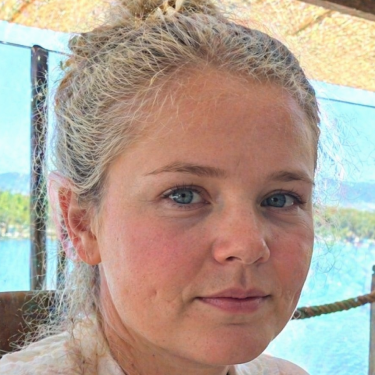
Lena K.
Germany
"We used BabyMorph almost as a joke during my third trimester — something to do on a Sunday afternoon. What came out was a baby girl with very light eyebrows, a wider forehead, and this particular way the nose sits slightly to the left. She was born six weeks later. The eyebrows. The forehead. The nose. Nobody believes it was generated before she arrived."
Their AI baby result

Jason T.
United States
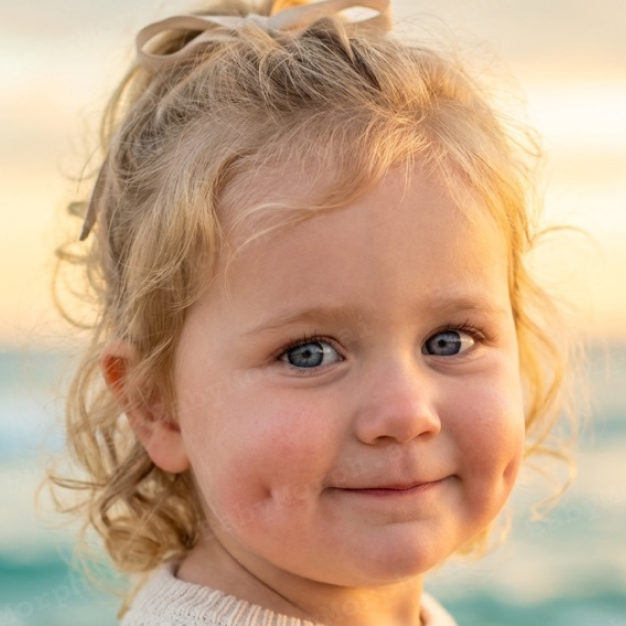
"I have an Asian wife and I've made a habit out of breaking these AI baby tools. Every single one I've tried has completely failed. BabyMorph actually blended her features and mine in a way that made sense — you could see both of us in there without one canceling out the other. People keep asking if it's a real photo."
Their AI baby result
Frequently Asked Questions
Can a brown-haired and blonde parent have a red-haired baby?
Yes. If both the brown-haired parent and blonde parent happen to carry the recessive MC1R gene mutation, they have a 1 in 4 chance of having a red-haired child.
Does red hair fade as the baby grows older?
True genetic red hair stays, but the shade can deepen from a light strawberry blonde or copper into a richer auburn as the child develops.
How does the MC1R gene cause red hair?
The MC1R gene is central to producing red hair by influencing the type of pigment made in hair follicles. When MC1R signaling is reduced by certain variants, it shifts pigment production towards pheomelanin, which is the red-gold pigment. In contrast, strong MC1R activity tends to favor eumelanin, the dark brown or black pigment. <em>Many variants</em> of MC1R exist, with some having a stronger association with red hair than others.
Is red hair a simple recessive genetic trait?
No, red hair is <em>not a simple recessive trait</em>. While often taught as such, hair color is influenced by multiple genes and their variable activity, not just one dominant and one recessive version. The MC1R gene plays a primary role, but other genes can modify the final hair shade. This complexity means that inheriting certain MC1R variants increases the chance, but doesn't guarantee, visible red hair.
What are the chances of having a red-haired baby if both parents are carriers?
If both parents carry one red-hair-associated MC1R variant, there is approximately a <strong>25% chance</strong> for each child to inherit two variants and potentially have red hair. There's also a 50% chance of inheriting one variant (making them a carrier) and a 25% chance of inheriting neither. This describes the gene combination, but other genes can still influence the visible hair shade.
Can other genes affect red hair color besides MC1R?
Yes, several other genes significantly influence hair color alongside MC1R. Genes like <em>OCA2</em>, <em>HERC2</em>, <em>TYR</em>, <em>SLC24A5</em>, and <em>SLC45A2</em> affect melanin regulation, synthesis, and skin pigmentation, all contributing to the final shade and intensity of red hair. This is why even siblings with similar MC1R inheritance can have surprisingly different hair colors, ranging from vivid orange-red to chestnut with copper highlights.
Does BabyMorph predict red hair accurately?
BabyMorph utilizes advanced AI to predict your future baby's features, including hair color, by analyzing parent photos. While AI cannot definitively determine complex genetic outcomes like red hair with 100% certainty due to the intricate interplay of multiple genes, it provides an entertaining and often insightful visualization based on the combined characteristics it identifies. It can offer a glimpse into potential hair tones and variations.
Can you carry the red hair gene without having red hair?
Yes, it is entirely possible to carry a red-hair-associated MC1R variant without having visible red hair yourself. A person might inherit only one such variant, which may result in brown, blonde, or auburn hair with only subtle reddish tones in sunlight. These individuals are considered carriers and can pass the variant on to their children, who could then have red hair if they inherit another variant from the other parent.