Eye Shapes and Epicanthic Folds in Mixed Heritage
A clear guide to epicanthic folds, eyelid anatomy, mixed-heritage inheritance and how eye shape changes from birth to adulthood.
Eye shape is not determined by a single “eye-shape gene”, and mixed heritage does not produce a simple midpoint between two parental appearances. The visible eye area reflects the bony orbit, eyelids, eyebrow position, skin and fat distribution, and facial growth. Epicanthic folds are one normal variation within this anatomy. They may be inherited, become less prominent during childhood, or remain a defining adult feature.
What eye shape and epicanthic folds actually describe
“Eye shape” is an everyday term covering several separate facial features. The eyeball itself is broadly similar in shape between people; what differs visibly is the surrounding orbital and eyelid anatomy. Parents may pass on different combinations of these features, so a child can resemble one parent in lid structure and the other in brow or orbital contour.
The anatomy around the eye
The visible eye area is influenced by:
- Palpebral fissure: the opening between the upper and lower eyelids, including its width, height and tilt.
- Canthal tilt: the angle between the inner corner of the eye (medial canthus) and outer corner (lateral canthus). A slight upward or downward tilt is common and usually unrelated to health.
- Upper-lid crease: a fold formed where the levator aponeurosis connects to upper-eyelid skin. Its height and visibility vary considerably.
- Epicanthic fold: a skin fold at the inner corner of the eye, often extending from the upper eyelid towards or over the medial canthus.
- Orbital shape: the bony eye socket, cheekbone projection and bridge of the nose alter how open, deep-set, rounded or elongated the eye region appears.
- Periorbital soft tissue: skin thickness, upper-lid fat and the tissue around the nasal bridge can make a crease or fold more or less visible.
An epicanthic fold should not be confused with the eyelid crease. A person may have a visible upper-lid crease and an epicanthic fold, one without the other, or neither. Folds occur in people with many ancestral backgrounds, including East and Southeast Asian, Central Asian, Indigenous American, Arctic, African and European populations. Their presence is a normal human variation, not a reliable test of a person’s ancestry.
Inheritance in children of mixed heritage
Facial traits are polygenic: hundreds or thousands of genetic variants contribute small effects, while prenatal growth and postnatal facial development shape the final appearance. This means it is not possible to assign a dependable percentage chance that a child will have an epicanthic fold from a photograph of two parents alone.
Genes with indirect roles
No single named gene determines an epicanthic fold in the way a simple dominant-recessive classroom trait might be taught. Research on facial morphology has identified many regions associated with facial width, nasal bridge shape, eyelid area and orbital structure. Genes involved in craniofacial development include PAX3, which contributes to neural crest and facial development, and RUNX2, which has roles in bone formation and cranial growth. Their ordinary population variants may contribute subtly to facial proportions, but they do not allow clinicians or consumer tools to predict an individual eyelid configuration.
EDAR is another gene often discussed in ancestry-related appearance research. A variant common in parts of East Asia has recognised effects on hair thickness and sweat gland traits, and may be associated with aspects of facial soft tissue. However, it must not be interpreted as an “epicanthic-fold gene”. Facial traits arise from combined effects across many loci and cannot be reduced to one ancestry-linked variant.
Genes more commonly associated with pigmentation, such as OCA2, HERC2, MC1R, TYR and SLC24A5, affect melanin pathways and can influence eye, hair or skin colour. They do not explain eyelid fold anatomy. It is entirely possible for a child to inherit a parent’s eye colour pattern while more closely resembling the other parent in eyelid shape.
Why siblings can look surprisingly different
Each pregnancy combines parental DNA differently. A child may inherit a cluster of variants associated with a broader nasal bridge, fuller upper eyelids or a more prominent brow from one side of the family, while a sibling inherits another combination. Recombination also means that grandparents, aunts and uncles can be visibly echoed in a child. Shared heritage gives useful context, but it cannot specify which features will be expressed together.
| Feature observed in a family | What may be inherited | Why the child may differ |
|---|---|---|
| Prominent epicanthic fold in one parent | Soft-tissue and nasal-bridge facial pattern | Other inherited facial proportions may make the fold subtle or not visibly expressed |
| High upper-lid crease in one parent | Lid attachment pattern and skin distribution | Childhood fat distribution can temporarily obscure the crease |
| Upward outer-eye tilt in both parents | Orbital and canthal geometry contributing to tilt | Expression can still vary in degree between siblings |
| Deep-set appearance in one family line | Orbital depth, brow prominence and soft tissue | Cheek growth and facial fullness may create a more open-eyed appearance |
How facial growth changes the appearance of the eyes
Parents often notice that newborn eyelids look unlike either parent’s adult eyelids. This is expected. At birth, facial bones are small, the nasal bridge is low and soft tissue can be puffy after delivery. The eye region changes markedly as the midface projects forwards and baby fat redistributes.
When the trait becomes visible
| Age | Typical changes in the eye region | How stable the appearance is |
|---|---|---|
| Birth to 6 months | Temporary puffiness, a low bridge and variable lid opening are common | Very changeable; photographs can be misleading |
| 1 to 3 years | Facial fullness remains high, but lid creases and inner-corner folds become easier to assess | Early pattern visible, not final |
| Age 3 | Most children show a recognisable family resemblance in eyelid and orbital appearance | Useful early indication |
| Age 6 | Midface growth and reduced toddler fullness can reveal a crease or make a fold appear less pronounced | Moderately stable |
| Age 10 | Orbital proportions are closer to later childhood appearance; brows and cheek contours are clearer | Often fairly stable |
| Age 18 | Puberty-related bone growth, fat distribution and brow development contribute to adult presentation | Closest to adult form, though ageing continues |
A fold that is obvious in infancy may become less visible as the nose bridge and midface grow. Conversely, a subtle fold may become more noticeable when childhood facial fullness decreases. These are ordinary developmental shifts rather than evidence that a feature has “appeared” or “disappeared” genetically.
What an AI image can and cannot responsibly show
A future-face rendering can illustrate plausible family resemblances, such as a range of lid crease visibility, eye aperture and canthal tilt. It should be read as a visual scenario rather than a genetic forecast. A model learns patterns from images; it does not inspect a child’s future facial skeleton, developmental environment or full genome.
This limitation matters particularly for mixed-heritage families. Datasets may contain uneven representation of different populations, lighting conditions and age groups. In addition, labels such as “Asian eyes” or “Western eyes” flatten a large range of normal features into inaccurate categories. A more useful approach is to describe observable anatomy: a low or high crease, a fuller upper lid, a gentle epicanthic fold, a broad palpebral fissure or a mild positive canthal tilt.
Normal variation and situations that need clinical advice
Epicanthic folds alone are usually harmless. In babies and young children, they can sometimes create the impression that the eyes turn inward, a phenomenon called pseudostrabismus. This occurs because the fold and broad nasal bridge hide part of the white of the eye near the inner corner. A clinician can distinguish this from true strabismus by checking the corneal light reflex and eye movements.
Seek advice from a GP, health visitor, optometrist or paediatric eye specialist if a child has a persistent eye turn, unequal pupil reflections in photographs, a drooping eyelid that blocks vision, unusual light sensitivity, a white pupil reflex, or a sudden change in eyelid position. These signs are not explained simply by inherited eye shape and deserve timely assessment.
Frequently asked questions
Will a child of mixed heritage have epicanthic folds if one parent has them?
They may, but there is no reliable single percentage. The child can inherit facial features that make a fold prominent, subtle or absent in visible form. Looking at close relatives may reveal family patterns, but it still cannot determine the outcome for one pregnancy.
Can an epicanthic fold disappear as a child grows?
Its visible prominence can decrease, especially from infancy through early childhood as the nasal bridge and midface develop. The underlying anatomy has not been replaced; rather, changing facial proportions alter how the skin fold is seen.
Is a monolid the same as an epicanthic fold?
No. A monolid generally describes an upper eyelid without a clearly visible supratarsal crease. An epicanthic fold is at the inner eye corner. Either feature can occur with or without the other.
Can eye colour predict eye shape in a future child?
No. Eye colour and eyelid anatomy involve different biological pathways. Variants around OCA2 and HERC2 are important in common eye-colour variation, whereas eye shape reflects many craniofacial and soft-tissue influences.
What our users say
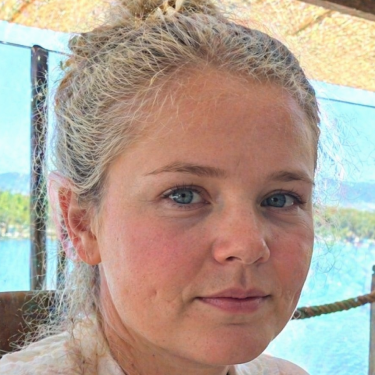
Lena K.
Germany
"We used BabyMorph almost as a joke during my third trimester — something to do on a Sunday afternoon. What came out was a baby girl with very light eyebrows, a wider forehead, and this particular way the nose sits slightly to the left. She was born six weeks later. The eyebrows. The forehead. The nose. Nobody believes it was generated before she arrived."
Their AI baby result
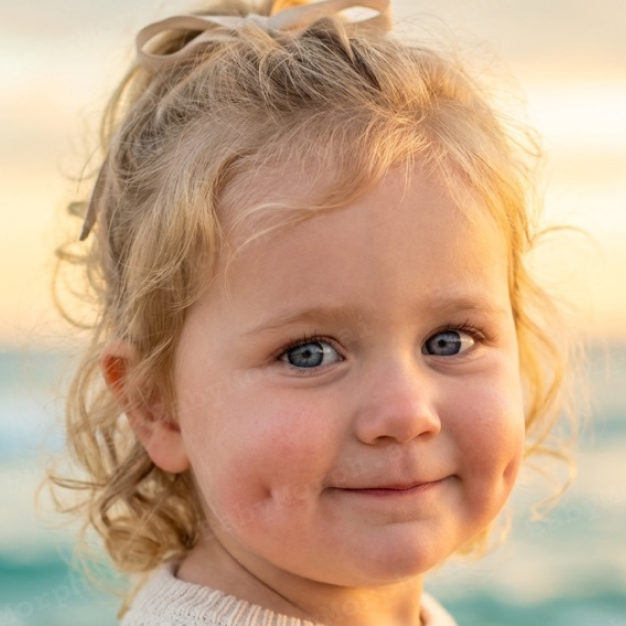

Jason T.
United States
"I have an Asian wife and I've made a habit out of breaking these AI baby tools. Every single one I've tried has completely failed. BabyMorph actually blended her features and mine in a way that made sense — you could see both of us in there without one canceling out the other. People keep asking if it's a real photo."
Their AI baby result
Frequently Asked Questions
When do these specific traits mature fully?
While core structural baselines emerge at birth, overall skeletal proportionality and cartilage mapping continue adjusting actively through childhood.
What is an epicanthic fold and how does it relate to eye shape?
An epicanthic fold is <em>a skin fold at the inner corner of the eye</em>, often extending from the upper eyelid towards or over the medial canthus. It is a normal human anatomical variation that contributes to the visible "eye shape" but is distinct from the eyelid crease. Eye shape itself is a broad term encompassing the palpebral fissure, canthal tilt, and other surrounding facial features.
Are epicanthic folds inherited, and how does mixed heritage affect this?
Yes, epicanthic folds can be inherited, but facial traits like these are <em>polygenic</em>, meaning many genetic variants contribute to their expression. For individuals of mixed heritage, this means a child may inherit a unique combination of features from both parents, making it impossible to predict the presence of an epicanthic fold with certainty based solely on parent photos. Genes with indirect roles, rather than a single 'epicanthic-fold gene', are involved.
Can a child's eye shape change significantly from birth to adulthood?
Yes, a child's eye appearance changes significantly from birth to adulthood. Newborns often have a lower nasal bridge and more facial fullness, which can obscure features like lid creases or epicanthic folds. As the child grows, the midface develops, bones mature, and fat redistributes, leading to a more defined and adult-like eye shape. <em>The eye region is particularly changeable until about age 3</em>.
What are the specific anatomical features that define eye shape?
Eye shape is defined by several anatomical features including the <strong>palpebral fissure</strong> (the opening between eyelids), <strong>canthal tilt</strong> (angle of eye corners), the <strong>upper-lid crease</strong>, and presence or absence of an <strong>epicanthic fold</strong>. Additionally, the underlying orbital bone structure, cheekbone projection, and periorbital soft tissue (skin thickness, fat distribution) all contribute to the overall visible eye appearance. These elements combine to create a unique eye contour.
Which genes are associated with epicanthic folds or eye shape?
No single 'epicanthic-fold gene' exists. Facial morphology, including epicanthic folds, results from the interplay of many genes involved in craniofacial development, such as <strong>PAX3</strong> and <strong>RUNX2</strong>. While certain gene variants, like those in <strong>EDAR</strong>, are associated with broader facial soft tissue traits in some populations, they don't directly determine an epicanthic fold. BabyMorph, an AI baby generator, uses complex algorithms to predict appearance based on parental photos, understanding that many genetic factors contribute.
Why do siblings in the same family sometimes have different eye shapes?
Siblings often have different eye shapes because each pregnancy involves a unique combination of parental DNA. Genes are inherited in varied clusters, and <em>recombination during meiosis means different siblings can receive different sets of genetic variants</em> influencing facial features like eye shape, nasal bridge, or eyelid structure. This genetic lottery explains why a child might resemble one parent's eyelid structure and the other's brow contour, while a sibling shows a different blend.
Can BabyMorph accurately predict epicanthic folds in a future child?
BabyMorph provides a predictive visualization of a future child's potential appearance by analyzing parental photos. While it can reflect the likelihood of various facial traits, <em>predicting epicanthic folds with absolute certainty is challenging due to their polygenic nature and developmental changes over time</em>. BabyMorph's AI considers many facial features and their interactions, offering an informed estimation rather than a definitive genetic diagnosis. Its purpose is to visualize possibilities, not to guarantee specific outcomes.