Inherited Facial Expressions: Muscle Layout Synergy
How facial muscles, inherited facial structure and learned habits combine to create family resemblances in smiles, frowns and subtle expressions.
Families often notice familiar smiles, frowns or raised eyebrows in a child long before the child resembles either parent in a photograph. These similarities are real in some cases, but they do not mean that a particular “expression gene” has been passed down. Facial expressions emerge from the interaction of inherited facial anatomy, muscle attachments, nerve control, temperament and years of social learning. A child may inherit a parent’s cheek shape or brow position, then use those features in an entirely individual way.
What can be inherited in facial expression?
An expression is a movement, not a fixed facial feature. It depends on the facial muscles, the skull and soft tissues beneath them, the skin over them, and signals from the brain through the facial nerve (cranial nerve VII). Families can share anatomical starting points that make certain expressions look alike, particularly at rest or during subtle emotional reactions.
Muscle arrangement and attachment points
The major muscles of facial expression are present in nearly all people, but their size, fibre direction, separation and attachment points vary. Small anatomical differences can alter the visible result of the same movement. For example:
- Zygomaticus major lifts the corners of the mouth during smiling. A split or bifid zygomaticus major can contribute to a cheek dimple in some people.
- Orbicularis oculi closes the eyelids and narrows the eyes in a genuine, engaged smile. Its visible effect is influenced by eyelid shape, cheek volume and skin texture.
- Frontalis raises the eyebrows and creates horizontal forehead lines. Brow height and forehead contour affect how dramatic this appears.
- Corrugator supercilii draws the eyebrows down and inward, contributing to concentration, concern and frowning.
- Levator labii superioris and related upper-lip muscles influence expressions of surprise, disgust and an open-mouthed smile.
- Mentalis elevates and wrinkles the chin, producing the familiar “pouting” or uncertain lower-lip movement seen in many young children.
These muscles are not inherited as a simple set of parental copies. Rather, the developmental instructions that shape the face may be shared within a family. That can produce similar cheek fullness, lip proportions, chin projection and brow placement, making a smile or frown appear strikingly familiar.
The face is a moving structure
A parent and child can perform a broadly similar smile while looking different because their skeletal and soft-tissue proportions differ. The zygomatic bones, upper jaw, lower jaw, nasal base and dental development provide the framework over which muscles pull. Facial fat pads, skin elasticity and the depth of the nasolabial folds also change how movement is seen.
This is why “micro-expressions” are especially difficult to treat as inherited traits. A brief lip press, asymmetric eyebrow raise or chin tension may reflect anatomy, but it may also reflect learned habits, current mood, cultural display rules or simply an individual motor pattern.
Genes, development and the anatomy behind resemblance
No single common gene determines whether a child will smile like their mother or make the same puzzled face as their father. Facial morphology is highly polygenic: many genetic variants, each usually with a small effect, contribute alongside prenatal conditions and postnatal growth.
Genes with indirect relevance
Several well-studied genes help illustrate why expression resemblance is indirect. PAX3 is important in early craniofacial development, including structures around the eyes and nasal bridge. RUNX2 contributes to bone development and has been associated in research with variation in craniofacial shape. These genes do not encode a “raised-eyebrow expression”; they contribute to the anatomical context in which eyebrows move.
EDAR affects ectodermal structures such as hair, teeth and sweat glands, and some variants are associated with facial and dental traits in particular populations. MC1R, OCA2 and the regulatory region within HERC2 are best known for pigmentation variation, including hair, skin and eye colour. Pigmentation changes the visual contrast of eyebrows, eyelashes, lips and iris, which can make an expression appear softer, more intense or more legible without changing the underlying muscle movement.
Genes including TYR and SLC24A5 also participate in pigmentation biology. They are relevant to facial appearance, but should not be presented as direct causes of a family’s characteristic grin, glare or laugh lines.
Early developmental timing
Much of the facial blueprint is established surprisingly early. Neural crest cells migrate into the developing face during the first weeks after conception. By roughly weeks 4 to 8 of embryonic development, the prominences that form the forehead, nose, upper lip, cheeks and jaws are merging and reshaping. Muscles of facial expression develop from the second pharyngeal arch and become connected to branches of the facial nerve during early fetal development.
That early anatomy is then extensively remodelled. Fetal movement, growth of the jaws, tooth eruption, puberty, body-fat distribution and skin maturation all affect the visible face. Genes set tendencies, not a complete cinematic script for future expressions.
Why children imitate parents even without matching anatomy
Expression resemblance is partly a social phenomenon. Newborns are attentive to faces, and infants progressively learn how the people around them communicate emotion. A child who regularly sees a parent lift one eyebrow before joking, purse their lips while thinking, or crinkle their nose when amused may adopt the same habitual gesture.
Temperament also matters. Some children are naturally more reactive, more reserved or more expressive. These traits have a heritable component at population level, yet they are not fixed and cannot reliably identify which parent a child will resemble emotionally. Family routines, siblings, peers, language, culture and neurodevelopment all shape the final pattern.
| Visible family similarity | Likely contributors | How confidently it can be predicted |
|---|---|---|
| Cheek dimples during a smile | Muscle variation, cheek soft tissue, facial proportions | Moderate only when a clear familial pattern is present |
| Wide-looking smile | Mouth width, lip shape, tooth and jaw development, zygomatic muscle pull | Limited; growth and dentition alter the appearance |
| Prominent brow raise | Frontalis movement, brow position, forehead shape, learned mannerisms | Low to moderate |
| One-sided smirk or asymmetric grin | Normal asymmetry, motor habit, dental bite, social imitation | Low |
| Laugh lines and eye crinkling | Cheek anatomy, skin thickness, sun exposure, age and habitual movement | Very low in childhood; increasingly environment-dependent with age |
When family expression traits become visible
Different components of an expression become recognisable at different ages. A rendered face at age 3, 6, 10 or 18 can reasonably show developmental changes in facial proportions, but it cannot establish the child’s future habitual expressions with certainty.
Age 3: expressive movement, infant facial proportions
By age 3, children have a broad emotional repertoire: joy, frustration, shyness, anticipation and pretend play are visible in the face. Their cheeks remain relatively full, the lower face is small and the nose and jaw are still immature. Family resemblance may be noticed in smile shape, eye narrowing or a characteristic pout, although behaviour strongly influences what is seen.
Age 6: clearer bone structure and social habits
At around 6, the face lengthens and the first permanent teeth may affect lip support and smile appearance. Children also become more socially aware, often developing recognisable “camera smiles”, concentration faces and embarrassment responses. Some parental mannerisms become more apparent through imitation.
Age 10: transitional facial proportions
At 10, midface and jaw growth are more evident, while childhood softness may still be present. Eyebrow shape, eyelid contour and dental alignment can make the family resemblance in expressions easier to recognise. However, puberty timing varies considerably, so the face may change rapidly over the next few years.
Age 18: near-adult expression framework
By 18, most facial skeletal growth is close to adult form, though subtle changes can continue into the twenties. Mature facial fat distribution, final dentition and a well-established social style make habitual expressions more stable. Even then, lifestyle, stress, skin health and personal behaviour continue to influence the face.
How to interpret AI-generated expression resemblance
An AI-generated child portrait is most useful as an illustration of possible inherited facial structure, not a forecast of personality or emotional style. A neutral or gently smiling image may suggest how parental eye spacing, lip contour, cheek prominence or brow shape could combine. It cannot determine whether a future child will laugh with one shoulder raised, furrow their brow when reading, or share a parent’s characteristic look of surprise.
Photographs also introduce uncertainty. Camera angle, focal length, lighting, make-up, facial hair, posed smiles and image age can all change the apparent muscle layout. For the most anatomically balanced result, use clear front-facing photographs with relaxed expressions and even lighting. It is sensible to compare several images of each parent rather than treating one photograph as definitive.
Frequently asked questions
Can a child inherit a parent’s exact smile?
A child can inherit facial proportions and soft-tissue features that make their smile look similar, and they may learn the parent’s smiling mannerism. An exact match is unlikely because muscle use, teeth, growth, personality and social habits differ between individuals.
Are dimples inherited?
Dimples often cluster in families, suggesting a genetic contribution to facial muscle or soft-tissue anatomy. They are not governed by one reliably predictable gene, however, and their depth or visibility can change as cheek fat and facial proportions change with age.
Why does my child make my facial expressions but not resemble me at rest?
Learned motor habits can create a strong resemblance during movement even when resting anatomy differs. A child may copy your eyebrow raise, lip press or laugh while having the other parent’s nose, jaw or eye shape.
Can facial asymmetry in expressions be inherited?
Some structural asymmetry may have familial influences, but one-sided expressions are commonly shaped by habit, bite alignment, nerve control and individual preference. Mild asymmetry is extremely common and usually normal.
What our users say
Lena K.
Germany
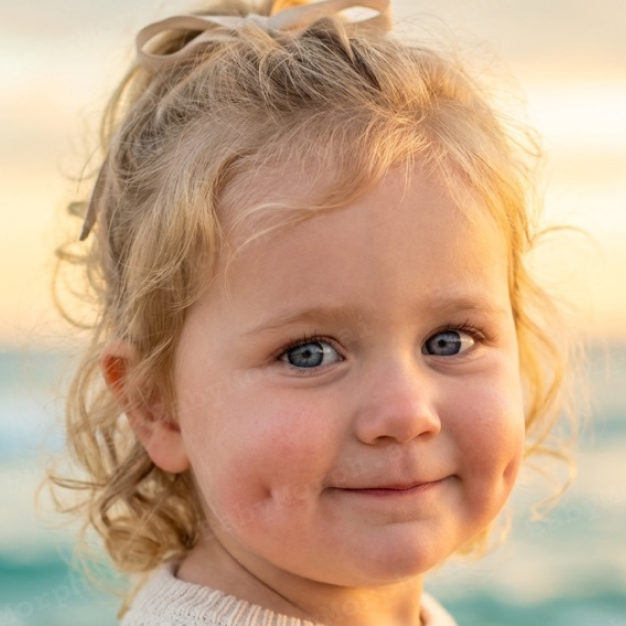
"We used BabyMorph almost as a joke during my third trimester — something to do on a Sunday afternoon. What came out was a baby girl with very light eyebrows, a wider forehead, and this particular way the nose sits slightly to the left. She was born six weeks later. The eyebrows. The forehead. The nose. Nobody believes it was generated before she arrived."
Their AI baby result

Jason T.
United States
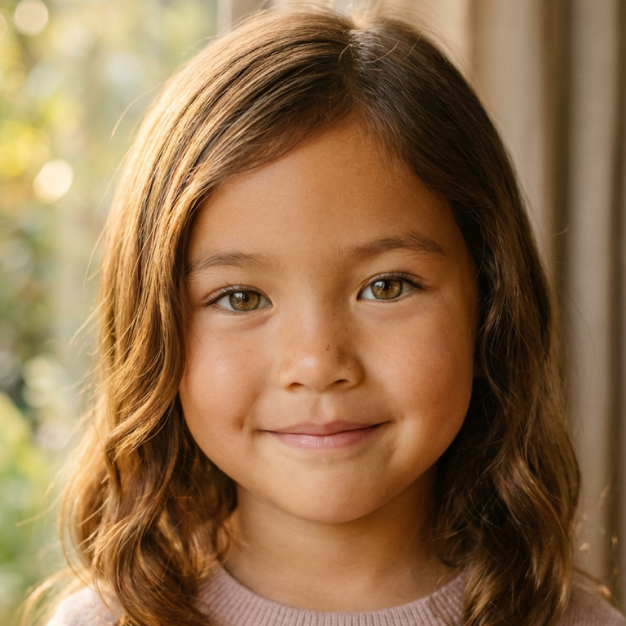
"I have an Asian wife and I've made a habit out of breaking these AI baby tools. Every single one I've tried has completely failed. BabyMorph actually blended her features and mine in a way that made sense — you could see both of us in there without one canceling out the other. People keep asking if it's a real photo."
Their AI baby result
Frequently Asked Questions
When do these specific traits mature fully?
While core structural baselines emerge at birth, overall skeletal proportionality and cartilage mapping continue adjusting actively through childhood.
Are facial expressions inherited through a specific gene?
No, a single "expression gene" is <em>not</em> passed down to determine how a child smiles or frowns. Facial expressions result from a complex interaction of inherited facial anatomy, muscle attachments, nerve control, temperament, and social learning. What can be inherited are anatomical starting points, like cheek shape or brow position, that influence how expressions appear.
How do small muscle differences affect expressions?
Minor anatomical differences in facial muscles significantly alter the visible outcome of expressions. For instance, variations in the <strong>zygomaticus major</strong>, which lifts mouth corners for smiling, can lead to dimples. The <strong>orbicularis oculi</strong>'s effect in narrowing eyes during a smile is influenced by eyelid shape and cheek volume. These subtle differences mean even the same muscle movement can look unique.
Can children really inherit a parent's smile or frown?
A child may indeed share a parent's characteristic smile or frown due to shared developmental instructions that shape their face. This can result in similar cheek fullness, lip proportions, or brow placement, making their expressions appear strikingly familiar. However, this isn't due to a direct inheritance of the "expression" itself, but rather the underlying anatomical framework.
Which genes are relevant to facial structure inheritance?
Many genes, each with a small effect, contribute to the complex polygenic trait of facial morphology. Genes like <strong>PAX3</strong> and <strong>RUNX2</strong> are crucial for craniofacial development, influencing structures around the eyes, nose, and bone formation. These genes establish the anatomical context for expressions, rather than directly dictating a specific facial movement.
Do pigmentation genes influence expression visibility?
Yes, pigmentation genes like <strong>MC1R</strong>, <strong>OCA2</strong>, and those in the <strong>HERC2</strong> regulatory region can indirectly affect how expressions are perceived. They influence the visual contrast of features such as eyebrows, eyelashes, and lips. This can make an expression seem softer, more intense, or more legible, without actually changing the underlying muscle movement or facial anatomy.
When does facial anatomy primarily develop?
Much of the facial blueprint is established very early, predominantly during the first weeks of embryonic development. Neural crest cells migrate to form facial prominences, and muscles of facial expression develop from the second pharyngeal arch, connecting to facial nerves. This initial anatomical structure is then continuously remodeled by growth, environment, and aging.
Why do children mimic parental expressions?
Children often imitate their parents' expressions as a social learning phenomenon. Infants are highly attentive to faces and progressively learn how to communicate emotions from their caregivers. A child observing a parent's habitual eyebrow raise or lip purse may adopt these gestures themselves, even if their underlying facial anatomy differs, leading to a perceived resemblance. BabyMorph can visualize these inherited traits.