Dominant Facial Features from Middle Eastern Ancestry
How Middle Eastern family traits are inherited, from nasal shape and pigmentation genes to facial changes at ages 3, 6, 10 and 18.
Families with Middle Eastern ancestry often notice recurring facial patterns across generations, such as a prominent nasal bridge, dark eyes, thick brows or a particular face shape. These patterns are real family resemblances, but they are not controlled by a single “Middle Eastern” gene or a simple dominant-versus-recessive rule. The Middle East contains genetically diverse populations shaped by long histories of migration, regional marriage patterns and shared ancestry. A child’s appearance reflects a unique combination of many inherited variants, developmental growth and chance.
There is no single Middle Eastern facial type
Middle Eastern ancestry can include roots in the Arabian Peninsula, the Levant, Anatolia, Iran, Iraq, the Caucasus, North Africa and many diaspora communities. Facial variation within any one of these regions is substantial. Two parents who both identify with the same heritage may still have very different pigmentation, nose shape, facial breadth, hair texture and eye characteristics.
It is therefore more useful to discuss family traits than population stereotypes. A child may resemble a grandparent from one side of the family because they inherited a particular combination of facial-growth variants, not because one ancestry is biologically “stronger” than another.
What people usually mean by “dominant” features
In everyday conversation, a dominant feature is one that is visually noticeable or appears in several relatives. In genetics, however, dominance has a narrower meaning: one version of a gene affects a trait when a person has only one copy of that version. A few visible traits can partly follow this pattern, but most facial features do not.
Nasal projection, cheekbone prominence, jaw width, brow shape and facial length are generally polygenic. This means hundreds or thousands of genetic variants may make small contributions. Their effects are also influenced by growth hormone, nutrition, sex, age and the way facial bones and soft tissues develop together.
Facial traits that may recur in families
Some features are frequently described as distinctive in particular Middle Eastern families. None should be expected in every child, and none is exclusive to Middle Eastern populations. They are best understood as recurring inherited patterns rather than rules.
| Trait family may notice | Anatomical basis | How inheritance usually works | When it becomes easier to judge |
|---|---|---|---|
| Nasal bridge or projection | Nasal bone length, cartilage shape, maxillary support and soft tissue | Highly polygenic; can resemble either parent or a grandparent | Childhood onward; changes markedly through puberty |
| Eye and brow appearance | Orbital shape, eyelid fold, brow ridge, hair density and pigmentation | Several genetic pathways contribute; brow density and colour may be conspicuous | Brow pattern by ages 3–6; bony contour later |
| Dark brown eyes | Iris melanin concentration and distribution | Often more likely when both parents have dark eyes, but not a single-gene certainty | Usually stabilises between 6 and 12 months, occasionally later |
| Thick, dark hair | Hair shaft thickness, follicle shape, density and melanin | Polygenic, with separate influences on colour, curl and density | Early childhood, though infant hair may shed and regrow |
| Longer or broader facial outline | Growth of the maxilla, mandible, cheekbones and forehead | Many variants plus sex-specific pubertal growth | More reliable from age 6; most defined in adolescence |
The nose is a common source of strong family resemblance
What is described as a “prominent nose” is not one feature. It may involve the height of the nasal root between the eyes, bridge convexity, tip projection, nostril width, the angle between nose and upper lip, and the forward position of the upper jaw. These components can be inherited separately. A child might have one parent’s high bridge, the other parent’s nasal tip and a grandparent’s broader alar base.
Genes associated with craniofacial development include PAX3, which has been linked in population studies to variation around the nasal bridge, and RUNX2, a gene important in bone development and associated with aspects of facial projection. Such findings do not allow a precise prediction from one gene test. Their individual effects are small, and many relevant variants remain unknown.
Genes behind pigmentation, hair and facial structure
Visible pigmentation often creates the impression that a trait has been inherited “dominantly”, especially when a child has dark hair, eyes and brows. In practice, pigmentation is among the better-studied yet still complex areas of appearance genetics.
- OCA2 and HERC2: variants in this region are strongly associated with blue versus brown eye colour in many European-ancestry populations. Their effects are less straightforward in families with darker irises, where several pathways contribute to high melanin levels.
- MC1R: helps regulate the balance of eumelanin and pheomelanin in hair and skin. Some variants are associated with red hair and fairer pigmentation, but their expression depends on genetic background.
- TYR: encodes tyrosinase, an enzyme essential to melanin production. Ordinary variation can contribute to pigmentation differences; rare harmful variants can cause forms of albinism.
- SLC24A5: is associated with skin pigmentation variation and has different frequencies across global populations. It is not a measure of ancestry and cannot predict a child’s exact skin tone.
- EDAR: influences structures derived from ectoderm, including hair follicles and teeth, and is best known for particular variants common in East Asian populations. It illustrates why hair form and facial appearance involve broad human genetic histories rather than neat regional categories.
Skin tone also changes with sun exposure, season and age. Newborn skin can look reddish, pale, olive or uneven in ways that are not a reliable guide to later pigmentation. A child’s eventual tone may fall between the parents’ tones, resemble one parent more closely, or vary across the face and body.
Why siblings can look surprisingly different
Full siblings receive different combinations of their parents’ genetic material. Recombination shuffles chromosomes before eggs and sperm are formed, so siblings do not inherit identical sets of facial-shape and pigmentation variants. A child may therefore show a maternal grandparent’s eye contour alongside a paternal jawline, while a sibling displays the reverse pattern.
There are additional reasons family resemblance is not fully predictable:
- Many facial traits are influenced by large numbers of variants with individually modest effects.
- Some traits become more or less visible as fat distribution changes during childhood.
- Hormones during puberty alter the nose, jaw, chin, brow region and facial soft tissues.
- Biological sex affects average patterns of facial growth, though there is extensive overlap between individuals.
- Photographs can exaggerate apparent similarity because lens choice, expression, lighting and grooming change perceived proportions.
For mixed-heritage parents, it is particularly unhelpful to assume that one parent’s ancestry will “win”. Dark irises may be statistically more likely than light irises in some parental combinations, but that does not mean the child’s bone structure, lip shape, curl pattern or complexion will follow the same apparent pattern.
When family features become visible
Facial prediction at a particular age should be interpreted as a plausible developmental portrait, not a fixed forecast. The face changes substantially from infancy to adulthood.
Age 3: early proportions and colouring
By age three, hair colour, eye colour and general brow density are often apparent. The face remains relatively round, with fuller cheeks and a small jaw. A nasal bridge may be visible, but nasal length and tip definition are still immature. This is a useful age for observing overall family resemblance rather than final bone structure.
Age 6: clearer facial framework
At six, baby fat has often reduced and the relationship between forehead, eyes, nose and mouth becomes easier to see. The midface and cheek contours may begin to resemble a parent or older sibling more strongly. Permanent teeth and jaw growth can also subtly change the lower face.
Age 10: pre-pubertal definition
At ten, facial width, eye spacing, brow shape and the nasal bridge are usually more stable than in early childhood. Yet the face still has considerable growth ahead. A child with a delicate-looking nose at ten may develop more projection during adolescence, particularly if close relatives show that pattern.
Age 18: near-adult proportions
By 18, most facial skeletal growth is close to completion, although subtle changes can continue into the early twenties. Puberty has had its greatest effect on jaw size, chin prominence, brow contour, facial hair potential and nasal dimensions. This age provides the strongest indication of mature resemblance, while still allowing for normal adult change.
Using family history more accurately
The most informative approach is to look across both sides of the family and across generations. Note repeated patterns rather than selecting one striking relative. For example, if several relatives have a high nasal root, dense eyebrows and a long lower face, those traits may be more plausible for a child than a feature seen in only one distant ancestor.
Family photographs from similar ages are especially useful. Compare neutral expressions and straight-on images where possible, remembering that cosmetic grooming, facial hair, weight changes and camera perspective can all obscure inherited structure. Even with excellent family information, probabilities remain broad: genetics can indicate ranges of likely resemblance, not a guaranteed face.
Frequently asked questions
Are Middle Eastern facial features genetically dominant?
No. There is no unified set of Middle Eastern facial features and no single inheritance pattern for the region. Some pigmentation outcomes may be more likely in particular parental combinations, but facial shape, hair texture and skin tone are usually influenced by many genes.
Will a child inherit a parent’s prominent nose?
They may, but a nose is made up of multiple independently varying components. A child can inherit bridge height from one parent and tip shape or nostril width from the other. Pubertal growth also means the adult result cannot be judged from an infant photograph.
Can dark-eyed parents have a light-eyed child?
It is less common in many families but possible, depending on the variants each parent carries. Eye colour is not governed by a simple brown-versus-blue school textbook model; OCA2, HERC2 and other genes interact to influence iris melanin.
At what age can you tell whether a child resembles a grandparent?
Some resemblance is apparent by ages three to six through colouring, eye area and general face shape. Bone-driven similarities in the nose, jaw and cheekbones often become clearer from age 10 and can be most evident after puberty.
What our users say
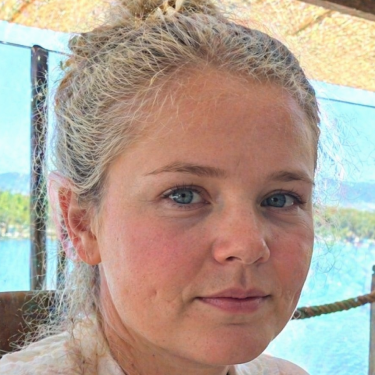
Lena K.
Germany
"We used BabyMorph almost as a joke during my third trimester — something to do on a Sunday afternoon. What came out was a baby girl with very light eyebrows, a wider forehead, and this particular way the nose sits slightly to the left. She was born six weeks later. The eyebrows. The forehead. The nose. Nobody believes it was generated before she arrived."
Their AI baby result
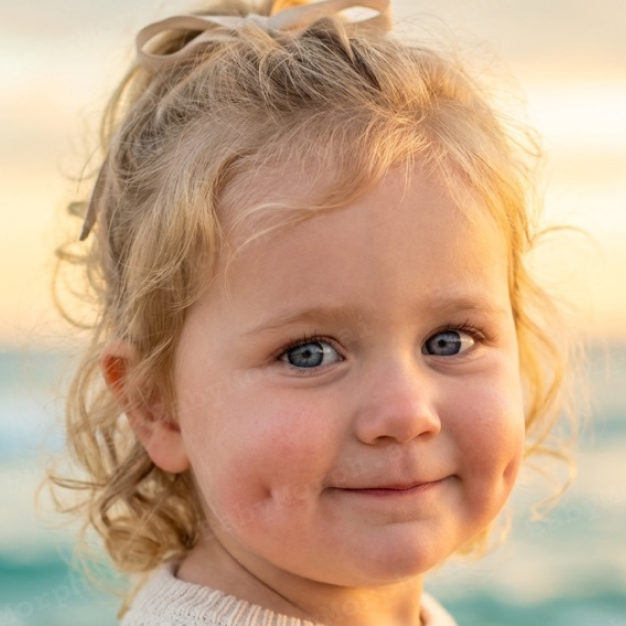

Jason T.
United States
"I have an Asian wife and I've made a habit out of breaking these AI baby tools. Every single one I've tried has completely failed. BabyMorph actually blended her features and mine in a way that made sense — you could see both of us in there without one canceling out the other. People keep asking if it's a real photo."
Their AI baby result
Frequently Asked Questions
When do these specific traits mature fully?
While core structural baselines emerge at birth, overall skeletal proportionality and cartilage mapping continue adjusting actively through childhood. Facial features like nasal projection and jaw width become more reliable to observe from age 6 and are most defined during adolescence, due to ongoing growth and development influenced by many genetic variants, hormones, and environmental factors. Pigmentation, like eye and hair color, also stabilizes over the first year or two of life, but skin tone can continue to change with sun exposure and age.
How are facial features inherited in Middle Eastern families?
Facial features in Middle Eastern families, like any other population, are inherited through a <em>complex interplay of many genes</em> (polygenic inheritance), not simple dominant-recessive rules or a single "Middle Eastern gene." Hundreds to thousands of genetic variants make small contributions, influenced by growth hormones, nutrition, and environmental factors. A child's appearance is a unique combination of these inherited variants, which can lead to resemblances to either parent or even grandparents from different sides of the family.
What are common Middle Eastern dominant facial features?
Commonly noticed facial features in Middle Eastern families include a prominent nasal bridge, dark eyes, thick eyebrows, and particular face shapes, but these are <em>not genetically dominant in the scientific sense</em>. In genetics, 'dominant' means one copy of a gene variant affects a trait, which applies to very few facial features. These traits are best understood as recurring inherited patterns within families, often involving polygenic inheritance, rather than strict dominant characteristics exclusive to Middle Eastern populations. They reflect broad human genetic histories.
Can genes predict a child's nose shape accurately?
Precisely predicting a child's nose shape from individual genes is <em>not currently possible</em> because nose shape is highly polygenic. It involves many components like root height, bridge convexity, tip projection, and nostril width, each potentially inherited separately. Genes such as PAX3 and RUNX2 are associated with some aspects of craniofacial development, but their individual effects are small, and many relevant variants are still unknown. A child's nose may combine features from both parents and grandparents.
Which genes influence eye and hair color in Middle Eastern ancestry?
Several genes influence eye and hair color in Middle Eastern ancestry, with pigmentation being a complex area of genetics. Genes like <strong>OCA2</strong> and <strong>HERC2</strong> contribute to eye color, though their effects are more straightforward in lighter irises. <strong>MC1R</strong> influences melanin balance, and <strong>TYR</strong> is crucial for melanin production. Additionally, <strong>SLC24A5</strong> is associated with skin pigmentation variation. These genes interact, making pigmentation highly variable and ensuring that exact predictions are not feasible.
How does BabyMorph use parent photos for predictions?
BabyMorph utilizes advanced AI to analyze facial features from two parent photos, predicting what their future child might look like. The AI considers a wide range of facial characteristics, including shapes of the nose, eyes, and jawline, as well as pigmentation and other inherited traits. While it offers a fun and interesting visual prediction, it's important to remember that human genetics are incredibly complex, and AI predictions are illustrative, not definitive. The tool provides a blend of both parents' features, reflecting the polygenic nature of inheritance.
Is there a single 'Middle Eastern' facial type?
No, there is <em>no single 'Middle Eastern' facial type</em>. The Middle East encompasses genetically diverse populations with roots in regions like the Arabian Peninsula, the Levant, Anatolia, and North Africa. These populations have been shaped by long histories of migration and varied marriage patterns. Consequently, facial variation within any one region is substantial, and individuals from the same heritage can have very different pigmentation, nose shapes, hair textures, and eye characteristics. It is more accurate to discuss recurring family traits than population stereotypes.
When does a child's skin tone stabilize to its adult shade?
A child's skin tone typically stabilizes to its adult shade <em>later in childhood</em>, though it's important to note that newborn skin can look very different from their eventual tone. Infant skin can appear reddish, pale, olive, or uneven, which is not a reliable guide for later pigmentation. Factors like sun exposure, season, and age continue to influence skin tone throughout life. While genes like SLC24A5 contribute to pigmentation, the final shade is a complex interplay of genetics and environment.