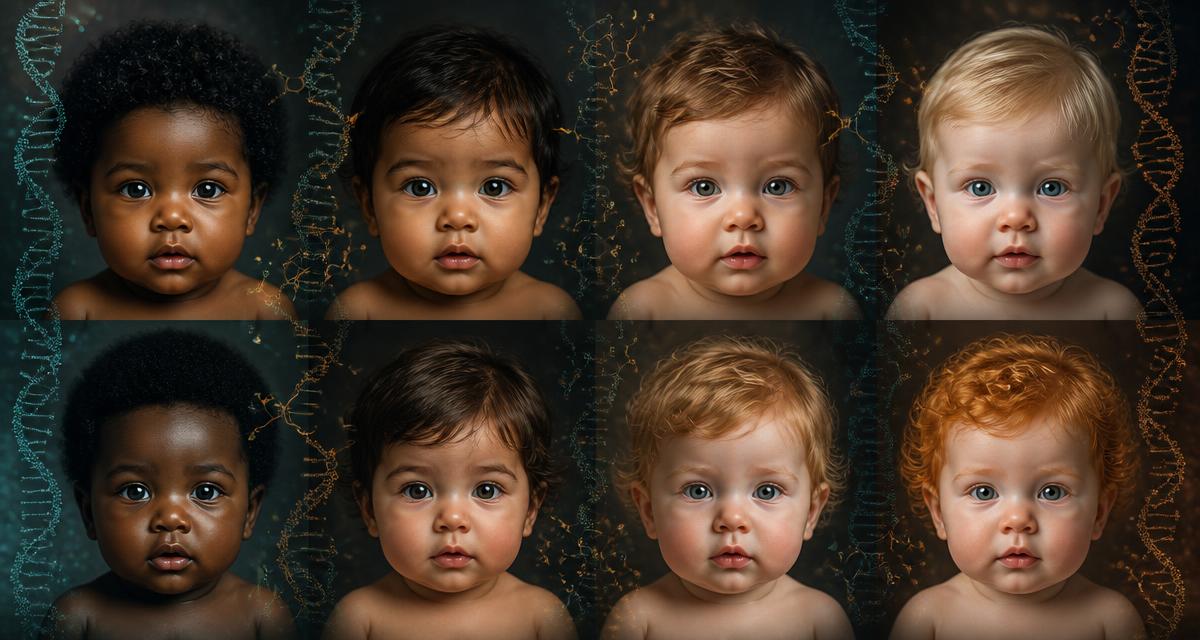
Will My Baby Inherit a Cleft Chin? Dominant Facial Genetics
Learn how chin bone shape, muscle attachment and polygenic inheritance influence whether a child develops a cleft chin as they grow.
A cleft chin, also called a chin dimple or mental cleft, is a visible indentation in the centre of the chin. It is often described as a “dominant” facial trait, but real inheritance is more complicated than a school genetics chart suggests. Whether a child develops one depends on the shape of the lower jaw, the arrangement of chin muscles and soft tissue, and the combined effects of many inherited variants.
What creates a cleft chin?
The chin is not simply the lower end of the jaw. Its visible form comes from several connected structures: the mandibular bone, especially the mental protuberance; the mentalis muscle that lies over the front of the chin; subcutaneous fat; skin thickness; and the fibrous attachments between these layers.
A cleft appears when the centre of the chin has a relative depression compared with the two sides. In some people, the bony prominence of the mandible has a shallow midline notch. In others, the bone is relatively smooth but the mentalis muscle and skin attach in a way that pulls the central skin inward. Many cleft chins reflect both bone contour and soft-tissue anatomy.
It is not the same as a facial cleft
The term can sound alarming, but a cleft chin is usually a normal variation in facial anatomy. It is not equivalent to a cleft lip or cleft palate. During early embryonic development, the paired mandibular prominences of the first pharyngeal arch merge at the midline, largely during the fourth and fifth weeks after conception. The lower jaw then develops through intramembranous ossification, beginning around the sixth to seventh week.
A visible chin dimple does not mean that the jaw failed to fuse. It represents a subtle difference in how the central chin contour develops and how the soft tissues sit over it.
Is a cleft chin really a dominant trait?
The short answer is that it can run strongly in families, but it is not reliably explained by one dominant gene. Older genetics teaching often presents cleft chins as a classic dominant characteristic: one parent with a cleft chin has a greater chance of having a child with one. This pattern is useful as a broad observation, yet it oversimplifies facial biology.
Most facial features are polygenic. That means many genetic variants each make a small contribution to facial width, jaw projection, bone growth, muscle pattern and skin attachment. A child may inherit a combination that produces a pronounced cleft, a barely visible central dimple, or no visible indentation at all.
Researchers have identified numerous genomic regions associated with aspects of facial shape, although no single, clinically useful “cleft chin gene” has been established. Genes involved in craniofacial development include PAX3, which has been associated with variation around the nasal bridge and facial proportions, and RUNX2, an important regulator of bone formation and craniofacial growth. EDAR influences several ectodermal traits, including hair and facial morphology in some populations. These genes should not be interpreted as direct tests for a chin cleft; they illustrate why a single-gene dominant model is inadequate.
Genes more commonly discussed for pigmentation, such as OCA2 and HERC2 for eye colour, MC1R for red-hair variation, TYR for melanin production, and SLC24A5 for skin pigmentation variation, do not determine whether a child has a cleft chin. Pigmentation can make a dimple look more or less noticeable in photographs, but it does not create the underlying contour.
Why the family pattern can look dominant
If a parent has a deep, clearly defined cleft chin and several close relatives share it, their family may carry a combination of variants that strongly favours the feature. Their child is therefore more likely than average to show some midline chin indentation. However, expression can vary considerably. A parent’s deep cleft may appear in their child as a shallow dimple, particularly if the other parent has a broad, smooth chin contour.
Conversely, two parents without an obvious cleft can have a child with one. They may each carry contributing variants, or the feature may become more visible as the child’s jaw and soft tissues mature.
How parental features affect the likelihood
Looking at the parents’ actual facial anatomy is usually more informative than applying a simple dominant/recessive label. Consider the chin in relaxed frontal photographs rather than only in posed smiles, because mentalis muscle contraction can deepen a temporary crease.
| Parental pattern | What may be inherited | Reasonable expectation for the child |
|---|---|---|
| Both parents have deep cleft chins | Multiple variants favouring central indentation, plus similar jaw and soft-tissue patterns | A visible cleft or dimple is relatively likely, though depth and width can differ substantially. |
| One parent has a pronounced cleft; one has a smooth chin | A mixed set of lower-face and soft-tissue traits | The child may have a deep cleft, a mild dimple, or a smooth chin. A precise percentage is not scientifically justified. |
| One parent has a subtle dimple only when smiling | Muscle and skin-attachment effects may be more important than bone shape | The child may show a similar expression-dependent indentation rather than a permanent cleft. |
| Neither parent has a visible cleft, but relatives do | Contributing variants can be present without obvious expression | A cleft remains possible, especially if it appears repeatedly on either side of the family. |
A hypothetical single dominant variant with complete penetrance would give a 50% chance when carried by one heterozygous parent. Cleft chins do not meet that neat model. Penetrance is variable: an inherited genetic tendency may be present but not visibly expressed. Development, facial growth, body composition and image conditions can also affect how strongly the feature is seen.
When does a cleft chin become visible?
A child’s chin changes markedly from infancy through adulthood. Babies have relatively small lower jaws, fuller cheeks and a soft layer of facial fat that can obscure a central indentation. A family resemblance may therefore be present structurally before it is easy to see.
| Age | Typical chin appearance | How reliable the cleft appearance is |
|---|---|---|
| Birth to 2 years | Rounder lower face, fuller chin pad and rapid growth | Often difficult to judge; a deep dimple may be visible, but subtle clefts can be hidden. |
| Around age 3 | Early toddler facial proportions begin to lengthen | A strong inherited chin dimple may be apparent, but soft tissue still dominates the look. |
| Around age 6 | Lower-face contours become clearer as baby fat reduces | Usually a more useful age for recognising a persistent central indentation. |
| Around age 10 | Jaw growth continues and facial width-to-height proportions shift | The cleft may become more distinct, especially in photographs with directional lighting. |
| Late teens, around age 18 | Pubertal mandibular growth and adult soft-tissue distribution are more established | Closest to the mature appearance, although adult facial change continues beyond 18. |
Puberty is particularly important. The mandible grows in size and projection during adolescence, with average timing and magnitude differing between individuals. Changes in facial fat and muscle definition can make a childhood dimple appear deeper, shallower or newly noticeable.
What can and cannot be predicted from parents’ faces?
Parental photographs can provide useful visual clues: the width of the chin, lower-jaw projection, central dimple depth, symmetry and whether the feature is visible at rest. Close relatives can add context, particularly when a similar chin appears across generations.
- A deep cleft in both parents supports a higher likelihood of a visible midline indentation.
- A dimple that appears only during speech or smiling may reflect muscle movement more than fixed bone shape.
- Different camera angles, shadows and beards can make a cleft look deeper or conceal it entirely.
- Sibling outcomes can differ because each child inherits a different combination of parental DNA.
- No facial image system can determine a child’s exact future jawbone structure or guarantee a specific dimple depth.
AI-generated age-progressed images should therefore be treated as visual estimates of likely family resemblance, not genetic diagnoses. They can represent broad inherited patterns, but a real child’s growth, expression and changing facial tissues will always introduce variation.
Frequently asked questions
Can a baby be born with a cleft chin if neither parent has one?
Yes. A visible cleft can arise from a combination of inherited variants that are not strongly expressed in either parent. It may also be present in relatives, or become clearer only after the child’s lower face grows and facial fat changes.
Does a cleft chin become deeper with age?
It can. As the mandible grows, especially through puberty, and the chin becomes less rounded by childhood fat, a central indentation may look more defined. This is not universal: changes in soft tissue can also make a dimple seem less prominent.
Is a cleft chin inherited from the mother or father?
It can come through either side of the family. The relevant genetic contributions are not restricted to one parent, and the child’s final chin shape reflects the particular combination they inherit from both parents.
Should a cleft chin ever be medically assessed?
An isolated chin dimple is generally a harmless normal feature. If it occurs alongside unusual jaw asymmetry, feeding difficulties, delayed jaw growth or other congenital differences, a paediatrician or craniofacial specialist can assess the child appropriately.
What our users say

Lena K.
Germany
"We used BabyMorph almost as a joke during my third trimester — something to do on a Sunday afternoon. What came out was a baby girl with very light eyebrows, a wider forehead, and this particular way the nose sits slightly to the left. She was born six weeks later. The eyebrows. The forehead. The nose. Nobody believes it was generated before she arrived."
Their AI baby result


Jason T.
United States
"I have an Asian wife and I've made a habit out of breaking these AI baby tools. Every single one I've tried has completely failed. BabyMorph actually blended her features and mine in a way that made sense — you could see both of us in there without one canceling out the other. People keep asking if it's a real photo."
Their AI baby result

Frequently Asked Questions
Can a cleft chin skip a generation?
Yes. Even though it is a dominant trait, a phenomenon called 'incomplete penetrance' can cause the gene to remain unexpressed in a parent but show up vividly in the child.
Is a cleft chin safe for a baby?
Absolutely. It is a completely cosmetic and normal structural bone variation that has absolutely no impact on the child's health or dental development.
What is the genetic reason for a cleft chin?
A cleft chin is primarily influenced by a complex interplay of multiple genes, not a single dominant gene as often taught. It's considered a polygenic trait, meaning various genetic variants contribute to the specific shape of the jawbone, mentalis muscle arrangement, and soft tissue attachments that create the visible indentation. While it can run strongly in families, its expression can vary significantly among individuals.
Does a dimple in the chin mean the jaw didn't fuse properly?
No, a chin dimple is a normal variation in facial anatomy and does <strong>not</strong> mean the jaw failed to fuse. The lower jaw forms through a complex process of bone development. A cleft chin represents a subtle difference in how the central chin contour develops and how the soft tissues sit over it, rather than an incomplete fusion of embryonic structures.
How likely is my baby to have a cleft chin if only one parent has it?
If one parent has a pronounced cleft chin and the other has a smooth chin, your child may inherit a deep cleft, a mild dimple, or a smooth chin. The outcome depends on the specific combination of genetic variants inherited from both parents influencing jaw structure and soft tissues. <em>A precise percentage is not scientifically justified</em> due to the polygenic nature of the trait and variable penetrance.
What is the difference between a cleft chin and a cleft lip?
A cleft chin is a harmless indentation on the chin, a normal variation in facial anatomy. It is completely different from a cleft lip or cleft palate, which are congenital anomalies where parts of the lip or roof of the mouth do not fuse completely during early fetal development. These conditions are medically significant and require intervention, unlike a cleft chin.
Can BabyMorph predict if my future child will have a chin dimple?
While BabyMorph utilizes advanced AI to blend parental facial features, predicting the exact presence and depth of a specific polygenic trait like a chin dimple is challenging. The AI generates an image based on numerous inherited traits, and while it might show a tendency if both parents have strong indicators, <em>it cannot offer a definitive genetic prediction</em> for such complex features with variable expression.
When does a cleft chin become visible in a child?
A cleft chin can become visible at various stages of a child's development. Babies have relatively small lower jaws and fuller cheeks, which might obscure a developing dimple. As a child grows, their jaw structure matures, and soft tissue changes, which can make a cleft chin more or less pronounced over time. Sometimes it's only noticeable later in childhood or even adolescence.